




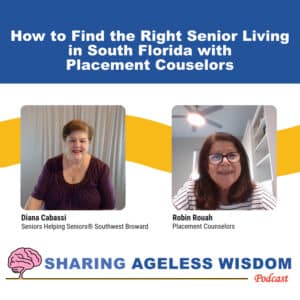
Welcome to the Sharing Ageless Wisdom Podcast! In this episode, host Diana Cabassi goes through various important topics with special guest Robin Rouah of Placement Counselors to explore the continuum of senior care. Robin shares how Placement Counselors assists families in finding the most appropriate living arrangements for themselves or their loved ones, and how it can be a better option to more generalized senior living agencies you find online.
Where to Watch/Listen to Sharing Ageless Wisdom Podcast
Sharing Ageless Wisdom is available to watch the video version on YouTube and Spotify, and available to listen as audio-only on Spotify, Apple Podcasts, Amazon Music, Pandora, iHeartRadio, Pocket Casts, and many more podcast apps! Just search for “Sharing Ageless Wisdom“.


Topics Discussed
- Exploring different types of senior living facilities
- Placement Counselors is a free service
- How Placement Counselors can save you time and connect you to better living arrangements vs online agencies
- Robin Rouah’s career journey
- What to expect when contacting Placement Counselors
- Special care considerations and facility licenses
- Common family struggles with senior placement
- Caregiver burnout
- Financial navigation and funding options
- Hospice isn’t just end-of-life care
- Geographic coverage area (Broward, Miami-Dade, Palm Beach, and Martin counties)
- The importance of community networking and collaborative care to help families
Podcast Summary
This discussion covers how Placement Counselors helps South Florida families navigate senior care placement through individualized intake and recommendations; the differences between using Placement Counselors versus online agencies that give broad results; key distinctions among independent living, assisted living, memory care, small residential group homes, nursing homes, and supportive homes; how licensure levels affect what care communities can provide (including extended congregate care, limited nursing, feeding tubes, and transfers such as Hoyer lifts); factors like mobility, dementia, caregiver stress and guilt, family coordination from afar, budgets, long-term care insurance, Medicaid; and how hospice and palliative support can follow a person across care settings.
Robin Rouah explains that the Placement Counselors service is free to families and it connects with many more resources to help anyone in need. Tune in for essential information and heartfelt advice on supporting and advocating for your senior loved ones.
Watch/Listen Now
Prefer to read the conversation instead of watching/listening? Click here for the full transcript.
You can reach Robin Rouah at: placementcounselors.com
Robin’s cell phone: 954-303-2728
Email: pcc@placementcounselors.com
Broward (office): (954) 965-2925
Miami-Dade (office): (305) 931-0618
Palm Beach (office): (561) 329-4337
For more information about Diana Cabassi and Seniors Helping Seniors® Southwest Broward, visit: seniorcaresouthwestbroward.com
We hope you find this information useful. If you know someone who could benefit from this information, share it with them too!
What is Sharing Ageless Wisdom?
Sharing Ageless Wisdom aims to feature senior industry experts in South Florida who will share valuable insight to help our viewers prepare for aging. We will also cover topics related to in-home senior care, caregivers, family, and more. We hope you’ll benefit from this essential information.
Sharing Ageless Wisdom is a video podcast hosted by Diana Cabassi, a Certified Senior Advisor and life coach in Broward County, Florida. Diana has over a decade of experience in caregiving and running Seniors Helping Seniors® Southwest Broward, an in-home senior care service serving families in Pembroke Pines, Davie, Cooper City, Weston, Southwest Ranches, Miramar, Sunrise, and Plantation, FL.
Any specific guest or topics you would like to see in a future episode?
Send us your guest requests or topic suggestions!
Tap this link to send an email message to
marketing@shs-seniorcare.com
with the Subject: “Sharing Ageless Wisdom Guest Request or Topic Suggestion”
Are you a local senior care industry expert and want to be a featured guest in a future episode?
If you are a senior care industry expert in Broward County, Florida, and would like to join us in a future episode, please email us to let us know.
Send an email message to
marketing@shs-seniorcare.com
with the Subject: “Sharing Ageless Wisdom – Local Senior Industry Expert Request”
FULL TRANSCRIPT for Sharing Ageless Wisdom – Episode 4
The Senior Living Connection with Robin Rouah – How to Find the Right Senior Living in South Florida, Common Family Struggles, Why Placement Counselors Is A More Useful Resource Than Online Agencies, and More
Diana Cabassi: Thank you for tuning into the Sharing Ageless Wisdom podcast. Our podcast aims to feature senior industry experts in South Florida who will share valuable insight to help our community prepare for aging. We hope that you will benefit from this essential information. Hello everyone. Welcome to our podcast.
My name is Diana Cabassi. Today it’s my pleasure to introduce you to my friend and trusted advisor, Robin Rouah. Robin is with Placement Counselors and her role in the continuum of senior care is to assist families in finding the most appropriate living arrangements for themselves or their loved ones.
Hello, Robin. Thank you for coming on the show.
Robin: Good morning, Diana. Thank you so much for having me today.
Diana Cabassi: It’s my pleasure. I’d like for you to share a little bit about yourself with us today, and also what it is that you do to advocate for us all.
Robin: Um, so a little bit about myself. I had been in the importing business for many years, and in 2002 I was out doing a lot of fundraising out in the community, and was looking for a job and went out and met this gentleman who owned this agency. I had been very involved in the senior community prior and he was looking for somebody to help him in this.
I knew nothing about placement or anything like that. But I had a strong work ethic, which he liked. And he taught me really everything that I know about this industry as far as placement. I have four children, and really enjoy being out in the community and helping working with the seniors. So that’s basically a little bit of what I do.
“Placement Counselors”, we are advocates for the seniors in trying to help them find appropriate assisted living, independent memory care communities when they could no longer live at home. So that is basically our role.
Diana Cabassi: So, Robin, I still remember the day that we met, and I can’t believe it’s been so long already, but, you know, it is what it is. And, so, you know, we met through a mutual friend and as soon as I met you, I knew that you were someone who I could trust. And, you know, you’re a great person and I trust you implicitly with whoever I send to you, and so I’m so happy that you agreed to come and talk with us today.
Robin: Thank you, Diana, ’cause I feel the same way. You know when you meet people and you see how genuine like you are, I have to share this with you. I remember the gentleman we spoke about who was outside of Walmart.
Diana Cabassi: Oh wow.
Robin: You recall that you went and helped and I think he came to me through the Jewish community and you helped him and you went to visit him.
He was living alone and, you know, so that speaks volumes of the kind of person that you are as well.
Diana Cabassi: So that was funny. I had walked into Walmart and I saw him sitting there and he was in one of these electric scooters. And I thought, you know, I immediately had a thought, well, well, I wonder if he’s okay, because he seemed troubled. And so I went into Walmart. I don’t know, an hour or so later I walk out and he’s still here. And I thought to myself, well I should really stop and see what I could do for him. And that was the voice in my head. And the other voice said, what are you crazy? And so I went to my car and then the voice in the good voice in my head said, ask him. And so I did.
And he had been sitting there for hours waiting for a ride, and he just lived around the corner. So basically I took him in and, um, to my car and, and took him to his home. And then later on he said, you’re such an angel. You’re my angel. He took my business card and he kissed it. I was like. You know, didn’t do it to expect anything out of it, but anyway, it’s, we’re not talking about me, Robin.
We’re talking about you.
Robin: But that’s what we do. But that, that’s, that is what we do. Right? It’s just, it’s in our, like I say, it’s in our DNA, you know, we, we just, this.
Diana Cabassi: So, you know, tell me what families can expect when they contact you.
Robin: So oftentimes family will come to me through, so we do a lot of networking in the hospitals and the nursing homes in the communities. When they reach out to me, it’s usually when their loved one could no longer return back to home. So, I like to do a very in-depth intake, so this way I know exactly the situation with the individual. Are they able to walk? How much care do they need? What are the finances like? I get very involved. So an intake take can sometimes take, you know, 30 minutes to an hour because I want to make sure that the places that I’m gonna recommend to this family are- I don’t wanna waste their time- so I want to make sure that it’s gonna fit their needs. And there’s a lot that really goes into that. So we basically hold the family’s hand and, you know, there’s oftentimes multiple siblings, a lot of back and forth between the families. Most times I’ll go and I’ll evaluate the patient on my own. But there are so many different kinds of assisted living communities, so I need to know which is gonna be the right place for that particular individual. And then I’ll usually recommend three or four places for them to look at and just really walk them through the whole process because it is very involving, it is very complicated, as you know.
Diana Cabassi: Absolutely. Absolutely. You know, nowadays, so many people look online for resources. Can you share with me a little bit about what makes a difference with Placement Counselors as opposed to using just online resources?
Robin: So the online resources they don’t target specifically. They don’t hone in on really what the needs are. And a lot of them don’t know even the licensure that a lot of these communities have. So if somebody just gets online and is looking for assisted living and they say they are in Hollywood, let’s say, so these online agencies will just basically target an area of, let’s say Broward, sometimes they even go into Dade because they don’t really know the area of South Florida, southeast Florida. If a family is looking, let’s say their loved one is diabetic or they have specific needs or they’re not able to walk, maybe they’re not even weightbearing. A lot of these assisted living communities would not be able to accept that particular resident, and to me it just becomes a lot of wasted time for the families. So, you know, a lot of the assisted living communities, some have an extended care license, some have limited nursing license, some can take feeding tubes where others cannot.
You know, it’s so individualized. So that’s the main difference to what we do, as opposed to the online agency. We really target exactly. If I have somebody that has a feeding tube, I’m not sending them to just a standard assisted living facility. You know, as it is, the families are so overwhelmed with what is going on and a lot of the families don’t even live here.
Diana Cabassi: Right. You know, that’s something that has happened in our society nowadays. You know, people go away to college and they stay.
Robin: Yeah.
Diana Cabassi: They don’t necessarily come back home, and so then their parents are in a different state and trying to manage care from afar and sometimes even from different countries.
I’ve had clients where their children are in Europe and, you know, and then there’s a time change difference that you need to deal with. But, you know, one of the things that actually just came up as a concern for one of my familes yesterday or the day before is that, um, the mom is in a small group home and she unfortunately has got, she has dementia and unfortunately she has gotten to the point where she is bedridden and cannot move.
She’s like a wet noodle. They can’t move her. Right. And so, she really needs to be moved because, you know, they develop bedsores if they’re not being moved and, you know, their position isn’t being changed. And so, he calls me up and he’s like, Diana, what do you suggest I do? And the reality is, is that not every facility, like you were saying, is set up or even able to use a Hoyer lift to transfer someone. Hoyer lift is like an elevator.
Robin: Correct, correct.
Diana Cabassi: You put the person in this little sling and the person can be moved. And so really, the only options I think in that case is to either take them home and hire help at home, or put them in a nursing home. You know, because I understand that assisted livings, cannot use that equipment.
Am I right?
Robin: So assisted living cannot use a Hoyer lift. That is correct. But if this person is in a group home, you’re talking about one of the, those small, you know, residential, now we’re really gonna depend on, depending on which group home the person is in, because some of them will do a one or two person transfer without using a Hoyer lift. The other option is sometimes if the individual is on hospice, then they can remain in the group home, even some of the larger communities, but they could remain in the group home. So I think in that particular situation, it would depend which group home the individual is actually in, maybe that particular one can’t manage the care, but maybe another one could before you look at a nursing home. Also in these group homes, most of them have a standard license, but some of them do have an ECC license, which is an Extended Congregate Care license, so they can do a higher level of care than your standard group home.
Diana Cabassi: And there you go. That’s why we can’t rely on these online resources. You know, it occurred to me that we started talking about a specific individual with a specific need. But can you maybe elaborate a little bit on the different types of homes there are? You know, what the advantage and disadvantage may be for the larger assisted living or, you know, whether someone is in memory care.
You know what the difference basically is between the different types of communities that exist.
Robin: Big difference. Big difference. So recently, we spoke about I have an individual who’s in a larger assisted living facility, and they feel they’re not getting adequate care in a larger place. Because in the larger assisted living, you pay for the, these are in rentals, let’s say. So you pay for the room and board of the apartment that you’re in, and then depending on the level of care that you require, you pay either based on levels of care or sometimes they have them whatever your individual needs are. If they need transport to the dining room, if they need help with dressing, bathing, so on and so forth. Medication management. So the larger places are set up mostly for that. They have a lot of activities. They have transportation. But sometimes you have an individual in there, who requires more care than they’re able to provide. So oftentimes I’ll get a call that they can no longer be in a large place, so we need to look at a nursing home. But oftentimes nursing homes is, that’s not the answer for this particular individual because to me if you don’t need the skill of a nurse, meaning if they don’t have a trach or, you know, anything like that, that requires the skill of a nurse 24 hours. I usually go and look at these smaller group homes. If I have a individual in this particular case where we have this individual that really is not going to the dining room in the large assisted living, they’re not utilizing any of the activities, they’re not able to transfer, and then actually the family needs to be providing private duty on top of the care that the facility is able to provide. So in that situation, I do a lot with the small group homes because if really what they need is just a higher level of care, even if they’re not able to walk, they may just be able to stand and bear weight with two people, with one person on either side assisting them. So that’s what we would call just being able to stand and pivot. They can certainly be in a smaller residential place. They’re nice because their meals are home cooked. They’re more individualized to the person. There’s usually two aides on staff for six residents, so it’s like living at home with a few other people and two aides around the clock. So we have that kind of situation, and I get that a lot when people can no longer stay in a large place, they need to go to something smaller.
The other communities in the larger, like we were discussing, you have assisted living, you have independent living, you have separate memory care communities within the larger buildings. A lot of it depends on what the budget is of the family. If you have a long-term care policy that would help pay for it. A lot of folks are now on the long-term Medicaid programs, so some of these larger assisted living communities, even the smaller ones, they will work with the long-term Medicaid program.
A lot of the larger buildings have specialty licenses. So if I have, for instance, somebody like we talked about a feeding tube, then I can rely on two or three, let’s say larger places that would be able to accept the patient with the feeding tube.
So there’s a lot of different options out there. People will often call me and say, well, we live east, we don’t wanna go west of 95. So, what can you recommend? And, you know, I’m in these buildings a lot. I know a lot of the, um, what the care that they’re able to provide. So we’re able to give that individualized service to the family to direct them to the correct building.
Diana Cabassi: So it’s basically a one-on-one relationship that you are creating with the family to identify exactly what the person’s needs are so that you could give them all of their various options. Is that right?
Robin: Correct.
Diana Cabassi: Yeah.
Robin: And it’s just, it gets so confusing for the families. Uh, you know, so many times I just, I spoke with somebody this morning and, you know, they often say to me, I’ve never done this before. I know a lot of us have never done this before, but they need help navigating the system because it’s so complicated and there’s so many choices out there.
Diana Cabassi: So do you find that there are any common struggles with families that you work with? Or even if it’s a generality, I think, maybe, um, do we find that people are wanting to stay home? Is that something that you find?
Robin: Yep.
Diana Cabassi: Yeah.
Robin: So oftentimes, um, there’s so many situations, Diana, um, oftentimes the individual themselves, they only wanna go home. So that’s a whole other thing because if the family knows, like I have a situation now, the husband is in a rehab. He does have some dementia. The wife can no longer care for him. So in the meantime, I’ve been working with her to look at some different memory care communities close to the area where she lives. He thinks he’s going home, but because of the dementia, he doesn’t quite understand. So I went to see him. I’ve been speaking with the wife and really trying to give her options on what to say to him. Um, the, the biggest thing is often, you know, you can’t ask, even though they’ve been married for 60 plus years, you can’t really ask them, you know, are you okay with moving to a place? Nobody wants to. Right? Um, so oftentimes I’ll suggest that they speak to their loved one and just say, okay, you no longer, you don’t have to stay in this rehab any longer, but we’re gonna go to a different rehab.
And it’s more like a step down from where we are currently. And when they ask, well, okay, then when am I going home? I like to keep it very open-ended. And they’ll just say, well, we’ll see how you do. And oftentimes, it works out very well in a lot of these communities. You know, our spouses, there’s a lot of stress on the spouses as well to care for their loved ones.
And that’s not an easy thing. There’s a lot of guilt. Um, but. You know, often I say like this particular, um, lady I was working with, I said, you know, you must take care of yourself. You have to come first, and if your husband is in a place where he’s well cared for, you can go and visit him. You can spend as much time as you want, but your health is first and foremost because what happens if something happens to you?
Diana Cabassi: Know the statistics are crazy on how many caregivers actually predecease
Robin: Correct.
Diana Cabassi: that they’re caring for because, you know, there’s care is almost 24 7
Robin: Correct,
Diana Cabassi: in particular if someone has, um, some form of dementia because every day is a new day and, and things evolve and the person who is caring for them is oftentimes elderly as well.
Robin: Right.
Diana Cabassi: And typically I find that, you know, the wife takes care of the husband until, until the husband, until she can no longer care for him, even if he’s no longer able to be cared for at home. She still insists on caring for him at home. So basically, you know, the women are left without their husbands, and then they need care and, and then there’s no more money for that care.
Robin: Yeah.
Diana Cabassi: Things, uh, you know, things are quite complicated and many families have to deal with that as well. You know, they use up the money in caring for one of the spouses and then the other spouses left, know, with no help. So, you know.
Robin: That’s what happens. And, and, you know, we don’t realize, um, sometimes it, it gets so complicated and I’m sure we can write novels on, on the situations and the stories. Um, we probably get, 500 calls a year. Uh, you know, on, on an average. And we help those 500 people, I may not help them find places to go to, because a lot of times I can’t say no to anybody.
So I’ll get calls from the hospital from homeless people. That they have limited income. We do a lot with what we call supportive homes as well, where it’s let’s say under a thousand dollars for them to be in a house setting where they’re not on the street. You know, we try our best to help whoever we can.
Um, I work with families and it’s to help them try to explain their finances. You know, it’s amazing how many people, when I ask, what’s your income or what is your assets? People don’t understand. They don’t know. So when I work with them and try to explain, okay, if they have so much in income and so much in assets, they could really afford to go to assisted living.
People don’t realize that. If they need an attorney, I recommend an attorney to them. If they need a recommendation on home care such as yourself, I make the recommendation. So we’re always trying to help and direct people to different venues out there, to different, uh, there’s so many, there’s so many people that can provide, um. Uh, access and can help the individuals, but they just, they don’t know it’s, it’s so- even us, um, I might be sidetracking, but when the owner of this agency started it, um, gosh, 27 years ago, there was maybe four placement agencies. Now, I don’t even know how many placement agencies there are, but, you know, people just need the tools and they need so much help, Diana.
Diana Cabassi: I know. Well, that’s the whole reason for this podcast. You know.
Robin: Yeah.
Diana Cabassi: In the years that I’ve been in this industry, you know, I came from a very different world. Um, and I’ve only been in this industry for 13 years
Robin: Hmm.
Diana Cabassi: This year. It’s, it’s, it’s an honor actually.
Robin: Yeah.
Diana Cabassi: You know, I didn’t know anything about here, here, I’m, I’m running a company.
I know nothing about the industry that I’m running the company for. But of course over the years I’ve learned, and, you know, that’s why I believe it’s so critical, um, to share this wisdom, and therefore the podcast. But anyway, um, circling back around to, to what we have, um, in this conversation.
Robin: Sorry I went somewhat-
Diana Cabassi: That’s okay, honey. Um, so what is something about, um, Placement Counselors that you wish to share with people? I mean, is there anything that, um, you haven’t mentioned that you think is important for people to know?
Robin: Um, I, you know, you know, like, I, like I said before, um. We’re individualized. So, when we get that call, you know, you bring up something before, um, I am on a lot of. Facebook groups. and I think we talked about this before, different social media, and oftentimes somebody is looking for nursing home or something for their parent. And, I’ll, I’ll read a lot of the comments. Oh, I went to this place. It was very good for, you know. My mother or father or try that place or, but the request was not specific in what the person was looking for. They were just looking for a nursing home, not knowing why the person was looking for the nursing home. So in this, uh, one case, I responded and I said, well, it’s good that everybody’s making suggestions, but until I really know, I would love to help you. Here’s my information. But until I really know the needs of your mom or dad. make a recommendation because I don’t know exactly they’re looking for or what, what the situation is.
And they did reach out to me and um, you know, to me that’s just, there’s so much out there that until you really specialize and hone in on what the person is needing and looking for, um, and. She wound up not, I think she wound up keeping the, the, it was the mom. She wound up keeping her at home, but at least I was able to give her the information and the tools and other people to contact without it just being, you know, try this place, try this place.
So on.
Diana Cabassi: So basically, um so what I hear and what I have experienced is that you help people wherever it is that they need the help. And if that involves placing them somewhere, then that’s good, but if that involves counseling them on what else they could do, then that’s fine for you too. Right?
Robin: Yeah, totally. You know, that’s why I said if we get, um, uh, I don’t know, just an average 500 calls a year, maybe we would, I would actually help place 20 or 25% of that. But, that’s why we’re here. You know, it’s just, we never know the direction, you know, what’s gonna happen sometimes. Um, yeah, I’ve, I’ve been with this company 22 years, so a very long time. And oftentimes I’ll get a call, hi, do you remember me? You helped find a place for my dad, but now he needs more care or now my mom needs help or, you know, anything like that. You know, so we’re just here to really help the community, whatever we can do, and, and let them know that that we exist, that there is help for them.
Diana Cabassi: And that’s why Robin’s wonderful.
Robin: Thank you.
Diana Cabassi: Um,
Robin: Thank you.
Diana Cabassi: So what’s the best way for people to reach you, Robin?
Robin: Yes. Um, So the website is placement counselors.com. And we also, um, my boss started a magazine, uh, uh, directory several years ago, and we have a website for that as well. um, I can give you that website. It’s um, 55, the number five five, and then the words plus. magazine.com. So it’s 55 plus magazine.com. And that’s a wonderful directory for people who need information. Um, listings of hospitals, nursing homes, um, different services out in the community that they can look at. We used to do a print magazine and now we’ve got a full website that they can look at as well.
Diana Cabassi: Well, that’s great. You know, wherever we can get information that is accurate,
Robin: Yes.
Diana Cabassi: is important because there’s so much misinformation out there. Right?
Robin: Yeah.
Diana Cabassi: So, Robin, is there anything else that you would like to share that perhaps you haven’t mentioned?
Robin: Um. I think that’s all of it. You know, Diana, I, I am so grateful to, to people like yourself. Um, like I was speaking with, um, somebody that works, a liaison from a nursing home and. It, it is just so wonderful to connect with people that do this for the right reasons, for, for a purpose. Um, it, it is so complicated out there, people just, I, I recently got a call from a gentleman in New York whose parents were here, both needed care.
Him and his brother both lived in New York, and the mom had dementia and they needed to hire 24 hour care, but there was nobody here to stay with them. It, it’s so, you know, so they actually came to me through Palm Beach Fire Rescue, somebody that I connected with and I was able to make some recommendations to at least get the mother into a group home quickly until the family got here and figured out what else they were going to do. So sometimes I can work with a family for years and they’re not ready because oftentimes they’re not ready. And sometimes I have to move them within the day.
We don’t charge for our service. It is a free service. All the communities that we work with, and I would say close to about 500 different communities, Tri-County. So we cover really Broward, Dade, Palm Beach, and even into Martin County and some on the West coast as well. So the communities pay a consulting fee to the agency. So my job is really to direct the family to the correct community for their loved one. They have the opportunity to. Go and look at it, ask whatever questions they like.
Their loved one would be evaluated to determine how much care they need and so on. We also do a lot, um if I didn’t notice, if I didn’t mention with hospice. So hospice is a whole other, um, we work with a lot of patients who are on the hospice in the inpatient unit, and sometimes, sadly, if they’re not imminent, they can’t stay on the unit. so I’ll help the families find some group homes as well for them. Hospice, if a lot of people don’t know, will follow their loved one. If they are on hospice, they will follow them wherever they are, if they’re in a large community, a smaller community. So that’s a great resource as well as I’m sure you know.
Diana Cabassi: Absolutely. You know, and sometimes people think that hospice is just for end of life.
Robin: Right.
Diana Cabassi: But you know, that’s not necessarily, um, an accurate statement because. People can be on hospice for palliative care for keeping them comfortable.
Robin: Correct.
Diana Cabassi: And that could go on for months and months. Um, and so, um, sometimes even years and then sometimes even people come off of hospice because they’re well enough.
Robin: I was just gonna say, they come off, they come back on, um, hospice is wonderful and even they’re doing a lot more than they did before. So there’s a lot of opportunity out there and I think it’s so wonderful you do this podcast because. For as long as we’re doing this, people, some people will say, oh, I didn’t know that your agency existed.
Diana Cabassi: Right.
Robin: You know, and I think it’s wonderful that we all work together in if I can help them, I’ll send them to you. I send them to so many other people that we network in the community. Um, and oftentimes they’re not ready. So I’ll send them, let’s say to you, and then when they are ready. You call me back and, you know, I, I just, the network is just so amazing, Diana.
I am truly grateful.
Diana Cabassi: So, you know, one of the things that I always say is, is that every individual is an individual,
Robin: Mhm.
Diana Cabassi: And with that, everyone’s desires and needs are also different. So that’s why using a service like yours, which they don’t need to pay for, is so in invaluable. So anyway, I am so grateful for you, Robin, for what you do, for who you are and for sharing all this “ageless wisdom” with our viewers and our listeners.
So thank you so much, Robin, for being on our show today.
Robin: Thank you.
Diana Cabassi: And I look forward to many more years, well, not too many more years.
Robin: Ha!
Diana Cabassi: Hahaha. Hopefully I’ll be retired in many more years, right? So anyway, for as long as I am working and living, I will be grateful to you, my dear.
Robin: Thank you and the same here, and, and you are an angel. You, you truly are. I, I appreciate you. And thank you again for having me. If anybody needs anything, you can, even if they don’t know, just reach out and, and least let us, help direct you to, you know, the right place.
Diana Cabassi: Exactly. Wonderful my dear.
Again, Robin, thank you so much for this valuable information. And for all of you who tuned in, we’ll put Robin’s information in the show notes. I hope you enjoyed this information and found this conversation valuable. If you want more content like this in the future, please subscribe to our channel and follow us on social media and let us know what you think about the show and what topics you would like to hear about in the future. Thank you so much everyone for tuning in. Have a wonderful day or evening.
Learn More About
Seniors Helping Seniors®
Southwest Broward


Seniors Helping Seniors® in-home senior care services is an exceptional program of care and compassion that matches active seniors who want to help with those who need help. Our companions can assist with meal preparation, grocery shopping, transportation to doctor appointments or any other errand or outing, light housekeeping, medication reminders, overnight stays, 24/7 care, and much more.
We like to say it’s… Like getting a little help from your friends®
We serve throughout southwest Broward County, FL, including the cities of Miramar, Pembroke Pines, Davie, Cooper City, Southwest Ranches, Weston, Sunrise, Plantation and surrounding areas.