




E-E-A-T and the Power of Peer-to-Peer Senior Care in Wine Country
When families in Napa, Sonoma, and the surrounding Wine Country communities search online for in-home senior care, they’re not just looking for a list of services. They’re looking for someone they can trust — someone who truly gets it. In the digital age, Google has formalized this instinct into a framework called E-E-A-T. And as it turns out, the peer-to-peer model of senior care may be its most powerful real-world expression.
What Is E-E-A-T, and Why Does It Matter?
E-E-A-T stands for Experience, Expertise, Authoritativeness, and Trustworthiness. [1] It’s a framework Google uses to assess the quality of content and services, especially for topics that directly impact people’s lives. [2] In fact, Google’s own documentation states that of all these aspects, trust is the most important. [3]
The framework is especially critical for what Google calls “Your Money or Your Life” (YMYL) topics — areas where inaccurate or low-quality information can have real, harmful consequences. [4] Senior care falls squarely into this category. When a family is choosing who will help their aging parent bathe, prepare meals, or navigate a doctor’s appointment, the stakes couldn’t be higher.
Here’s how Google breaks down each component:
- Experience: Has the content creator — or in this case, the caregiver — personally encountered the topic? [5] Google added this first “E” to its framework in December 2022, recognizing that first-hand knowledge often provides more practical, helpful insight than theoretical expertise alone. [6]
- Expertise: Does the person demonstrate deep, relevant knowledge of the subject matter? [7]
- Authoritativeness: Is the person or organization recognized as a credible, go-to source within their field? [8]
- Trustworthiness: Is the content — or the care — accurate, honest, and safe? [9] According to Google, trust is the cornerstone of the entire framework; untrustworthy pages or providers score low on E-E-A-T regardless of how expert or experienced they appear. [10]
The Peer-to-Peer Model: E-E-A-T in Human Form
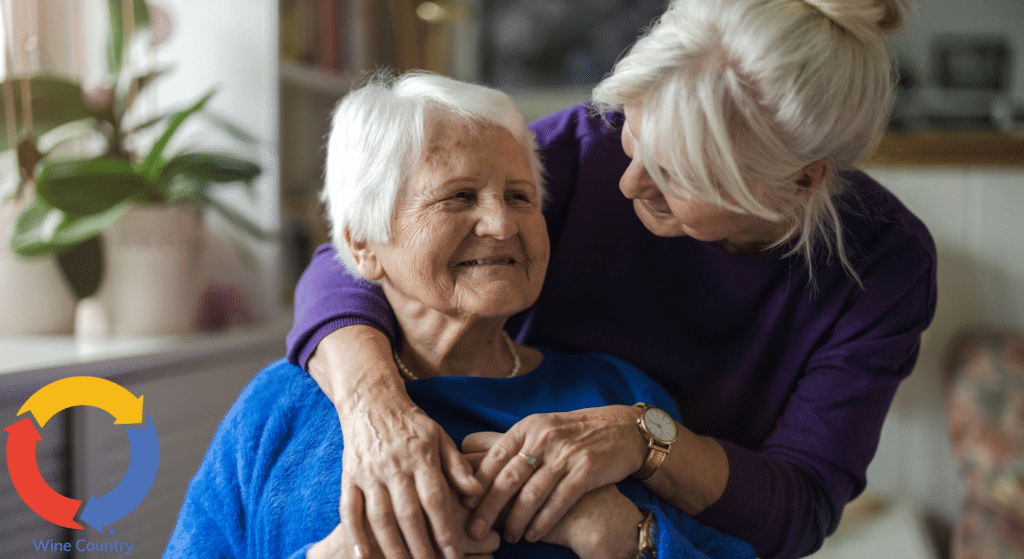
Now, consider what it means when a senior caregiver — someone who is themselves navigating the realities of aging — shows up at the door of an older adult who needs a little extra help.
That caregiver doesn’t just have knowledge about what it feels like to wake up with stiff joints, to grieve the loss of a spouse, to worry about losing independence, or to feel invisible in a world that moves too fast. They have lived experience of it. And that distinction is everything.
Research published in JAMA Network Open found that peer-to-peer support programs for older adults were associated with improvements in mental health, physical health, and notably, a statistically significant reduction in anxiety symptoms compared to standard community services. [11] A separate study published in PMC found that peer-to-peer services may provide meaningful benefit to older adults in regard to their health care utilization, with participants in peer support programs being less likely to visit urgent care clinics. [12]
This is the science behind what many families already feel intuitively: there is something uniquely powerful about being cared for by someone who truly understands your world.
Why Loneliness Makes This Even More Urgent
The stakes of getting senior care right are not just logistical — they are deeply medical. According to the National Institute on Aging, as people age, many find themselves spending more time alone, leaving them vulnerable to social isolation and loneliness, and related health problems such as cognitive decline, depression, and heart disease. [13]
The CDC reports that social isolation and loneliness can increase a person’s risk for heart disease, stroke, type 2 diabetes, depression, anxiety, and even earlier death. [14] Research from the National Academies of Sciences, Engineering, and Medicine found that social isolation presents a major risk for premature mortality comparable to other risk factors such as high blood pressure, smoking, or obesity. [15]
A national poll from the University of Michigan found that more than one third of people age 50 to 80 feel lonely, and nearly as many feel isolated. [16] These aren’t abstract statistics — they describe real people in our communities, in Napa, Sonoma, Petaluma, and Vallejo, who are quietly struggling.
The antidote isn’t just any companionship. Research from Clinical Social Work Journal found that peer support groups offer various health benefits including increased life satisfaction and social integration, and decreased loneliness, anxiety, and depressive symptoms. [17] The key word is peer — someone who shares your generational context, your cultural touchstones, and your understanding of what it means to grow older.
The Four Pillars of E-E-A-T, Applied to Peer-to-Peer Senior Care
Let’s bring this full circle. Here’s how the peer-to-peer caregiving model maps directly onto Google’s E-E-A-T framework — and why it represents the gold standard in senior care.
1. Experience (The First E)
A senior caregiver has personally navigated the physical and emotional terrain of aging. They know what it’s like to need help and to ask for it. Google recognized that first-hand life experience on a topic is often the most valuable form of knowledge. [18] In senior care, this lived experience isn’t a bonus — it’s the foundation.
2. Expertise
Expertise doesn’t always come from a textbook. It comes from decades of lived wisdom — knowing how to have a difficult conversation about independence, how to recognize when a friend is struggling, and how to offer help without diminishing dignity. As Google’s guidelines note, content and care are most valuable when created by people with adequate expertise and relevant qualifications — and life itself is a qualification. [19]
3. Authoritativeness
A peer caregiver speaks with the authority of shared experience. When a 68-year-old caregiver tells a 79-year-old client, “I understand what you’re going through,” that statement carries a weight that no clinical credential can replicate. Authoritativeness in this context is earned through genuine connection and community recognition — not just titles.
4. Trustworthiness
Trust is the most crucial ingredient in E-E-A-T. [10] And trust between two people who share a generational bond — who grew up in the same era, who understand the same cultural references, and who face the same fears about the future — is built faster and runs deeper. The National Institute on Aging notes that people who engage in meaningful, productive activities with others tend to live longer, boost their mood, and have a sense of purpose. [20] That’s what a trusted peer companion provides.
Introducing Seniors Helping Seniors® in-home care Wine Country
At Seniors Helping Seniors® in-home care Wine Country, serving Napa, Sonoma, Petaluma, Vallejo, Santa Rosa, and the surrounding communities, this peer-to-peer philosophy isn’t a marketing angle — it’s the entire model.
Founded in early 2025 by Katie Holman and operating out of Napa, Seniors Helping Seniors® in-home care Wine Country thoughtfully matches active, retired seniors with older adults who need a little extra help at home. Every caregiver brings the most powerful credential in the business: they know what it feels like to be on the other side of that door.
Services range from light housekeeping and meal preparation to reliable transportation and joyful companionship — all delivered by someone who genuinely understands the Wine Country lifestyle and the deep value of aging in place with dignity. As the National Institute on Aging affirms, aging in place promotes life satisfaction, a positive quality of life, and self-esteem — all of which are needed to remain happy, healthy, and well into old age. [21]
For adult children searching for trustworthy, compassionate in-home support for their aging parents — and for active seniors looking for meaningful, flexible work that lets them give back to their community — Seniors Helping Seniors® in-home care Wine Country offers something rare: care that feels like friendship, built on the most authentic form of E-E-A-T there is.
If you’re in Napa County, Sonoma County, or the surrounding Wine Country region and want to learn more about how peer-to-peer in-home care can make a difference for your family, we invite you to reach out to Seniors Helping Seniors® in-home care Wine Country today.
Citations
[1] https://yoast.com/what-is-e-e-a-t/
[2] https://www.networksolutions.com/blog/google-eeat/
[3] https://developers.google.com/search/docs/fundamentals/creating-helpful-content
[4] https://www.searchenginejournal.com/google-e-e-a-t-how-to-demonstrate-first-hand-experience/474446/
[5] https://mailchimp.com/resources/google-eeat/
[6] https://adonis.media/insights/what-is-google-eeat
[7] https://www.networksolutions.com/blog/google-eeat/
[8] https://mailchimp.com/resources/google-eeat/
[9] https://mailchimp.com/resources/google-eeat/
[10] https://yoast.com/what-is-e-e-a-t/
[11] https://pubmed.ncbi.nlm.nih.gov/34129024/
[12] https://pmc.ncbi.nlm.nih.gov/articles/PMC6844703/
[13] https://www.nia.nih.gov/news/social-isolation-loneliness-older-people-pose-health-risks
[14] https://www.cdc.gov/social-connectedness/risk-factors/index.html
[15] https://www.nationalacademies.org/projects/HMD-HSP-17-25/publication/25663
[16] https://www.michiganmedicine.org/health-lab/1-3-older-adults-still-experience-loneliness-and-isolation
[17] https://link.springer.com/article/10.1007/s10615-025-01010-y
[18] https://developers.google.com/search/blog/2022/12/google-raters-guidelines-e-e-a-t
[19] https://www.networksolutions.com/blog/google-eeat/
[20] https://www.nia.nih.gov/news/social-isolation-loneliness-older-people-pose-health-risks
[21] https://www.ruralhealthinfo.org/toolkits/aging/1/overview