




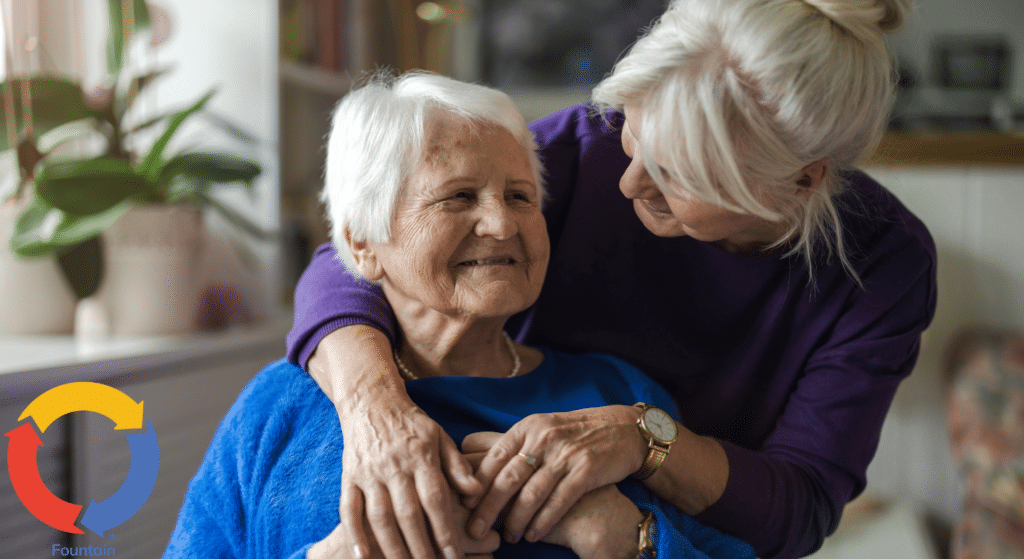
Why Peer-to-Peer Care Builds Trust in Senior Home Care
When we talk about what makes a caregiver truly trustworthy, we often think about credentials, background checks, and reliability. Those things matter enormously. But there is another dimension of trust, one that cannot be earned through a certification course or a resume: the kind of trust that comes from shared life experience.
As your team from Seniors Helping Seniors® in-home care Fountain, we have built our entire model around this idea. We call it peer-to-peer care: the practice of matching active, independent seniors with older adults who need a little extra help at home. It is a model that, perhaps more than any other in the home care space, embodies what Google’s content quality framework calls E-E-A-T: Experience, Expertise, Authoritativeness, and Trustworthiness [1].
In this post, we are shining a spotlight on why the peer-to-peer professional is not just a feel-good concept. It is one of the most credible, most human, and most effective forms of in-home senior care available today.
What Is E-E-A-T, and Why Does It Matter Beyond the Internet?
You may have heard the term E-E-A-T in the context of digital marketing or search engine optimization. It stands for Experience, Expertise, Authoritativeness, and Trustworthiness, a framework Google uses to assess the quality of content, especially for topics that impact people’s lives [2]. Google places particular emphasis on E-E-A-T for what it calls “Your Money or Your Life” topics, areas where inaccurate or low-quality information can have real, harmful consequences for people’s health, safety, or well-being [3].
What is fascinating is that the same four pillars Google uses to evaluate whether a piece of content is worth trusting are also the same pillars that make a senior caregiver worth trusting.
The Four Pillars of Peer-to-Peer Care Through the Lens of E-E-A-T
1. Experience: “I’ve Been There, Too”
Google added the first “E,” Experience, to its quality framework in December 2022, recognizing that first-hand knowledge is as valuable as professional expertise [4]. The idea is simple: someone who has actually lived through a situation can offer insights that no textbook or training manual can replicate [5].
Now think about what that means in the context of senior care. When a 68-year-old caregiver sits down with an 82-year-old client in Fountain, Colorado, she is not just performing a service. She understands what it feels like to wake up with stiff joints on a cold Front Range morning. She knows the quiet grief of losing a spouse, the pride of having raised a family, and the challenge of asking for help after a lifetime of independence. That is not something you can learn in a classroom. That is lived experience, and it is irreplaceable.
Research published through the National Institutes of Health confirms this dynamic. Studies on peer support among older adults show that shared physical health conditions and age-related experiences are powerful tools for building trust and developing meaningful working relationships between supporters and those they serve [6]. When caregivers truly understand what a senior is going through, seniors are more likely to accept help without feeling a loss of dignity [7].
2. Expertise: A Lifetime of Practical Knowledge
Expertise, in the E-E-A-T framework, is about demonstrating deep knowledge of a subject, not just surface-level familiarity [8]. For a senior caregiver, expertise is not measured only in degrees. It is measured in decades.
An active senior who has managed a household, navigated the healthcare system, cooked thousands of meals, and adapted to the physical and emotional changes of aging brings a form of practical expertise that is uniquely suited to helping another senior do the same. They know which shortcuts make meal prep easier for arthritic hands. They know how to encourage a reluctant neighbor to take a walk without making it feel like a chore. They know, from personal experience, how to balance independence with the acceptance of help.
This kind of expertise is especially meaningful in the context of non-medical in-home care, including tasks like light housekeeping, meal preparation, companionship, and dementia support, where emotional intelligence and practical wisdom often matter more than clinical training.
3. Authoritativeness: Earned Through a Life of Service
Authoritativeness, according to Google’s framework, is about being recognized as a credible, go-to source within a given domain [9]. It is built through reputation, consistency, and the respect of one’s peers.
In the Fountain Valley community, a region shaped by military heritage, rugged independence, and tight-knit neighborhoods, authority is earned the old-fashioned way: through years of showing up, serving others, and being known as someone whose word means something. Many caregivers are veterans, retired professionals, and longtime community members who have spent their lives building exactly that kind of reputation.
When a senior in Security-Widefield or Fort Carson opens the door to a caregiver from Seniors Helping Seniors® in-home care Fountain, they are not opening it to a stranger. They are opening it to a neighbor, someone who has walked similar paths, served in similar ways, and earned the right to be trusted.
4. Trustworthiness: The Foundation of Everything
Google is explicit that, of all the E-E-A-T pillars, trustworthiness is the most important [10]. Untrustworthy content, or untrustworthy care, fails regardless of how experienced, expert, or authoritative the source may appear.
Trust in caregiving is built through consistency, reliability, and genuine human connection. Research shows that seniors who receive care from someone in a similar stage of life often report feeling more at ease from the very beginning [7]. The peer-to-peer model turns in-home care into a relationship rather than a transaction [11].
This matters enormously for the families being served. Adult children, many of them balancing demanding careers, military service at Fort Carson, or their own family responsibilities, need to know that their aging parent is not just safe, but genuinely comfortable and cared for. Knowing that care is being provided by a peer offers reassurance that emotional needs are being met alongside practical ones [12].
The Loneliness Crisis: Why Peer Connection Is a Health Imperative
The stakes of getting senior care right could not be higher. The National Institute on Aging reports that social isolation and loneliness are linked to higher risks for a wide range of physical and mental conditions, including high blood pressure, heart disease, cognitive decline, Alzheimer’s disease, and even premature death [13].
The numbers are sobering. Research published by the National Academies of Sciences, Engineering, and Medicine found that approximately one-quarter of community-dwelling Americans aged 65 and older are considered socially isolated, and 43% of adults aged 60 and older report feeling lonely [14]. A meta-analysis published through the National Institutes of Health found that social isolation or loneliness in older adults is associated with a 50% increased risk of developing dementia and a 26% increased risk of all-cause mortality [15].
Companionship is not a luxury. It is a health intervention. And peer-to-peer companionship, rooted in shared experience and mutual understanding, is one of the most powerful forms of connection available to older adults [16].
Research on peer support in behavioral health for seniors also confirms that peer support is grounded in shared lived experiences, creating a foundation of trust and understanding that can significantly benefit seniors facing emotional and psychological challenges [17]. When a caregiver and a client share a generation, they also share a language of cultural references, historical events, and the texture of a life well-lived. That shared language is the foundation of genuine friendship.
The Peer-to-Peer Professional: A Portrait
So who is the peer-to-peer professional in our team?
She might be a retired schoolteacher from Stratmoor who spent 30 years shaping young minds and now finds deep purpose in helping a neighbor with dementia feel safe and seen. He might be a veteran from Fort Carson who served his country for two decades and now channels that same commitment to service into helping a fellow veteran in South Colorado Springs maintain independence at home.
These are not people who stumbled into caregiving. They are people who chose it because they understand, from the inside, what it means to need a hand and to offer one. They bring to every visit not just a willingness to help, but a lifetime of experience, practical wisdom, and a genuine desire for human connection.
For the seniors they serve, the result is something that goes far beyond a checklist of completed tasks. It is the feeling of being understood, of being seen as a whole person rather than a care recipient, and of having a friend who also happens to help with the dishes.
How Seniors Helping Seniors® in-home care Fountain Puts This Into Practice
As your team from Seniors Helping Seniors® in-home care Fountain, we do not just talk about peer-to-peer care. We have built our entire operation around it. Since 2020, we have been thoughtfully matching active, independent seniors with older adults who need daily, non-medical assistance across Fountain, Security-Widefield, Fort Carson, South Colorado Springs, and the surrounding El Paso County communities.
Our services include:
- Light housekeeping — keeping the home comfortable and safe
- Meal preparation — nutritious, home-cooked support tailored to individual needs
- Dementia care support — compassionate, patient assistance for clients and peace of mind for families
- Joyful companionship — the kind that comes from genuine friendship, not obligation
- Respite care — giving family caregivers the break they need and deserve
Every match we make is intentional. We look for shared interests, shared backgrounds, and shared values because we know that the best care relationships are the ones that feel less like a service and more like a friendship.
For families navigating the challenge of finding trustworthy, compassionate care for an aging parent in the Fountain Valley, we offer something no clinical checklist can replicate: the assurance that your loved one is spending time with someone who genuinely understands them.
And for active seniors and veterans in Southern Colorado who are looking for meaningful, flexible part-time work, a way to stay engaged, contribute to their community, and earn income doing something that truly matters, we would love to talk with you about joining our caregiver family.
The Bottom Line
In a world increasingly focused on credentials and certifications, it is easy to overlook the most powerful form of expertise there is: the wisdom that comes from having lived a full life. The peer-to-peer professional is not just a caregiver. They are a living embodiment of E-E-A-T, bringing real experience, hard-won expertise, community-earned authoritativeness, and the deep trustworthiness that only comes from genuine human connection.
As your team from Seniors Helping Seniors® in-home care Fountain, that is not a marketing concept. It is the way we show up every single day for the seniors and families of the Fountain Valley.
If you would like to learn more about peer-to-peer in-home care services in Fountain, Security-Widefield, Fort Carson, and the surrounding Southern Colorado communities, we invite you to reach out. No senior should have to navigate the challenges of aging alone, and in this community, they do not have to.
Citations
[1] https://developers.google.com/search/docs/fundamentals/creating-helpful-content
[2] https://www.networksolutions.com/blog/google-eeat/
[3] https://www.searchenginejournal.com/google-e-e-a-t-how-to-demonstrate-first-hand-experience/474446/
[4] https://developers.google.com/search/blog/2022/12/google-raters-guidelines-e-e-a-t
[5] https://www.adonis.media/insights/what-is-google-eeat
[6] https://pmc.ncbi.nlm.nih.gov/articles/PMC9121547/
[7] https://seniorsbluebook.com/articles/why-seniors-caring-for-seniors-creates-trust-comfort-and-companionship
[8] https://mailchimp.com/resources/google-eeat/
[9] https://yoast.com/what-is-e-e-a-t/
[10] https://yoast.com/what-is-e-e-a-t/
[11] https://seniorsbluebook.com/articles/why-seniors-caring-for-seniors-creates-trust-comfort-and-companionship
[12] https://seniorsbluebook.com/articles/why-seniors-caring-for-seniors-creates-trust-comfort-and-companionship
[13] https://www.nia.nih.gov/news/social-isolation-loneliness-older-people-pose-health-risks
[14] https://www.ncbi.nlm.nih.gov/books/NBK557972/
[15] https://pmc.ncbi.nlm.nih.gov/articles/PMC7437541/
[16] https://pace-ri.org/the-power-of-companionship-for-seniors-a-key-ingredient-to-quality-aging/
[17] https://www.thesupportivecare.com/blog/the-role-of-peer-support-in-behavioral-health-for-seniors