




For many families, the hardest part of starting home care is not deciding that help is needed. It is making that first phone call without knowing what happens next.
The assessment is usually the first step. Understanding the process can remove much of the uncertainty. This guide explains what happens during the assessment, who takes part, and how quickly care can begin after the first conversation.
Watch: What to Expect During a Home Care Assessment
What is a home care assessment?
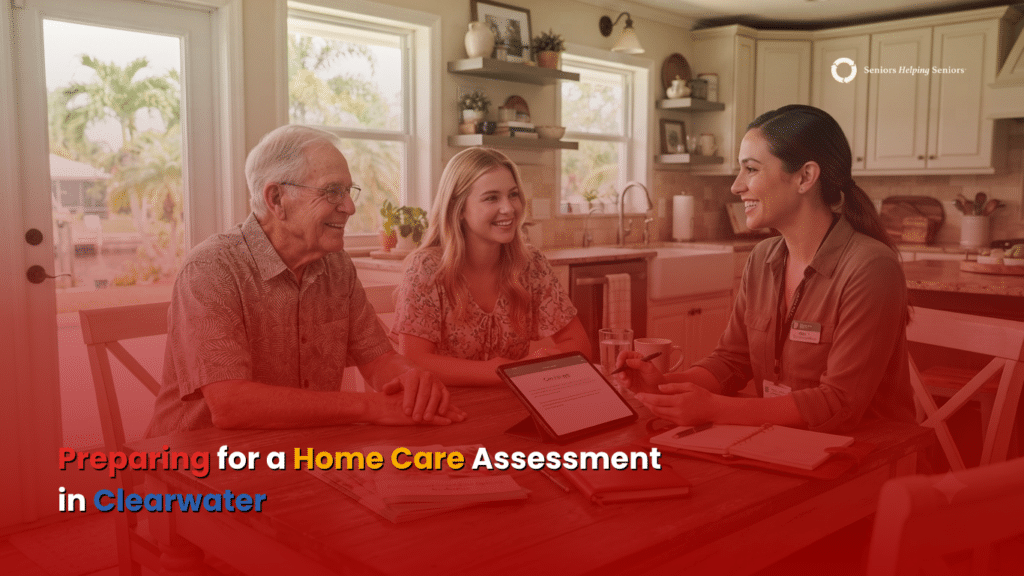
A home care assessment is an in-home visit with an experienced coordinator, often a nurse. The coordinator evaluates your parent’s needs, living situation, daily routines, and personal preferences. They use this information to develop a care plan that fits your family’s situation.
The assessment is not a test your parent can pass or fail. Instead, it is a conversation combined with practical observations. Together, these details help the coordinator determine the right level of care and the most helpful types of support.
The coordinator visits your parent’s home to see the living environment firsthand. This gives them a clearer picture than relying only on descriptions from family members.
What happens during the assessment visit?
The visit generally follows a consistent structure, though it is adjusted based on your parent’s specific situation.
There are five things that typically happen during a home care assessment in Clearwater:
- Introduction and conversation: the coordinator meets your parent and any family members present, and spends time understanding the situation in your parent’s own words, not just from family observations
- Review of daily routines: questions about a typical day, including meals, medications, mobility, hygiene routines, and how your parent currently manages each one
- Walkthrough of the home: the coordinator observes the physical space for safety considerations, such as stairs, bathroom accessibility, and general home layout
- Discussion of preferences: conversations about caregiver preferences, schedule needs, and any specific concerns your parent or family has about accepting help
- Care plan recommendation: based on everything discussed and observed, the coordinator recommends a starting level of care, which can be adjusted as needs change
The full visit typically takes about an hour, though this varies depending on the complexity of the situation.
What Families Should Know
The assessment is not a one-time, permanent decision. Care plans are meant to evolve. Many families start with a modest level of support and adjust upward or downward as circumstances change. Nothing about the initial assessment locks a family into a fixed arrangement.
Who should be present during the assessment?
There is no single right answer here, but a few patterns tend to work well.
There are three common arrangements families in Clearwater use for the assessment visit:
- Parent and primary family caregiver: the most common arrangement, allowing both perspectives to be heard directly
- Parent alone: some seniors prefer to have the conversation independently, particularly if they want to maintain a sense of control over the process
- Multiple family members: for families coordinating care across siblings, having more than one family member present can help everyone hear the same information firsthand and reduce later confusion
If your parent is resistant to the idea of home care, having the assessment focus on a low-pressure, informational conversation rather than a decision-making session can sometimes help ease that resistance.
How is the caregiver match determined?
After the assessment, the agency matches your parent with a caregiver based on the information gathered during the visit.
There are four factors typically considered in a caregiver match:
- Care needs: the specific tasks and level of support identified during the assessment
- Schedule: matching availability between the caregiver and the family’s preferred visit times
- Personality fit: Seniors Helping Seniors® in-home care considers personality and interests when matching, since a good rapport meaningfully improves the caregiving relationship
- Continuity: once a good match is found, the goal is to keep the same caregiver assigned consistently rather than rotating staff
If the initial match does not feel right, adjustments can be made. The goal is a caregiver relationship that actually works for your parent, not just filling a schedule slot.
How quickly does care start after the assessment?
For families in Clearwater and Pinellas County, care typically begins within about a week of the initial call, with the assessment usually happening within the first few days.
There are three steps that typically follow the assessment:
- Caregiver matching: based on the information gathered, the agency identifies an appropriate caregiver
- Schedule confirmation: the family and agency agree on visit days and times
- First visit: the caregiver begins providing care according to the agreed plan
Services typically require a minimum of three hours per visit and six hours per week. Families can adjust the schedule over time as needs change.
What Families Should Know
There is no obligation created by scheduling an assessment. It is an information-gathering conversation, not a commitment to begin services. Families are free to take time to decide after the visit.
How does Seniors Helping Seniors® in-home care handle assessments in Clearwater?
Seniors Helping Seniors® Pinellas County conducts in-home assessments for families throughout Clearwater and Pinellas County, typically within a few days of the initial call. The assessment is conducted by an experienced coordinator, often a nurse, who takes time to understand both the practical needs and the personal preferences involved.
Most caregivers matched through this process are experienced mature adults, typically between the ages of 50 and 70, who bring reliability, patience, and life experience to every visit. The same caregiver is assigned to each client on a consistent schedule once matched.
Services include companionship, homemaker services, personal care, transportation, and dementia support services. Care is available to private pay families, VA-funded families, and those using Medicare Advantage or PACE program benefits.
Home Care Services in Clearwater and Pinellas County
Seniors Helping Seniors® Pinellas County provides home care throughout Clearwater and all of Pinellas County, including Dunedin, Safety Harbor, Palm Harbor, Largo, Seminole, Pinellas Park, and St. Petersburg. If you are unsure whether your address is within our service area, call and we will confirm quickly.
Ready to Talk? Here Is the Next Step.
Seniors Helping Seniors® Pinellas County
2536 Countryside Blvd. Suite 400-425
Clearwater, FL 33763
727-401-4700