



This is one of the most emotionally charged decisions families face. A parent has received an Alzheimer’s diagnosis or another form of dementia. The question becomes: do we keep them home with professional support, or move them to a memory care facility?
There is no universal right answer. However, families can use a clear framework to compare their options. Consider the stage of the disease, your parent’s current needs, and the level of support available at home.
This guide covers that framework for families in Clearwater and Pinellas County.
What is the difference between in-home dementia support and memory care?
In-home dementia support is non-medical home care delivered by a trained caregiver in your parent’s own home. It focuses on daily assistance, companionship, safety supervision, and consistency of routine, all in the environment your parent already knows.
Memory care is a specialized residential facility designed specifically for people with dementia. It provides 24-hour supervision, a structured environment, secured premises, and programming designed around cognitive decline.
The core difference is environment and supervision intensity. In-home support brings care to your parent in a familiar setting. Memory care moves your parent to a purpose-built environment with round-the-clock staff.
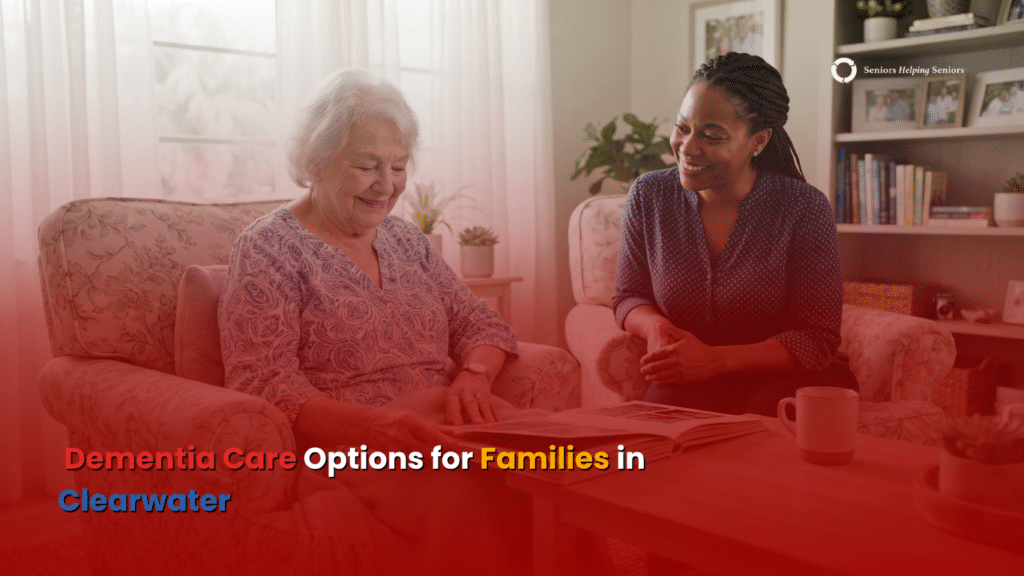
What does research say about familiarity and dementia?
This is where the case for home-based care is strongest and most consistent.
For people with dementia, familiar environments reduce confusion and anxiety in ways that are well-documented in gerontological research. A person with dementia who has lived in the same home for 20 or 30 years has a spatial and sensory familiarity with that environment that continues to provide grounding even as cognitive function declines.
Moving a person with dementia, particularly in the mild to moderate stages, to an unfamiliar environment frequently causes a significant temporary worsening of symptoms. Disorientation, agitation, and distress are common in the weeks following a move to a memory care facility, even when the facility is high quality.
This does not mean a facility is always the wrong choice. It means that the decision to move should be driven by genuine clinical need, not by logistical convenience or family anxiety, because the transition itself carries real costs for your parent.
What Families Should Know
Keeping a parent with dementia at home is not the easier choice. It requires consistent, quality caregiving and a realistic assessment of what is actually needed. But for many families in Clearwater, it is the choice that best honors what their parent would have wanted and what the research supports in the early to moderate stages of the disease.
When does in-home dementia support work well?
Home-based dementia support works best in specific conditions. Understanding those conditions helps families make a clear-eyed assessment.
There are five conditions under which in-home dementia support is typically the right choice:
- Early to moderate stage dementia: your parent still has meaningful function, recognizes familiar people and places, and can engage with a consistent caregiver
- A safe and manageable home environment: the home can be adapted for safety without creating risks that cannot be managed with caregiver support
- Caregiver consistency: a single caregiver or small team of consistent caregivers can be established, which is critical for someone with dementia who relies on recognition and routine
- Family involvement: family members are engaged enough to monitor for changes and coordinate with the care team when the plan needs to adjust
- Realistic care plan: the level of professional support in place matches the actual level of need, not what the family hopes is needed, but what is actually required
The peer-to-peer caregiving model used by Seniors Helping Seniors® in-home care is particularly well-suited to dementia support because the caregiver consistency that comes with our approach is exactly what dementia patients need most. A familiar face, a familiar voice, a consistent routine. That is not a nice-to-have. It is a clinical factor.
When does memory care become the right choice?
There are situations where memory care is genuinely the better option, and being honest about this matters.
Memory care is likely the right choice when:
- Your parent requires 24-hour supervision that cannot safely or practically be provided at home. Late-stage dementia often reaches this point.
- Wandering has become a serious safety risk that cannot be managed in a home environment, even with modifications.
- Behavioral symptoms, including aggression, severe agitation, or significant psychosis, have reached a level that requires clinical management beyond what home caregivers can safely handle.
- Your parent’s physical care needs have escalated to the point where the level of hands-on support required exceeds what home-based care can realistically deliver.
- The family caregiver has reached a point of burnout that is affecting the quality of care the parent is receiving.
The transition to memory care is often the right move, but it is most appropriate when it is driven by these clinical realities rather than by the complexity of managing home-based care.
What Families Should Know
Many families move a parent to a memory care facility earlier than is clinically necessary because the logistics of home-based care feel overwhelming. This is understandable. But it is worth asking whether the right answer is a facility, or whether the right answer is more professional support at home. Those are different solutions to different problems.
How do the costs compare?
Cost is not the only factor, but it is a real one.
Memory care in the Clearwater and Pinellas County area is among the most expensive forms of senior care, typically running significantly higher than standard assisted living due to the specialized staffing and secured environment required.
Home-based dementia support is billed by the hour and is typically more cost-effective than memory care until a parent needs a very high volume of daily supervision. Below approximately 10 to 12 hours of care per day, in-home support is almost always the more cost-effective option. Above that threshold, the all-inclusive structure of a memory care facility can become more competitive.
For current rates on in-home dementia support in Clearwater, call us directly. We will give you honest numbers.
How does Seniors Helping Seniors® in-home care approach dementia support in Clearwater?
Seniors Helping Seniors® in-home care provides dementia support services throughout Clearwater and Pinellas County using a peer-to-peer caregiving model. Most caregivers are experienced mature adults, typically between the ages of 50 and 70, who bring patience, consistency, and genuine life experience to every visit.
Consistency is the core of what we do for dementia clients. The same caregiver assigned on a regular schedule. Familiar routines built and maintained. A caregiver who knows your parent’s baseline well enough to notice when something has changed.
That continuity is not just a service feature. For a person with dementia, it is a clinical asset.
Services extend beyond dementia support to include personal care, homemaker services, companionship, and transportation. Care is available to private pay families, VA-funded families, and those using Medicare Advantage or PACE program benefits.
Home Care Services in Clearwater and Pinellas County
Seniors Helping Seniors® in-home care provides home care throughout Clearwater and all of Pinellas County, including Dunedin, Safety Harbor, Palm Harbor, Largo, Seminole, Pinellas Park, and St. Petersburg. If you are unsure whether your address is within our service area, call and we will confirm quickly.
Ready to Talk? Here Is the Next Step
If you are trying to figure out whether home-based dementia support or a memory care facility is the right move for your parent, we are happy to have that conversation honestly, including telling you if we think a facility is the better fit.
Call Seniors Helping Seniors® Pinellas County. We will listen first and give you an honest assessment.
Seniors Helping Seniors® Pinellas County
2536 Countryside Blvd. Suite 400-425
Clearwater, FL 33763
727-401-4700