




One of the most common calls we receive from families in St. Petersburg starts the same way: “My parent can no longer drive, and they need rides to their appointments. Can you help with that?”
The answer is yes. But before we explain how, it helps to clarify what we actually provide. Our service differs from a transport-only option. For some families, that difference matters more than they initially expected.
This guide explains what accompanied transportation looks like and when a standard ride service may be the better fit. It also explains why some families discover that transportation is only part of the problem.
What is the difference between a ride service and accompanied transportation?
A transport-only or ride service picks up your parent, drives them to their destination, and drops them off. The driver’s job ends at the door. Whether your parent can get from the car into the building safely, navigate an unfamiliar medical office, communicate their needs to a provider, or wait comfortably until their appointment is over is not part of the service.
Accompanied transportation is different in every one of those ways.
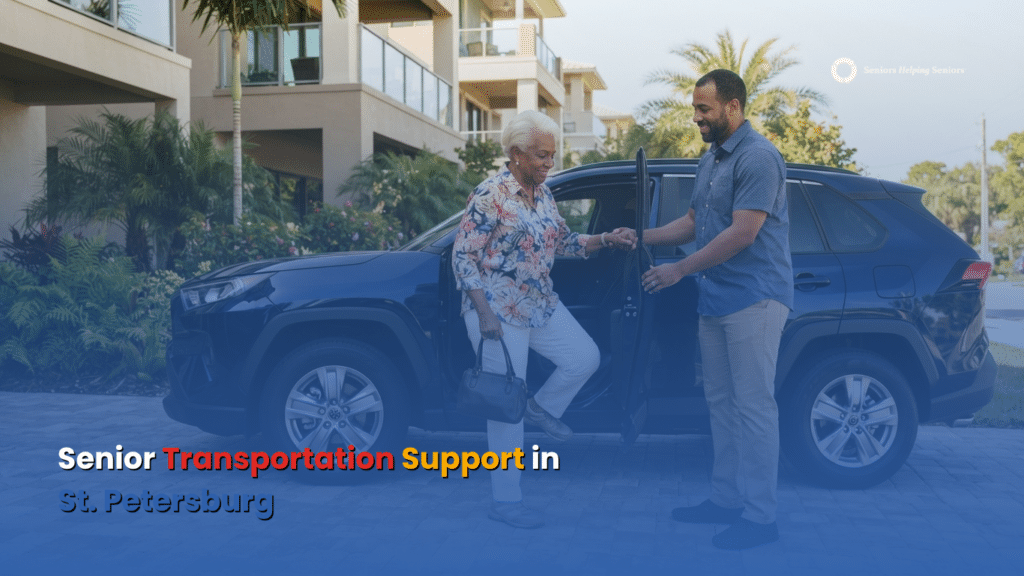
When Seniors Helping Seniors® in-home care provides transportation, a trained caregiver goes with your parent for the entire visit. They help with getting in and out of the vehicle. They walk in with your parent, stay with them throughout the appointment, and help them back out when it is done. They can take notes during a medical appointment. They can ask questions on your parent’s behalf. They provide safety supervision and companionship throughout.
The ride is part of the service. It is not the whole service.
When does a transport-only service make sense?
We want to be straightforward about this. A transport-only service is the right solution in some situations, and we will tell you honestly if we think that applies to your parent.
A ride service is likely sufficient when:
1. Your parent is cognitively sharp and physically steady enough to get in and out of a vehicle independently and navigate their destination without assistance
2. The destination is familiar and your parent is comfortable managing the visit on their own
3. The primary need is simply the vehicle and the driver, not supervision, support, or companionship during the outing
If your parent fits that description, a transport-only option may be more cost-effective for your situation. There is no reason to arrange a more comprehensive service when a simpler one genuinely meets the need.
What Families Should Know
The families who call us asking only about transportation often discover during the assessment that their parent’s situation is more complex than transportation alone. That is not a sales pitch. It is simply what coordinators observe when they see the full picture. When your parent can no longer drive, that loss rarely exists in isolation.
What does accompanied transportation actually include?
The scope of what a caregiver provides during a transportation visit goes well beyond the drive itself.
There are six things a Seniors Helping Seniors® caregiver typically provides during an accompanied transportation visit:
- Physical assistance: help getting in and out of the vehicle safely, walking to and from the entrance, and navigating any physical challenges along the way
- Safety supervision: constant presence to reduce the risk of falls, confusion, or disorientation in an unfamiliar environment
- Appointment advocacy: sitting with your parent during medical or professional appointments, taking notes, helping communicate symptoms or concerns to providers, and ensuring nothing important is missed
- Companionship: the kind of calm, familiar presence that reduces anxiety for older adults who find medical appointments stressful or disorienting
- Errand support: many transportation visits are paired with errands such as pharmacy pickups, grocery stops, or other practical needs that can be managed during the same outing
- Reporting back: after the visit, a caregiver who knows your parent well can communicate meaningfully to family members about how the appointment went, what was said, and any changes in condition they observed
This is what full-service accompanied transportation looks like. It is not drop-off and pickup. It is a caregiver who stays.
Why do families who call about transportation often need more?
This is something we see consistently, and it is worth explaining honestly.
When an older adult loses the ability to drive, it is rarely the only thing that has changed. Driving requires judgment, coordination, spatial awareness, and confidence. When those abilities decline enough to make driving unsafe, other areas of daily life are usually showing strain as well.
Families often focus on transportation because it is the most visible and immediate problem. The appointment is tomorrow. Someone needs to provide a ride. That feels urgent and concrete in a way that other concerns do not.
But when a coordinator visits the home to assess transportation needs, they almost always observe a fuller picture. Medications that need managing. A kitchen that is harder to navigate than it used to be. A parent who is more isolated than the family realized. Mobility challenges that go beyond getting in and out of a car.
We bring this up because we believe families deserve to know what their parent’s situation actually looks like. Sometimes the right answer really is just a ride service. And sometimes what looks like a transportation problem turns out to be the first sign that a broader care conversation is overdue.
What Families Should Know
A home care assessment is the most useful next step for any family that is uncertain. It is not a commitment. It is a conversation with a coordinator who has seen hundreds of situations like yours and can give you an honest read on what your parent actually needs.
How does Seniors Helping Seniors® in-home care handle transportation in St. Petersburg?
Seniors Helping Seniors® Pinellas County provides accompanied transportation as part of a broader non-medical home care plan throughout St. Petersburg and Pinellas County. Transportation is not offered as a standalone pickup-and-dropoff service. When a caregiver takes your parent somewhere, they go in with them and stay for the duration of the visit.
Most caregivers are experienced mature adults, typically between the ages of 50 and 70, who bring patience, attentiveness, and genuine life experience to every outing. Transportation visits are typically incorporated into a broader care plan that may also include companionship, homemaker services, personal care, and dementia support services. Care is available to private pay families, VA-funded families, and those using Medicare Advantage or PACE program benefits.
Home Care Services in St. Petersburg and Pinellas County
Seniors Helping Seniors® Pinellas County provides home care throughout St. Petersburg and all of Pinellas County, including Clearwater, Palm Harbor, Largo, Seminole, Pinellas Park, Dunedin, and Safety Harbor. If you are unsure whether your address is within our service area, call and we will confirm quickly.
Ready to Talk? Here Is the Next Step.
If your parent can no longer drive and you are trying to figure out what kind of support makes sense, give us a call. We will ask a few questions, give you an honest read on what we think is needed, and tell you directly if a transport-only option is actually the better fit for your situation.
Seniors Helping Seniors® Pinellas County
2536 Countryside Blvd. Suite 400-425
Clearwater, FL 33763
727-401-4700