




Most families have one person who ends up doing most of the caregiving. This can happen because of location, personality, availability, or simply by default. One sibling may live closer or have more flexibility. In other cases, someone steps in when help is first needed and continues taking on more responsibilities.
Over time, that imbalance can become a problem. It affects the caregiver carrying most of the responsibility. It can also affect the parent receiving care and create tension between siblings.
This guide is for the person doing most of the caregiving who has not yet found a way to discuss it with their siblings. It explains why these conversations can be difficult and how to approach them productively. It also covers how professional care can make the situation more sustainable for the entire family.
Why is this conversation so difficult?
Sibling caregiving conversations involve more than schedules and daily tasks. Family history, different expectations, and personal circumstances can all affect how people respond.
There are four common reasons these conversations become difficult:
- Old family dynamics resurface: Childhood roles often continue into adulthood. One sibling may have always been seen as responsible or dependable. Another may have had a different role in the family. Caregiving decisions can bring these old patterns back to the surface.
- People may feel accused: Conversations about fairness can easily sound like criticism. A sibling doing less may have genuine limitations. They may also be unaware of how much responsibility another sibling has taken on.
- Everyone sees the situation differently: A sibling who lives nearby and visits often sees the parent’s daily challenges firsthand. Someone who calls weekly or visits during holidays may see a very different situation. As a result, siblings may disagree about how much care their parent actually needs.
- Conflict feels difficult to avoid: Bringing up caregiving responsibilities may create tension. Because of this, many primary caregivers avoid the conversation. They continue taking on more responsibilities until the situation becomes difficult to manage.
What Families Should Know
Waiting until the primary caregiver is exhausted can make this conversation harder. At that point, frustration and resentment may already be building. Discussing responsibilities earlier gives everyone more time to understand the situation and consider practical solutions.
How do you start the conversation?
The goal of the first conversation is not to resolve everything. It is to open a door and establish that the current situation needs to change.
There are four principles that help the conversation go better:
- Lead with what is happening, not what you need: instead of opening with what you want siblings to do differently, start by describing what your parent’s current situation actually looks like. The week-by-week reality, the appointments, the tasks, the concerns. Many siblings genuinely do not have an accurate picture, and giving them one is more productive than leading with a request or a complaint
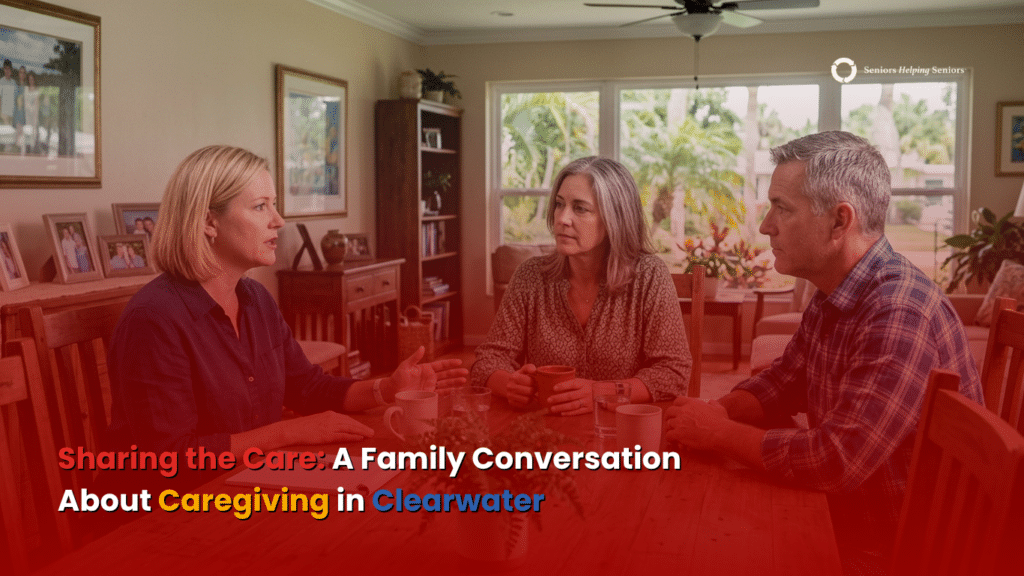
- Use a family meeting format rather than a one-on-one conversation: getting everyone on the same call or in the same room at the same time means each person hears the same information and no one feels singled out or triangulated
- Come with specific asks rather than general frustration: “I need someone to cover the Tuesday appointments for the next month” is easier to respond to than “I just need more help.” Specific, concrete, time-bounded requests are more actionable and less charged
- Acknowledge that people have different constraints: a sibling who lives in another state, works full time, or has young children has genuine limitations. Acknowledging those limitations before they are raised as defenses tends to reduce defensiveness and open up more honest conversation about what each person can actually contribute
What are the different ways siblings can contribute?
One of the most useful reframes in the sibling caregiving conversation is that contribution does not have to be equal in kind, only fair in burden.
There are five ways siblings can contribute that do not all require physical presence:
- Direct care time: visits, appointments, hands-on help. For siblings who live nearby and have flexibility, this is the most direct contribution
- Financial contribution: for siblings who live far away or have demanding work schedules, contributing financially to professional care costs can be a meaningful and practical form of participation
- Administrative and coordination tasks: managing medical paperwork, coordinating with providers, researching care options, handling insurance claims. These are real work that often fall to the primary caregiver by default
- Remote support and communication: being the sibling who calls the parent regularly, handles the phone conversations with agencies, or stays on top of the care schedule
- Scheduled relief visits: committing to specific dates when a distant sibling takes over so the primary caregiver gets a real break, not just a theoretical one
The goal is not mathematical equality but a shared sense that everyone is contributing something real in proportion to their capacity.
What Families Should Know
Professional home care often resolves the sibling tension by shifting the burden off family members entirely for some tasks. When a caregiver handles the daily check-ins, the appointments, and the household support, the question of which sibling does more of that work becomes less fraught. The family’s role shifts toward coordination and advocacy rather than direct daily care.
What if the conversation does not go well?
Not every sibling conversation reaches a productive resolution, at least not the first time. Some siblings minimize the situation. Some feel criticized regardless of how the conversation is framed. Some have genuinely complicated relationships with the parent that make their involvement complicated.
If the conversation stalls, there are three options worth considering:
- Bring in a neutral third party: a geriatric care manager or aging life care professional can assess the parent’s situation independently and present findings to the whole family. When the information comes from a professional rather than a sibling, it is often received differently
- Set a time limit for the current arrangement: telling siblings that the current situation is sustainable for another ninety days and you need a plan before then is more concrete than an open-ended request for help
- Move forward with professional care regardless: if siblings will not engage, getting professional care in place protects your parent and reduces your own burden, even without family consensus. You cannot force participation, but you can take action
How does professional home care change the family dynamic?
One of the things we hear most consistently from families after home care is in place is that it reduces family conflict. Not because the underlying relationships change, but because the pressure that was activating the conflict decreases.
When a professional caregiver is handling the daily support, the primary sibling is not the sole point of contact for every need. The parent has consistent care that does not depend on which family member can get there that day. The siblings who were not contributing to daily care can contribute in other ways without the primary caregiver feeling like they are still carrying everything.
Professional care does not replace family involvement. It structures it differently, in a way that tends to be more sustainable for everyone.
Home Care Services in Clearwater and Pinellas County
Seniors Helping Seniors® Pinellas County provides home care throughout Clearwater and all of Pinellas County, including Dunedin, Safety Harbor, Palm Harbor, Largo, Seminole, Pinellas Park, and St. Petersburg. If you are unsure whether your parent’s address is within our service area, call and we will confirm quickly.
Ready to Talk? Here Is the Next Step.
If you are the sibling carrying most of the caregiving weight and you are trying to figure out how to make the situation more sustainable, give us a call. We can talk through what your parent’s current situation looks like and what professional care could take off your plate.
Seniors Helping Seniors® Pinellas County
2536 Countryside Blvd. Suite 400-425
Clearwater, FL 33763
727-401-4700