




Mom fell on a Tuesday.
By Wednesday, everyone was treating her differently.
Her daughter carried her laundry.
Her son told her not to use the stairs.
Someone moved the coffee maker so she wouldn’t have to reach for it.
Her granddaughter grabbed her arm every time she stood up.
Finally, Mom snapped.
“Would everybody please stop acting like I’m going to break?”
Nobody meant to make her feel helpless.
They were scared.
And sometimes that’s what happens after an older parent falls.
The bruise can heal faster than the family’s fear does.
A Fall Can Change More Than Mobility
Falls deserve to be taken seriously.
Sometimes they reveal a medical issue. Sometimes there’s an injury. Sometimes they lead to changes in mobility, therapy, equipment or the support someone needs at home.
But there’s another change that can happen after a fall.
The family starts seeing Mom differently.
Before Tuesday, she was Mom.
She lived alone.
Made her own breakfast.
Walked to the mailbox.
Went to church.
Watered her flowers.
Decided when she wanted to go to Kroger.
Then she fell.
Now everyone is watching.
“Careful.”
“Let me get that.”
“Don’t do that.”
“Are you sure?”
Maybe Mom’s body didn’t change dramatically overnight.
But everyone’s perception of her did.
Fear Makes Sense
If you’ve watched a parent fall, or received the phone call afterward, you know how quickly your mind can race.
What if she’d hit her head?
What if nobody had been there?
What if it happens again?
What if next time is worse?
Those fears aren’t irrational.
They’re love mixed with the realization that someone you’ve always thought of as capable can be vulnerable.
So you respond.
You help.
You hover.
You start trying to eliminate anything that could possibly lead to another fall.
The intention is protection.
But without realizing it, protection can become restriction.
“Just Let Me Do It”
It starts with little things.
Mom reaches for the laundry basket.
“I’ve got it.”
She gets up to make coffee.
“Sit down. I’ll do it.”
She wants to walk to the mailbox.
“Why don’t you wait until I’m here?”
She mentions going to lunch with a friend.
“Maybe you should stay home today.”
Eventually, Mom stops reaching for the laundry.
Stops making the coffee.
Stops walking to the mailbox.
Stops making plans.
Not necessarily because she can’t.
Sometimes because everyone around her has started communicating the same message:
We’re not sure you can do this anymore.
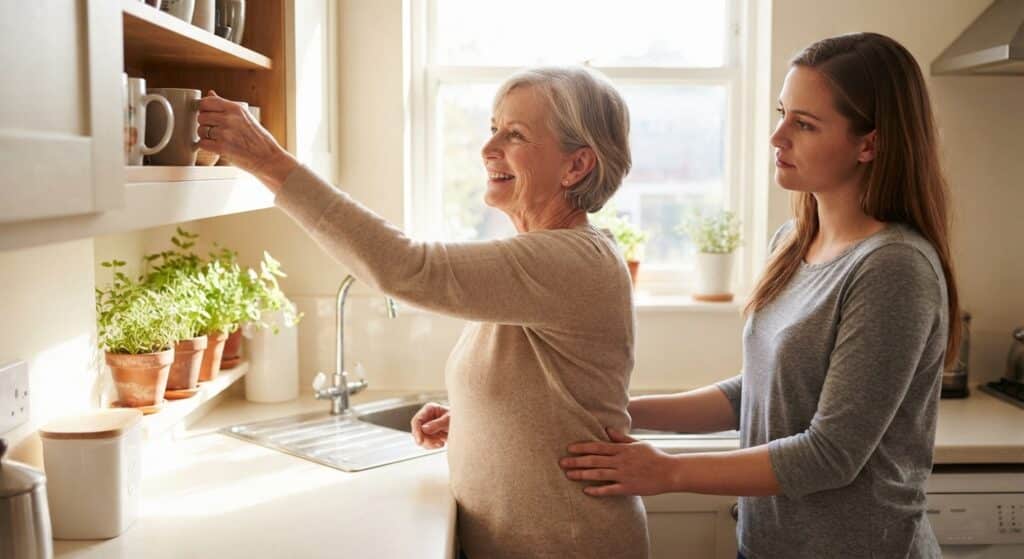
Safety and Independence Aren’t Opposites
Families can get trapped into thinking there are only two options.
Let Mom do everything herself and accept the risk.
Or do everything for her and keep her safe.
There’s a lot of space between those choices.
Maybe Mom still does the laundry, but someone carries the basket downstairs.
Maybe she still showers independently, but someone is nearby.
Maybe she still goes grocery shopping, but someone goes with her.
Maybe she continues walking outside, but she has company.
Maybe she no longer drives, but she still decides where she wants to go.
Support doesn’t always mean taking something over.
Sometimes support means making it possible for someone to keep doing it.
Ask Before You Take Over
One of the simplest things families can do after a fall is ask:
“What would help you feel safe doing this?”
Not:
“You shouldn’t do that anymore.”
Not:
“I’ll do it.”
Ask.
Mom may have ideas.
Maybe she’d feel better with someone walking beside her.
Maybe she’d like to talk with her physical therapist about the stairs.
Maybe she wants help carrying something but doesn’t need you to complete the whole task.
Maybe she’s scared too and hasn’t told you.
The conversation changes when Mom is part of the solution instead of the problem everyone else is trying to solve.
Confidence Matters Too
There’s a part of recovery families don’t always see.
Confidence.
After a fall, an older adult may become afraid of falling again.
That fear can change behavior.
Someone who used to walk around the neighborhood stays inside.
Someone who went to church every Sunday starts watching from home.
Someone who loved shopping starts asking a daughter to pick things up instead.
At first, that may seem safer.
But a smaller life isn’t automatically a better life.
This is where medical professionals, physical therapists and occupational therapists can be incredibly important.
They can help families understand what is actually safe, what may need modification, and what activities someone should continue working toward.
Family fear shouldn’t be the only thing deciding what Mom can do.
Don’t Let One Tuesday Rewrite Mom’s Identity
Mom is more than the person who fell.
She’s still the person who loves tending her flowers.
The person who knows exactly which Publix has the good bakery.
The person who meets friends after church.
The person who insists nobody else knows how to fold the fitted sheets correctly.
A fall is something that happened to her.
It doesn’t automatically become who she is.
That’s worth remembering when every instinct tells you to wrap her in bubble wrap.
Support Should Preserve Participation
This is one of the things I appreciate about good caregiving.
Sometimes the job isn’t doing something for an older adult.
It’s doing it with them.
Walking alongside Dad instead of telling him to stay in the chair.
Going to the grocery store with Mom instead of automatically doing her shopping.
Being nearby while she gets ready.
Helping with the part of a task that’s become difficult while leaving the rest alone.
Providing a ride so giving up driving doesn’t mean giving up lunch with friends.
The question becomes:
How much support does Mom need to keep participating in her own life?
That’s a very different question from:
What should we stop letting Mom do?
Watch the Language
Families may not realize how often they’re reinforcing fear.
“Be careful.”
“Don’t fall.”
“Let me do that.”
“Are you sure you can?”
Again and again.
Imagine hearing those words every time you stood up.
Eventually, you might start wondering whether everyone else sees something you don’t.
Instead, try:
“Want some company?”
“How can I help?”
“Would it make this easier if I carried that part?”
“What did your therapist say about this?”
“Do you want an arm or are you good?”
Those words leave room for Mom to answer.
Independence Doesn’t Mean Doing Everything Alone
We sometimes define independence too narrowly.
Independence isn’t necessarily:
“I don’t need anyone.”
For many of us, independence is actually:
“I still get to make decisions about my own life.”
Most adults rely on other people constantly.
We hire plumbers.
Ask friends for rides.
Order groceries.
Have someone cut our hair.
None of that makes us dependent.
As we age, the kinds of support we use may change.
The goal isn’t to prove Mom can do absolutely everything herself.
It’s to make sure she still has agency over the life she’s living.
Let the Right People Help Determine What’s Safe
After a fall, families shouldn’t have to guess about everything.
Depending on what happened, Mom’s physician or other healthcare professionals may recommend evaluation or follow-up.
Physical therapists can help with strength, balance and mobility.
Occupational therapists can look at how someone manages everyday activities and the home environment.
Those professionals can help answer questions that fear alone can’t.
Then family and caregiving support can help put the plan into everyday life.
Because the goal isn’t pretending the fall didn’t happen.
It’s responding to what actually changed without assuming everything changed.
The Question I’d Ask Your Family
If Mom has fallen recently, look at what has changed since then.
Then ask:
Did this change because Mom physically can’t do something anymore?
Or:
Did this change because we’re afraid to let her try?
Sometimes the answer will absolutely be the first one.
Something may no longer be safe.
A task may need to change.
Mom may genuinely need more help.
That’s okay.
But sometimes you’ll discover that the family’s fear has quietly become more restrictive than Mom’s actual abilities.
That’s worth talking about.
Help Mom Keep Living Her Life
Aging safely matters.
So does living.
Going outside.
Seeing friends.
Attending church.
Shopping.
Gardening.
Choosing your own breakfast.
Making your own coffee.
Doing the ordinary things that remind you:
This is still my life.
If someone you love needs a little more support after a fall, the goal doesn’t have to be taking everything away.
Maybe the better question is:
What support would make it possible for Mom to keep doing the things that matter to her?
Because the goal isn’t to remove every risk from Mom’s life.
It’s to give her enough support to keep living it.
A Gentle Invitation
If your family has found itself hovering after Mom or Dad experienced a fall or change in mobility, we understand why.
Sometimes a little support can make everyone feel more comfortable without taking away the older adult’s independence.
At Seniors Helping Seniors® Nashville, that might mean companionship, transportation, help with personal care, or simply having someone nearby while your loved one continues participating in everyday life.
We’d be happy to talk through what that could look like.
Safety should protect Mom’s life, not replace it.