




June is Alzheimer’s and Brain Awareness Month. Andy Malivuk, owner of Seniors Helping Seniors®, recently appeared on WFLA’s Bloom Tampa Bay to discuss what families dealing with a dementia diagnosis actually need to know — from recognizing the early warning signs to managing caregiver burnout to having one of the hardest conversations families face.
The clip above covers the full segment. Below is a summary of the key points for families in St. Petersburg and Pinellas County navigating this situation.
Watch: 13 Million Americans Care for Loved Ones with Dementia
How widespread is Alzheimer’s and dementia in the Tampa Bay area?
The numbers are significant. Florida has the second largest concentration of people living with Alzheimer’s and dementia in the country. In the Tampa Bay area, that translates to roughly one in eight people — more than 70,000 individuals — living with the disease.
For families in St. Petersburg and Pinellas County, that concentration means that professional care options, support programs, and dementia resources are more developed here than in many parts of the country. It also means most families in this area are either directly affected or know someone who is.
What are the warning signs that go beyond normal aging?
One of the most important distinctions families need to make is between normal age-related forgetfulness and the early signs of Alzheimer’s or dementia.
Normal forgetfulness looks like misplacing keys occasionally but being able to retrace your steps and find them. It looks like forgetting a few items at the grocery store.
Early dementia looks different. It is when someone forgets why they went to the grocery store at all. It is when the keys start turning up in genuinely odd places — the freezer, the oven. It is when the forgetting starts to affect daily routine or safety in ways that cannot be explained away.
There are three questions worth asking when evaluating what you are seeing:
- Is the forgetfulness impacting daily routine or safety, or is it an occasional inconvenience?
- Is your parent able to retrace their steps and correct the lapse, or does the memory simply not return?
- Are the incidents becoming more frequent or more unusual over time?
When the answers point toward impact on routine, safety, or escalating frequency, it is time to take the signs seriously and involve a doctor.
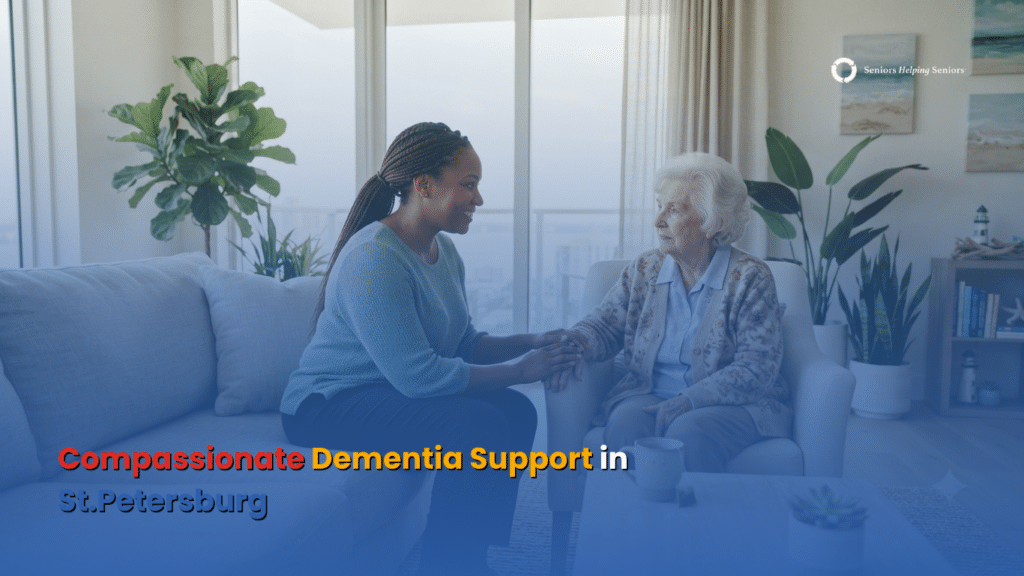
What Families Should Know
Getting a diagnosis is not the same as giving up. Early diagnosis opens the door to care planning, support resources, and treatment options that can meaningfully slow progression and improve quality of life for both the person with dementia and the family caring for them.
What does caregiver burnout look like in dementia situations?
Burnout is one of the most consistent realities of dementia caregiving, and it happens faster than most families expect.
The pattern is recognizable. An adult child starts helping a parent manage day-to-day life. They are also working full time, possibly raising their own children. The caregiving demands grow gradually. Sleep suffers. Mistakes start happening at work. The emotional weight accumulates without relief.
What families often miss is that the care recipient — the parent with dementia — feels that stress too. A caregiver who is depleted, frustrated, or running on empty is not providing the same quality of presence and support as one who has adequate relief built into the arrangement.
Burnout in dementia caregiving is not a sign of failure. It is a predictable outcome of an unsustainable situation without professional support.
What Families Should Know
One of the most effective tools for managing caregiver burnout in dementia situations is compassionate detachment — the practice of mentally naming the disease rather than the person. Reminding yourself that the behavior you are responding to is Alzheimer’s, not your parent, helps reduce the anger and grief that build up over time and makes it possible to stay present longer.
How do you have the conversation with a parent who may have dementia?
This is one of the hardest conversations families face. The goal is not to be perfect. The goal is to open a door.
There are four principles that consistently help families navigate this conversation:
- Lead with patience and love: the tone of the conversation matters more than the specific words. A calm, caring approach is more likely to keep the door open than a confrontational one
- Use I statements: instead of “you keep forgetting things and you need to see a doctor,” try “I have noticed you misplaced your keys in some unusual places recently, and I have been a little worried. Are you feeling okay?” The focus shifts from accusation to concern
- Frame the doctor visit as ruling things out: getting a resistant parent to see a doctor is easier when the visit is framed as eliminating possibilities rather than confirming fears. Something as simple as “it could be a vitamin deficiency, let’s just check” lowers the resistance
- Accept that the first conversation is just a start: the goal is not resolution in one sitting. It is planting the idea and keeping communication open so the next conversation is easier
Once a doctor is involved, they will guide the family through diagnosis and next steps. The family’s role is to get to that point.
What resources are available for families dealing with Alzheimer’s and dementia?
Families in St. Petersburg do not have to navigate this alone. There are several resources that can help at different stages of the journey.
There are five starting points for families in St. Petersburg and Pinellas County:
- Alzheimer’s Association: alz.org provides education, support groups, a 24/7 helpline, and local chapter resources throughout Florida
- Alzheimers.gov: the federal government’s resource hub for research, diagnosis information, and caregiver tools
- Your parent’s primary care physician: the first and most important professional contact for diagnosis and referrals to specialists
- Aging life care professionals: also known as geriatric care managers, these specialists help families navigate the full range of care options, coordinate services, and develop long-term care plans
- Home care agencies: non-medical home care provides dementia-trained caregivers who can support your parent at home while giving family caregivers consistent, scheduled relief
Getting professional support in place early makes a meaningful difference in outcomes for both the person with dementia and the family caring for them.
How does Seniors Helping Seniors® in-home care support families dealing with dementia in St. Petersburg?
Seniors Helping Seniors® in-home care provides dementia support services throughout St. Petersburg and Pinellas County using a peer-to-peer caregiving model. Most caregivers are experienced mature adults, typically between the ages of 50 and 70, who bring patience, consistency, and genuine life experience to every visit.
Consistency matters especially in dementia care. A familiar caregiver who shows up on a regular schedule reduces confusion and anxiety for someone with cognitive decline far more effectively than rotating staff. The same caregiver is assigned to each client on a consistent schedule.
Services extend beyond dementia support to include companionship, homemaker services, personal care, and transportation. Care is available to private pay families, VA-funded families, and those using Medicare Advantage or PACE program benefits.
Home Care Services in St. Petersburg and Pinellas County
Seniors Helping Seniors® in-home care provides home care throughout St. Petersburg and all of Pinellas County, including Clearwater, Palm Harbor, Largo, Seminole, Pinellas Park, Dunedin, and Safety Harbor. If you are unsure whether your address is within our service area, call and we will confirm quickly.
Ready to Talk? Here Is the Next Step.
If you are navigating a dementia diagnosis in your family and are not sure where to start, give us a call. We can talk through what your parent’s situation looks like and what level of support would help.
Seniors Helping Seniors® Pinellas County
2536 Countryside Blvd. Suite 400-425
Clearwater, FL 33763
727-401-4700