




Palm Harbor has one of the largest populations of older adults in Pinellas County. Many residents have lived in the same home for decades and strongly prefer to remain there as they age. When families notice that a parent needs more support, they often begin comparing home care and assisted living.
This decision is not always easy, but understanding the differences can make it more manageable. This guide explains the key differences between home care and assisted living, including cost, quality of life, and the factors families should consider most.
Watch: Home Care VS Assisted Living
What is the difference between home care and assisted living?
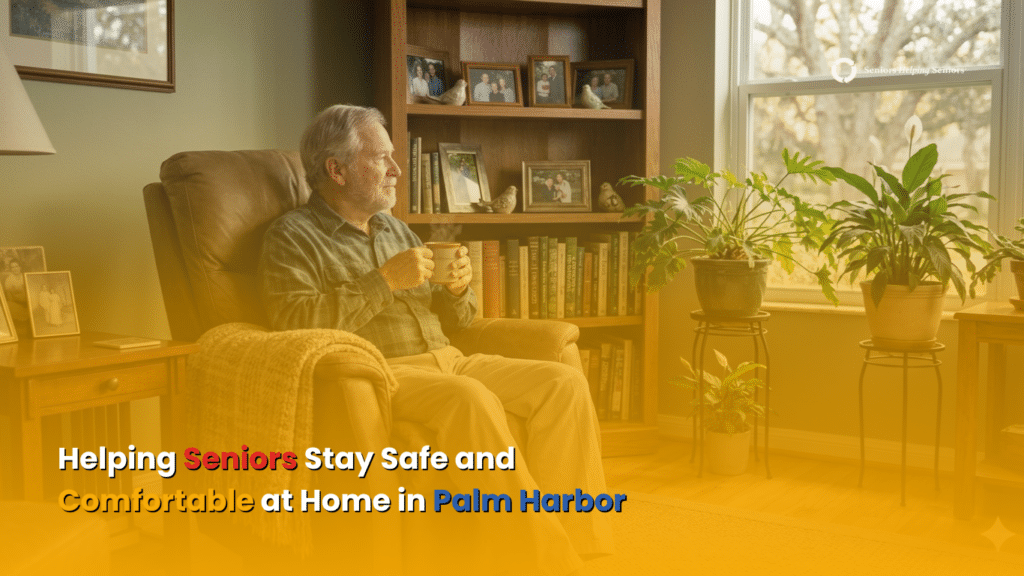
Home care means a trained caregiver comes to your parent’s home on a scheduled basis to provide support. That support can range from companionship and light housekeeping to hands-on personal care such as bathing, dressing, and mobility assistance. Your parent stays home, in their own environment and routine.
Assisted living requires your parent to move into a residential community where staff provide housing, meals, social activities, and personal care services. The level of care depends on the services selected and the resident’s needs.
The biggest difference is the setting. Home care brings support into your parent’s home, while assisted living moves your parent into a care facility.
How do the costs compare in Palm Harbor?
Home care is billed by the hour. Assisted living is billed as a monthly package, typically with a base rate plus add-on fees for higher levels of personal care. Because the structures are different, a meaningful cost comparison depends on how many hours of care your parent actually needs.
The general crossover point is approximately 10 to 12 hours of care per day. Below that threshold, home care is typically more cost-effective than assisted living that includes meaningful personal care support. Above that threshold, the all-inclusive nature of assisted living can become more competitive.
For most families in Palm Harbor, the starting point is a few hours of support several days a week, which is well below that crossover point. You can review the ways families pay for home care, including VA and Medicare Advantage options, before making the comparison.
What Families Should Know About Hidden Costs
Assisted living base rates often exclude medication management, incontinence supplies, and personal care beyond the base level. The real monthly cost is frequently higher than what is advertised. Always request a full itemized breakdown before making any cost comparison between options. Call us for current home care rates in the Palm Harbor area.
What are the quality of life differences?
For many families in Palm Harbor, this is where the decision actually gets made, not on cost alone, but on what day-to-day life looks like for their parent under each option.
There are four quality of life factors families most commonly weigh:
- Familiarity: home care allows a parent to remain in the home and neighborhood they know, a meaningful advantage, particularly for older adults with any degree of cognitive change
- Consistency: with a reliable home care agency, the same caregiver visits on a regular schedule, building a genuine relationship rather than rotating through different facility staff
- Independence: home care supports what a parent can still do rather than replacing it, and most people retain more meaningful independence at home than in a facility setting
- Social environment: this depends entirely on your parent’s personality. Some people thrive with the structured activities and peer community that assisted living offers. Others find that environment overwhelming and do far better with the steady, one-on-one presence of a familiar caregiver at home. Neither preference is wrong.
Neither option is categorically superior on quality of life. The right choice depends on your parent’s personality, social preferences, and how much independence they currently have.
What should actually drive the decision?
Cost is not the only important factor. Independence, safety, consistency of care, and what your parent actually wants all belong in the conversation.
If your parent can move around safely, follow a basic routine, and engage with a caregiver who comes to them, home care is almost always the right starting point.
If your parent requires around-the-clock supervision, presents safety risks that cannot be managed at home, or has reached a stage of cognitive decline where a structured environment genuinely helps, a facility may be the more appropriate choice.
Three questions worth asking before deciding:
- Does my parent still have independence that is worth preserving, and would a facility take that away prematurely?
- Can the level of care my parent needs be realistically provided at home, now and over the next year or two?
- What does my parent actually want, and how much should that factor into this decision?
Most families who contact us are not yet at the point where assisted living is necessary. A well-matched home care plan often allows a parent to stay in their Palm Harbor home safely for years longer than families initially assumed was possible.
What Families Should Know
Home care agencies and assisted living facilities both have a financial interest in your decision. Neither is a neutral source of advice. The most useful step is an honest in-home assessment, not to commit to anything, but to understand what level of support is actually needed and whether it can be provided at home.
When does assisted living make more sense than home care?
There are situations where assisted living is the genuinely better choice, and it matters to be clear about that.
Assisted living is likely the better option when:
- Your parent requires 24-hour supervision that cannot be safely or affordably managed at home
- Your parent genuinely thrives in a structured group social environment and that need cannot be met through home care and community resources
- The home itself presents safety risks that cannot be reasonably corrected
- Your parent has reached a stage of dementia where a memory care setting provides more appropriate support than home-based dementia support services
Home care is not the right answer in every situation. But for most Palm Harbor families in the early to moderate stages of recognizing that a parent needs more help, it is the right place to start.
How does Seniors Helping Seniors® in-home care serve families in Palm Harbor?
Seniors Helping Seniors® Pinellas County provides non-medical home care throughout Palm Harbor and surrounding Pinellas County communities using a peer-to-peer caregiving model. Most caregivers are experienced mature adults, typically between the ages of 50 and 70, who bring reliability, patience, and life experience to every visit.
Services include companionship, homemaker services, personal care, transportation, and dementia support services. Care is available to private pay families, VA-funded families, and those using Medicare Advantage or PACE program benefits.
Caregivers are background checked and trained. The same caregiver is assigned to each client on a consistent schedule, which reduces disruption and builds trust over time.
Home Care Services in Palm Harbor and Pinellas County
Seniors Helping Seniors® Pinellas County provides home care throughout Palm Harbor and all of Pinellas County, including Clearwater, Dunedin, Safety Harbor, Tarpon Springs, Largo, Seminole, Pinellas Park, and St. Petersburg. If you are unsure whether your address is within our service area, call and we will confirm quickly.
Ready to Talk? Here Is the Next Step.
If you are trying to figure out whether home care or assisted living is the right move for your parent in Palm Harbor, we are happy to have that conversation honestly, including telling you if we think a facility is the better fit for your situation.
Call Seniors Helping Seniors® Pinellas County to discuss what your parent actually needs. A coordinator will walk you through what level of support makes sense and whether it can be provided at home.
Seniors Helping Seniors® Pinellas County
2536 Countryside Blvd. Suite 400-425
Clearwater, FL 33763
727-401-4700