



Why Independence Can Mean Something Different to Aging Veterans
Dad has a way of answering almost every offer of help.
“I’ve got it.”
His daughter hears it when she asks whether he wants someone to mow the lawn.
She hears it when she offers to pick up groceries.
She hears it again when she suggests that having someone stop by a couple of afternoons a week might make things easier.
“I’ve got it,” he says.
And maybe he does. At least, he has managed so far.
But his daughter notices the laundry piling up. She notices he’s skipping a few activities he used to enjoy because getting there has become a hassle. She notices that the simple errands he once handled without thinking now take most of his afternoon.
She isn’t trying to take anything away from him.
She just wants his days to be a little easier.
The problem is that Dad doesn’t hear it quite that way.
The Person Dad Has Always Been
For years, Dad was the one everyone counted on.
He served in the military when he was younger. He worked, raised a family, fixed things around the house, and showed up when someone needed him.
If the car wouldn’t start, people called Dad.
If a neighbor needed a hand, Dad was there.
If something needed doing, he usually found a way.
For some veterans, military service is an important part of how they understand responsibility, teamwork, and self-reliance. For others, it is one chapter in a much longer story.
No two veterans have the same experiences, and there is no single way a veteran feels about aging or accepting help.
But the daughter in this story knows one thing about her father: being capable matters to him.
He has spent a lifetime taking care of things.
So when she says, “Dad, I think you need help,” he may hear something she never intended.
He may hear, “You can’t do it anymore.”
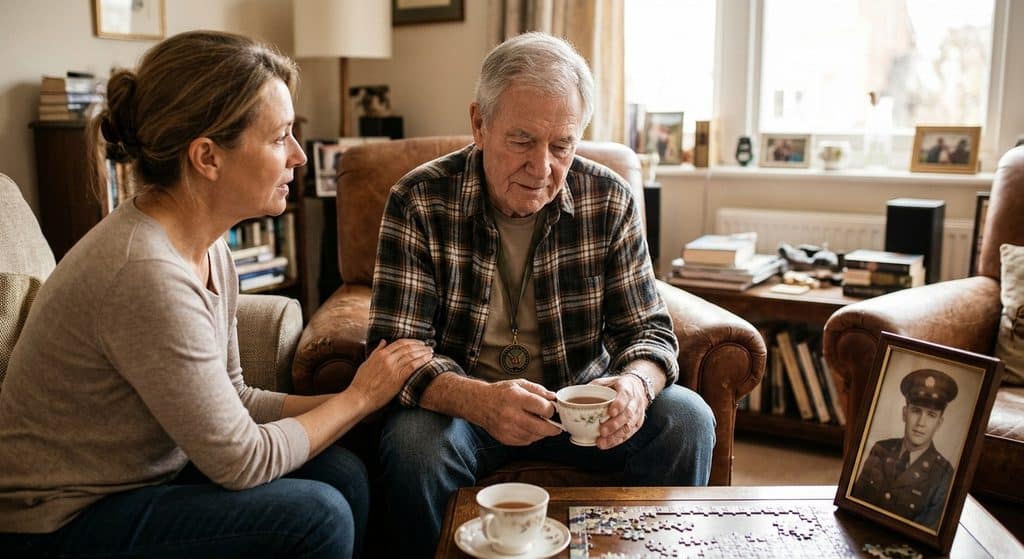
When An Offer Sounds Like A Verdict
This is one of the hardest parts of caring for an aging parent.
We notice something that could be easier.
We offer a solution.
And somehow the conversation turns into an argument.
The adult child thinks, “Why won’t he let me help?”
Dad thinks, “Why does everyone suddenly think I can’t take care of myself?”
Both may be acting out of love and concern. They’re simply having two different conversations.
The daughter is talking about the laundry, the errands, and the work around the house.
Dad is talking about his identity.
For someone who has always taken pride in being the person others depend on, accepting assistance can feel personal.
That doesn’t mean families should ignore genuine concerns. It means the way we begin the conversation matters.
Start With What Matters To Him
Before talking about services, schedules, or caregivers, try asking a different kind of question.
“Dad, what do you most want to keep doing on your own?”
“What’s gotten more frustrating lately?”
“Is there anything you’d gladly hand off if it meant you had more time for the things you enjoy?”
Those questions don’t assume he needs rescuing.
They ask him to help shape the plan.
Maybe he doesn’t care much about mowing the lawn anymore, but he absolutely wants to keep working in his garden.
Maybe he’d welcome help with laundry but doesn’t want anyone touching his workshop.
Maybe he would appreciate a ride to meet friends, but doesn’t want someone organizing his entire week.
Those details matter.
When we make assumptions, we risk solving the wrong problem.
When Help Feels Like Losing Control
Imagine someone showing up at your house and deciding how things should be done.
They reorganize the kitchen because it makes more sense to them.
They move things to places you can’t find.
They start doing tasks you’ve always done yourself.
And every time you try to participate, they tell you to sit down and relax.
Even when the intentions are good, that may not feel like help.
It may feel like your home and your routine no longer belong to you.
Older adults deserve the same respect we would want for ourselves.
Ask before changing things.
Explain options instead of announcing decisions.
Offer a trial arrangement rather than treating every choice as permanent.
And remember that doing something slowly isn’t necessarily the same as being unable to do it.
Support That Makes Room For Independence
Sometimes the best support doesn’t replace what Dad loves doing.
It makes room for more of it.
Maybe someone helps with light housekeeping so Dad has the energy to work on a project in the garage.
Maybe a caregiver drives him to a veterans’ gathering, church event, or lunch with friends.
Maybe someone helps prepare meals so he can spend less time managing groceries and more time enjoying his day.
Or maybe he just appreciates having someone around who understands what it’s like to have lived a long, full life.
At Seniors Helping Seniors® Nashville, our caregivers are seniors themselves.
That shared stage of life can help conversations feel more natural. Our caregivers understand the importance of routines, relationships, and being treated with respect.
But no caregiver should arrive with a plan to take over someone’s life.
The starting point should always be the person receiving care.
What About Veterans’ Benefits
Families sometimes ask whether a veteran may qualify for help through the Department of Veterans Affairs.
That’s a reasonable question, but the answer depends on the individual, the specific program, eligibility rules, and the services involved.
It’s important not to assume that military service automatically means a particular home care service will be covered.
A VA benefits counselor, accredited veterans service organization representative, or the VA itself can help families explore applicable programs and requirements.
Our conversation here is about how to approach support respectfully, whether a family is exploring private-pay care or another appropriate option.
One Small Yes Is Enough To Start
A daughter doesn’t have to convince Dad to accept every kind of help in one conversation.
Maybe they start with one task he already finds annoying.
Maybe he agrees to have someone drive him to a weekly activity.
Maybe he wants to meet a potential caregiver before deciding whether the arrangement feels comfortable.
Or maybe he says no for now, and they revisit the conversation later.
Unless there’s an immediate safety concern or a legal decision-making issue, families can often leave room for a parent to think about the options.
A small choice that Dad makes for himself may work better than a perfect plan someone else makes for him.
Honoring Service Means Listening, Too
Veterans Day gives us an opportunity to thank the people in our communities who served.
We should do that.
But I also think honoring someone means being interested in the person they are today, not only the person they were years ago.
Ask about what matters to them.
Ask what kind of day they enjoy.
Ask what they want to keep doing.
And when they tell us, listen.
Dad may still say, “I’ve got it.”
Maybe the next question isn’t, “Are you sure?”
Maybe it’s, “Okay. Is there one thing I could make easier without getting in your way?”
That’s a conversation built on respect.
Help That Respects The Life Dad Has Built
If you’re helping an aging parent who values doing things his own way, you don’t have to choose between respecting his independence and offering support.
At Seniors Helping Seniors® Nashville, we provide non-medical companionship, transportation, errands, meal preparation, light housekeeping, personal care, and respite.
Our caregivers are seniors themselves, and our approach begins with listening.
We’d be glad to talk about what Dad wants to keep doing himself and where a little help might make the day easier.
Because respecting someone’s independence doesn’t mean leaving them to do everything alone.