




Mom sounded fine on the phone.
That was almost the problem. She said she’d eaten dinner. That her doctor’s appointment went well. She said the neighbor had stopped by.
Then they hung up. And her daughter sat in her kitchen 500 miles away wondering:
Was any of that actually true?
Should she call the neighbor? Her brother? Mom’s doctor? Should she buy a plane ticket? Or was she overreacting again?
This is one of the hardest parts of caring for a parent from far away.
You don’t get to see what you’re worrying about.
Distance Doesn’t Make You Less of a Caregiver
When we picture family caregivers, we usually picture the person who is physically there.
The daughter taking Dad to his appointment.
The son carrying groceries into Mom’s house.
The spouse helping with dinner.
But there’s another kind of caregiver I’ve talked with many times.
They’re caring from Atlanta.
Chicago.
Dallas.
New York.
Sometimes from the other side of the country.
They’re coordinating appointments from an airport.
Ordering groceries from their phone.
Talking to doctors during lunch.
Checking the weather in Hermitage because Mom mentioned the power flickered.
They’re doing a tremendous amount.
And somehow still feeling like they aren’t doing enough.
If that’s you, I want you to hear this:
Distance doesn’t make you less of a caregiver. It just changes the way you care.
The Phone Can Tell You a Lot. It Can’t Tell You Everything.
Adult children often become remarkably good at listening.
You notice when Mom sounds tired.
Or even when Dad tells the same story twice.
You hear the hesitation before an answer.
“Did you eat today?”
“Of course.”
“What did you have?”
Pause.
“Oh…something.”
Then you’re left wondering what that pause meant.
Maybe nothing.
That’s the exhausting part.
When you live nearby, you can open the refrigerator.
From 500 miles away, you have to imagine what’s inside it.

Every Small Change Feels Like a Decision
Mom mentions she tripped over the rug.
Do you fly home?
Dad says he didn’t go to church because he was tired.
Is that normal?
The neighbor says Mom hasn’t picked up her newspaper.
Do you panic?
Long-distance caregiving can feel like constantly deciding whether something is a problem without having enough information to make the decision.
And that’s where guilt creeps in.
If you don’t react, you worry you’re ignoring something.
If you do react, you worry you’re overreacting.
There’s rarely a moment when you feel completely certain you got it right.
Guilt Loves Geography
I’ve heard long-distance caregivers say things like:
“My sister is doing everything.”
“I should be there.”
“I always feel terrible every time Dad has an appointment.”
“Mom says she’s okay, but what if she’s just saying that because she doesn’t want me to worry?”
Distance can make every limitation feel like a personal failure.
But living closer doesn’t automatically make someone a better son or daughter.
And living farther away doesn’t mean you’ve abandoned anyone.
Sometimes geography is simply geography.
The question isn’t whether you can magically eliminate the distance.
It’s how you build a plan that works despite it.
You Need People Who Can See What You Can’t
Long-distance caregiving gets easier when you stop trying to solve everything from far away and begin building a trusted local circle.
Think about who is physically near your parent.
A sibling. Neighbor. Church friend. Physician. Pharmacist. Financial advisor.
Professional caregiver.
Maybe someone from Mom’s Sunday school class knows she hasn’t been there for three weeks.
Maybe a neighbor notices Dad hasn’t taken the trash cans back in.
Those relationships matter because they provide something you can’t get through FaceTime.

Context.
The goal isn’t to recruit people to spy on your parent.
It’s to make sure there are trusted people in their everyday life who genuinely know them.
Create a “Who Would Know?” List
Here’s a practical exercise I recommend.
Think through several situations and ask:
Who would know?
If Mom didn’t eat today, who might notice?
Or when Dad stopped attending church, who would know?
If there were unopened groceries on the porch, who might see them?
When Mom missed an appointment, who would get the call?
If Dad seemed confused, who spends enough time with him to recognize that it was unusual?
If every answer is:
“Me, eventually,”
you may need a stronger local support network.
Visits Shouldn’t Become Inspections
This is another challenge long-distance families experience.
You finally get to Hermitage for the weekend.
You want to enjoy your parent.
Instead, you immediately start inspecting.
What’s in the refrigerator?
Are the bills paid?
Why is that bruise there?
When did you last shower?
What’s this medication?
When did the lawn get this bad?
Suddenly the entire visit becomes an assessment.
You arrived as a daughter.
By Saturday morning, you’re the care manager.
And both of you feel it.
That’s one reason local support can be so valuable.
When someone trustworthy is regularly present, your visits don’t have to carry the entire burden of figuring out how Mom is doing.
You get a little more room to simply be together.
Technology Helps. Relationships Help More.
There are wonderful tools for long-distance families.
Shared calendars.
Medication reminders.
Video calls.
Grocery delivery.
Doorbell cameras.
Online patient portals.
Those tools can solve real problems.
But technology can’t notice everything.
It can’t always tell you that Dad seems quieter than usual.
Or that Mom hasn’t talked about her friend from church lately.
Or that the house feels different.
Sometimes the most valuable information comes from another human being who knows what “normal” looks like.
Decide What Actually Requires You
Just like caregivers who live nearby, long-distance caregivers can fall into the trap of believing they personally need to coordinate everything.
Ask yourself:
What actually requires me?
Maybe the conversation with Mom’s cardiologist does.
More importantly, financial decisions do.
Maybe the big family conversation absolutely needs you.
But does scheduling the haircut require you?
Does ordering groceries?
Does every check-in?
Building support isn’t giving away your responsibility.
It’s deciding where your presence matters most.
What Local Companionship Can Look Like
Families sometimes hear “caregiver” and picture someone taking over.
That’s not always what support needs to look like.
It might be someone who visits Dad on Tuesday afternoon.
They grab lunch.
Run an errand.
Go to the grocery store.
Talk about the Titans.
Maybe they go to church together on Sunday.
For the adult child living several states away, those visits can provide something important too:
Peace of mind that another trusted person is regularly spending meaningful time with someone you love.
At Seniors Helping Seniors® Nashville, our model is built around matching older adults with caregivers who are seniors themselves.
That peer relationship matters.
The goal isn’t to make Mom feel monitored.
It’s to help her stay connected and supported.
Have a Plan Before the 10 P.M. Phone Call
Long-distance caregiving becomes much harder when every decision is made during a crisis.
Before you need it, know:
Who has a key?
Who’s the emergency contact?
Who can get to Mom quickly?
Which hospital would she likely use?
Where is the medication list?
Who has the necessary legal documents?
Which of us can provide transportation?
Who checks in regularly?
Which neighbor should you call?
Who can help if you can’t immediately get on a plane?
You don’t need to predict every emergency.
You simply want enough of a plan that the first step isn’t panic.
Let Yourself Be Their Child Again
This may be the part that matters most.
Caregiving can slowly change the relationship between adult children and their parents.
Every phone call becomes:
“Did you take your medicine?”
“Have you eaten?”
“Did you call the doctor?”
“Did you pay that bill?”
Those questions may be necessary.
But they shouldn’t be the only things you talk about.
Ask about the neighbor.
The Titans.
The grandkids.
The terrible restaurant Dad tried.
The church gossip Mom definitely wasn’t supposed to tell you.
Laugh.
Tell stories.
Be their child.
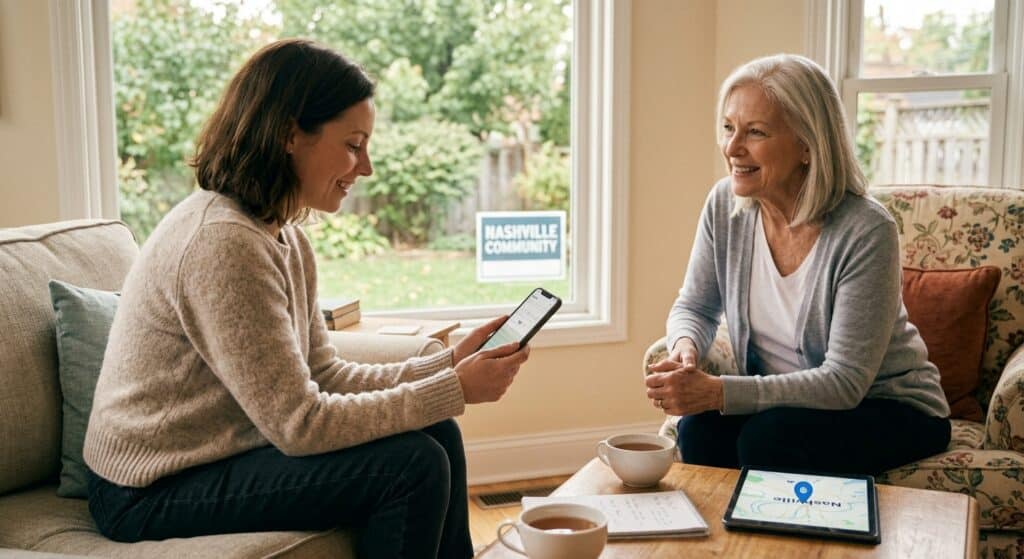
A good support system doesn’t replace you.
It gives you more room to have the relationship that nobody else can replace.
Loving Someone Doesn’t Require Living Nearby
There will probably always be moments when distance hurts.
A doctor’s appointment you wish you could attend.
A birthday dinner you miss.
A phone call that makes you wonder whether you should book a flight.
That’s part of loving someone from far away.
But guilt isn’t a care plan.
Relationships are.
Communication is.
Preparation is.
Community is.
Support is.
You don’t have to be standing in Mom’s kitchen every Tuesday to be deeply involved in her life.
You simply need enough trusted people around her that neither of you feels like everything depends on the next phone call.
Distance doesn’t make you less of a caregiver.
It just changes the way you care.
How We Can Make the Distance Seem Smaller
If your parent lives in Hermitage or the surrounding communities while you live somewhere else, we’d be happy to talk about what a local layer of support could look like.
That might mean companionship, transportation, errands, outings, or simply having another trusted person regularly spending time with Mom or Dad.
The goal isn’t to replace your role.
It’s to help you keep being their son or daughter, wherever you happen to live.