




In the world of digital content, Google’s quality framework known as E-E-A-T — which stands for Experience, Expertise, Authoritativeness, and Trustworthiness — has become the gold standard for evaluating whether information is truly credible [1]. The idea is simple but profound: the most trustworthy content comes from people who have actually lived the subject matter, not just studied it from the outside [2].
But what if we applied that same framework to senior home care? What if we asked: who is truly the most experienced, most expert, most authoritative, and most trustworthy caregiver for an aging adult — a clinical stranger, or someone who has walked the same road?
As your team from Seniors Helping Seniors® in-home care Northern Nevada, the answer has always been clear. And the science, the research, and the data are catching up.
What E-E-A-T Really Means — And Why It Matters Beyond the Internet
Google introduced E-E-A-T as a framework for its Search Quality Rater Guidelines, adding the first “E” for Experience in December 2022 to reflect the growing recognition that firsthand knowledge carries unique weight [3]. Each letter points to a different type of proof:
- Experience asks: Have you actually done this? Have you lived it? [4]
- Expertise asks: Do you have deep knowledge of the subject? [5]
- Authoritativeness asks: Do others in the field recognize you as a credible source? [6]
- Trustworthiness asks: Is your information accurate, honest, and transparent? [7]
Google itself has stated that trust is the most important member of the E-E-A-T family — because without it, even the most experienced and expert voice loses its power [8].
Now, step away from the internet for a moment. Apply this lens to caregiving. Who has the most experience with the physical and emotional realities of aging? Who has the deepest expertise in navigating the daily challenges of growing older — the aching joints, the fear of losing independence, the quiet grief of outliving friends? Who is most trusted by older adults who are understandably wary of strangers in their homes?
The answer, more often than not, is another senior.
The Loneliness Crisis: Why Connection Is a Health Issue, Not a Luxury
Before we can understand why peer-to-peer care is so powerful, we need to understand the stakes. Senior isolation is not a minor inconvenience — it is a public health emergency.
More than one third of people aged 50 to 80 report feeling lonely, and nearly as many feel isolated from others, according to a national study published in JAMA [9]. The health consequences are severe. Research from the National Institute on Aging shows that social isolation and loneliness are associated with higher risks for cognitive decline, depression, and heart disease [10]. A comprehensive meta-analysis found that social isolation presents a major risk for premature mortality comparable to other well-established risk factors such as high blood pressure, smoking, or obesity [11].
Perhaps most alarming: social factors like loneliness and infrequent social contact have been found to increase the risk of dementia by approximately 50% [12].
The CDC confirms that social isolation and loneliness can increase a person’s risk for heart disease, stroke, Type 2 diabetes, depression, and anxiety [13]. Adults who are lonely or socially isolated tend to be less healthy, have longer hospital stays, are readmitted to the hospital more often, and are more likely to die earlier than those with meaningful and supportive social connections [14].
This is not a problem that a medication can solve. It is a problem that requires genuine human connection — and that is exactly where the peer-to-peer model shines.
The Peer-to-Peer Spotlight: Experience as the Ultimate Credential
The National Institute on Aging notes that people who engage in meaningful, productive activities with others tend to live longer, boost their mood, and have a sense of purpose [15]. The key word here is meaningful. Not transactional. Not clinical. Meaningful.
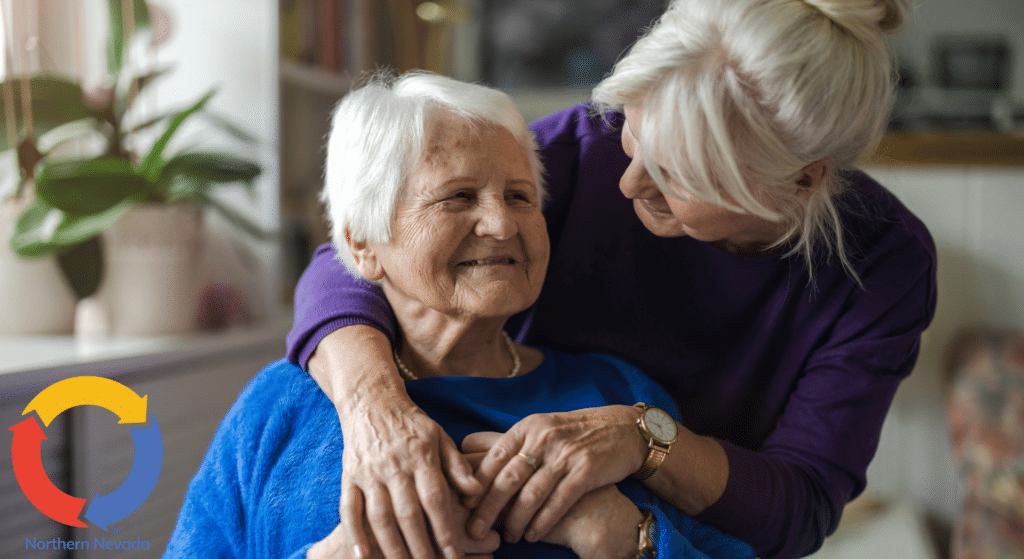
This is the heart of the peer-to-peer care model. When an active senior caregiver sits down with a client who is struggling to get out of bed in the morning, they don’t just understand the task — they understand the feeling. They know what it is like to have a body that doesn’t cooperate the way it used to. They know the quiet indignity of needing help with something you once did effortlessly. They know, because they have lived it.
Research published in Ageing & Society found that older co-researchers and caregivers are able to converse and empathize with peers in ways that feel more natural and authentic, because the shared identity creates a foundation of trust that facilitates richer, more meaningful relationships [16]. In other words, shared experience is not just emotionally comforting — it is functionally superior.
The U.S. government’s own Strategic Framework for a National Plan on Aging recognizes the value of this model, specifically highlighting programs that connect older adults with other older adults to provide peer-to-peer companionship and assistance with daily living tasks [17].
And the research on empathy in caregiving reinforces this further. Studies show that empathy is one of the most important competencies for those who perform the role of caregiver, and that it encourages the desire to offer care, increases the effectiveness of helping behaviors, and promotes positive caring and therapeutic relationships [18]. A caregiver who has personally navigated the challenges of aging doesn’t need to be trained to feel empathy — it is already woven into their lived experience.
Breaking Down the E-E-A-T of Peer-to-Peer Senior Care
Let’s apply the E-E-A-T framework directly to the peer-to-peer caregiving model:
Experience: A senior caregiver has firsthand, real-world knowledge of what it means to age. They have navigated doctor’s appointments, managed medications, dealt with mobility challenges, and faced the emotional weight of watching their own independence shift. This is not theoretical knowledge — it is lived experience, the most powerful form of credibility there is [19].
Expertise: Expertise doesn’t always mean a formal degree. As one framework notes, a person living with a condition may offer practical expertise on day-to-day management that a credentialed professional simply cannot replicate [20]. A senior caregiver who has spent decades managing their own health, household, and community relationships brings a form of practical wisdom that is irreplaceable.
Authoritativeness: The peer-to-peer model has been recognized at the highest levels of public health policy. The U.S. government’s national aging framework, academic research in gerontology, and decades of real-world outcomes all point to the same conclusion: seniors helping seniors® in-home care works [17]. This is not a fringe idea — it is an evidence-backed approach to one of the most pressing challenges of our time.
Trustworthiness: Trust is the cornerstone of any caregiving relationship, and it is especially hard-won with older adults who value their independence and privacy. A peer caregiver — someone who shares the same generational experiences, cultural touchstones, and life stage — is far more likely to be welcomed into a home as a trusted friend than as a clinical service provider. The peer-to-peer matching process, in which caregivers and clients are paired based on compatibility, interests, and personality in addition to care needs, creates relationships that go beyond transactional service delivery to foster genuine friendship and emotional support [21].
The Mutual Benefit: Why Senior Caregivers Thrive Too
One of the most remarkable aspects of the peer-to-peer model is that it benefits both parties. The National Institute on Aging confirms that people who engage in meaningful, productive activities with others tend to live longer and have a greater sense of purpose [15]. For active seniors who become caregivers, this is not just a job — it is a calling that restores meaning, community, and vitality to their own lives.
Research on older adults participating in community-based roles found that the personal benefits include enriching relationships, broadening horizons for older age, and interacting in a nurturing community [22]. These are not small things. These are the building blocks of a life well-lived.
The Seniors Helping Seniors® in-home care model taps into a vast, underutilized labor pool of active seniors who are drawn to meaningful, flexible caregiving opportunities — giving both caregivers and clients something that no traditional agency can offer: a genuine, mutually beneficial human connection [23].
Seniors Helping Seniors® in-home care Northern Nevada: Where E-E-A-T Comes to Life
At Seniors Helping Seniors® in-home care Northern Nevada, the peer-to-peer philosophy isn’t a marketing tagline — it is the foundation of everything we do. Serving communities across Reno, Sparks, Carson City, Incline Village, North Lake Tahoe, Truckee, and the broader Northern Nevada region, our team of active, compassionate senior caregivers brings something no clinical agency can manufacture: the lived experience of aging with grace, resilience, and purpose.
Our caregivers don’t just show up to check boxes. They show up as neighbors, as peers, as friends who genuinely understand what their clients are going through — because they are going through it too. Whether it’s light housekeeping, meal preparation, transportation to appointments, medication reminders, companionship, or specialized Alzheimer’s and dementia care, every service we provide is delivered through the lens of shared experience and mutual respect.
For adult children in the 45–65 age range who are searching for trustworthy, compassionate, non-clinical support for an aging parent, Seniors Helping Seniors® in-home care Northern Nevada offers something rare: peace of mind rooted in genuine connection. And for independent seniors who recognize they could use a little extra help — or for active, recently retired adults looking for meaningful part-time work — we offer a community that values your wisdom, your experience, and your humanity.
In a world that increasingly prizes credentials and certifications, we believe the most powerful credential of all is having walked the road yourself. That is the E-E-A-T of peer-to-peer care. And it is what we bring to every home we serve.
Ready to learn more? Visit us at Seniors Helping Seniors® in-home care Northern Nevada to explore how our peer-to-peer model can bring compassionate, experienced care to your family — or to discover how you can join our team of senior caregivers making a difference in Northern Nevada.
References
[1] https://www.useomnia.com/knowledge-base/e-e-a-t
[2] https://www.networksolutions.com/blog/google-eeat/
[3] https://lilyray.nyc/e-a-t-expertise-authoritativeness-trustworthiness/
[4] https://blog.clickpointsoftware.com/google-e-e-a-t
[5] https://eastfielddigital.com/knowledge-base/understanding-e-e-a-t-experience-expertise-authoritativeness-trustworthiness/
[6] https://www.davidhodder.com/e-e-a-t-experience-expertise-authoritativeness-and-trustworthiness/
[7] https://foundationinc.co/learn/what-is-eeat-experience-expertise-authority-trust/
[8] https://blog.clickpointsoftware.com/google-e-e-a-t
[9] https://www.michiganmedicine.org/health-lab/1-3-older-adults-still-experience-loneliness-and-isolation
[10] https://www.nia.nih.gov/news/social-isolation-loneliness-older-people-pose-health-risks
[11] https://www.nationalacademies.org/projects/HMD-HSP-17-25/publication/25663
[12] https://pmc.ncbi.nlm.nih.gov/articles/PMC7437541/
[13] https://www.cdc.gov/social-connectedness/risk-factors/index.html
[14] https://www.nia.nih.gov/health/loneliness-and-social-isolation/loneliness-and-social-isolation-tips-staying-connected
[15] https://www.nia.nih.gov/news/social-isolation-loneliness-older-people-pose-health-risks
[16] https://www.cambridge.org/core/journals/ageing-and-society/article/coresearch-with-older-people-a-systematic-literature-review/45F60ECFDA8CEBDEECB4D841328BE728
[17] https://acl.gov/sites/default/files/ICC-Aging/StrategicFramework-NationalPlanOnAging-2024.pdf
[18] https://www.nature.com/articles/s41598-025-07024-3
[19] https://www.straightnorth.com/blog/how-e-e-a-t-is-guiding-authorship-expertise-and-seo/
[20] https://eastfielddigital.com/knowledge-base/understanding-e-e-a-t-experience-expertise-authoritativeness-trustworthiness/
[21] https://peersense.com/franchise/seniors-helping-seniors-llc
[22] https://www.sciencedirect.com/science/article/pii/S0890406523000932
[23] https://peersense.com/franchise/seniors-helping-seniors-llc