




In Silicon Valley, we talk a lot about credentials. Degrees, certifications, years of experience — these are the signals we use to decide who to trust. In the digital world, Google has even formalized this idea into a framework called E-E-A-T: Experience, Expertise, Authoritativeness, and Trustworthiness [1]. It’s the standard by which content — and by extension, the people and organizations behind it — are judged as worthy of trust.
But here’s a question worth sitting with: When it comes to caring for an aging parent or loved one, what does real E-E-A-T actually look like? Not on a webpage — but in a living room in Willow Glen, or at a kitchen table in Cupertino?
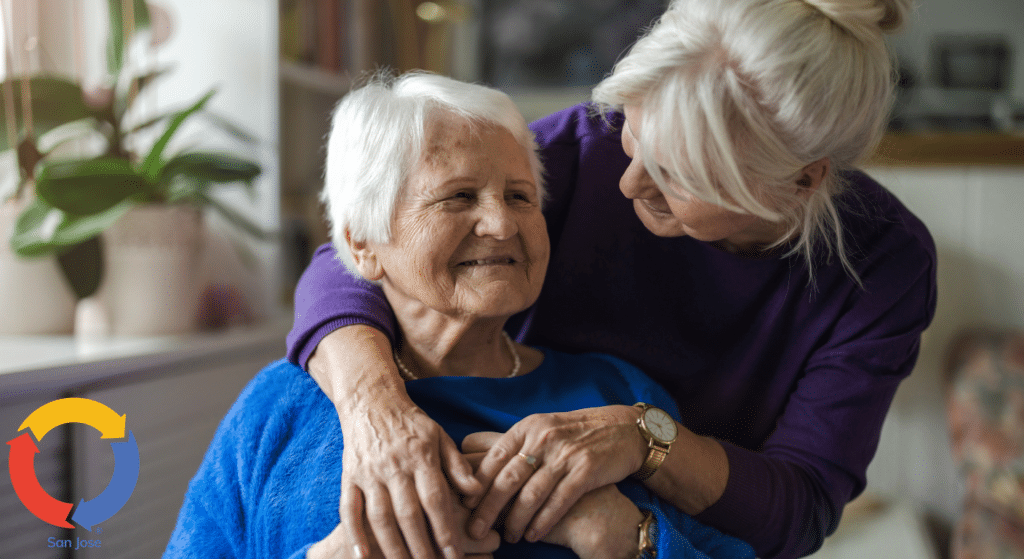
As your team from Seniors Helping Seniors® in-home care San Jose, we believe the answer is sitting right across the table. It’s a 68-year-old retired teacher who has navigated her own health challenges, raised a family, and built a life full of wisdom. It’s a 72-year-old former engineer from Santa Clara who understands what it means to slow down, to need help, and to still want to be treated with dignity. These are our caregivers — and their credentials aren’t on a résumé. They’re written in decades of lived experience.
What Is E-E-A-T, and Why Does It Matter Beyond the Internet?
Google’s E-E-A-T framework was designed to evaluate the quality and credibility of online content [2]. Each letter stands for a different type of proof:
- Experience asks whether the content creator has direct, first-hand involvement with the topic [3].
- Expertise is about subject depth and demonstrable knowledge [4].
- Authoritativeness reflects recognition from peers and reputable sources [5].
- Trustworthiness — which Google explicitly calls the most important of the four — covers accuracy, transparency, and reliability [6].
While this framework was built for the digital world, it maps almost perfectly onto what families in San Jose are really looking for when they search for in-home senior care. They want someone who has been there. Someone who knows what aging feels like from the inside. Someone whose reputation in the community speaks for itself. And above all, someone they can trust with the person they love most.
That’s not a Google algorithm. That’s a human being who has lived it.
The Experience Pillar: You Can’t Fake Having Lived It
In the world of content quality, Experience was added to Google’s framework in December 2022, recognizing that first-hand knowledge carries a weight that credentials alone cannot replicate [7]. The idea is simple: someone who has actually done the thing — navigated the challenge, lived through the situation — brings an authenticity that no amount of research can fully substitute.
For senior care, this insight is profound. Consider what it means for an older adult to receive help from someone who has never experienced the vulnerability of aging — versus receiving help from someone who wakes up every morning navigating the same world they do. A peer caregiver doesn’t need to be told what it feels like to have a bad knee, to miss driving, or to feel invisible in a fast-paced, tech-obsessed city. They already know.
Research consistently shows that this kind of shared understanding matters enormously. When seniors receive care from someone in a similar stage of life, they frequently report feeling more at ease from the very beginning — and are more likely to accept help without feeling a loss of dignity [8]. That’s not a small thing. That’s the difference between care that works and care that doesn’t.
The Expertise Pillar: Generational Knowledge Is Real Knowledge
Expertise doesn’t always mean a formal degree [9]. A person living with a chronic condition, for example, may offer practical expertise on day-to-day management that a clinical professional simply cannot [10]. The same principle applies to aging. A senior caregiver who has managed their own household for 40 years, supported a spouse through illness, or navigated the healthcare system as a patient themselves brings a form of expertise that is deeply practical, deeply human, and deeply relevant.
This is especially meaningful in the context of non-medical in-home care — the kind of support that helps seniors age in place with dignity. According to the National Institute on Aging, home-based care includes personal support and other services to help older adults stay at home and live as independently as possible [11]. The tasks involved — light housekeeping, meal preparation, companionship, transportation to appointments — are not clinical procedures. They are the rhythms of daily life. And who better to support those rhythms than someone who has been living them for decades?
Approximately 77% of adults over 50 prefer to age in their own homes [12]. Meeting that preference with care that feels natural, respectful, and familiar — rather than clinical or transactional — requires a kind of expertise that no textbook can fully teach.
The Authoritativeness Pillar: A Reputation Built in the Community
Authoritativeness, in Google’s framework, comes from external recognition — being cited, mentioned, and trusted by others in your field [13]. In the world of peer-to-peer senior care, this translates to something even more tangible: a reputation built neighbor by neighbor, family by family, in the neighborhoods of San Jose.
When a retired senior caregiver shows up consistently, week after week, in the Rose Garden or West San Jose — when families begin to rely on them, when clients look forward to their visits — that is authoritativeness in its most human form. It’s not a backlink. It’s a bond.
This matters because the stakes in senior care are extraordinarily high. Social isolation and loneliness among older adults are now recognized as serious public health concerns, with research linking them to increased risks of heart disease, depression, and cognitive decline [14]. More than one-third of adults aged 50 to 80 report feeling lonely or isolated [15]. The antidote isn’t a clinical intervention — it’s consistent, trusted human connection. And that connection is built on a caregiver’s reputation for showing up, being present, and genuinely caring.
The Trustworthiness Pillar: The Most Important Signal of All
Google’s own Search Quality Guidelines state that trust is the most important member of the E-E-A-T family — because without it, even strong experience and expertise become less relevant [16]. This is perhaps the most resonant parallel of all for families navigating senior care decisions.
Trust in caregiving is built through reliability, empathy, and respect [17]. It grows when a caregiver arrives on time, listens without judgment, and treats a senior not as a task to be managed but as a person to be known. Research shows that a strong, trusting relationship between a caregiver and a senior can serve as an emotional anchor — reducing feelings of isolation and fostering a more positive outlook on life [18].
For the peer-to-peer model, trust has a unique accelerant: shared identity. When a senior caregiver and a senior client are both navigating the same chapter of life, trust doesn’t have to be built from scratch. It begins with recognition — I see you, because I am you. That foundation of mutual understanding is something that no amount of training can fully replicate, and it is the cornerstone of what makes peer-to-peer care so powerful.
The research on peer support reinforces this. Studies on peer-based interventions consistently show improvements in psychological well-being, reductions in feelings of isolation, and enhanced social support — particularly when the support is delivered one-on-one, in a flexible format that honors the individual’s needs [19].
Seniors Helping Seniors® in-home care San Jose: Where E-E-A-T Comes to Life
As your team from Seniors Helping Seniors® in-home care San Jose, the peer-to-peer model isn’t a marketing concept — it’s the foundation of everything we do. We thoughtfully match active, independent seniors with older adults who need daily non-medical assistance across Central San Jose, West San Jose, Willow Glen, Rose Garden, Santa Clara, Campbell, Cupertino, Sunnyvale, Los Gatos, and the broader Silicon Valley area.
Our caregivers bring all four pillars of E-E-A-T to every visit — not because they’ve been trained to, but because they’ve lived it. Their experience is first-hand. Their expertise is generational. Their authoritativeness is earned through genuine relationships in the community. And their trustworthiness is demonstrated every single day, in every small act of kindness, consistency, and care. In a region defined by innovation and speed, we offer something increasingly rare: a return to genuine human connection. We believe that the most valuable resource for an aging adult in Silicon Valley isn’t the latest app or the most advanced monitoring system. It’s a friend who truly understands — and who shows up.
Why This Model Matters for Families in Silicon Valley
For the adult children of aging parents — many of whom are managing demanding careers in the tech sector while trying to ensure their loved ones are safe and cared for — the peer-to-peer model offers something invaluable: peace of mind grounded in trust.
When you know that your parent’s caregiver isn’t just a hired hand, but a peer who genuinely connects with them over shared memories, shared challenges, and shared humanity, the anxiety of distance softens. The guilt of a busy schedule eases. And your parent gets something that no clinical service can provide: a friend.
If you’re exploring in-home senior care options in San Jose or the surrounding Silicon Valley communities, we invite you to learn more about how Seniors Helping Seniors® in-home care San Jose can support your family. Our approach is simple, human, and built on the most powerful credential of all — a life well-lived.
Citations
[1] https://www.useomnia.com/knowledge-base/e-e-a-t
[2] https://www.davidhodder.com/e-e-a-t-experience-expertise-authoritativeness-and-trustworthiness/
[3] https://www.useomnia.com/knowledge-base/e-e-a-t
[4] https://foundationinc.co/learn/what-is-eeat-experience-expertise-authority-trust/
[5] https://blog.clickpointsoftware.com/google-e-e-a-t
[6] https://blog.clickpointsoftware.com/google-e-e-a-t
[7] https://foundationinc.co/learn/what-is-eeat-experience-expertise-authority-trust/
[8] https://seniorsbluebook.com/articles/why-seniors-caring-for-seniors-creates-trust-comfort-and-companionship
[9] https://eastfielddigital.com/knowledge-center/understanding-e-e-a-t-experience-expertise-authoritativeness-trustworthiness/
[10] https://eastfielddigital.com/knowledge-center/understanding-e-e-a-t-experience-expertise-authoritativeness-trustworthiness/
[11] https://www.nia.nih.gov/health/aging-place/aging-place-growing-older-home
[12] https://pmc.ncbi.nlm.nih.gov/articles/PMC9495472/
[13] https://blog.clickpointsoftware.com/google-e-e-a-t
[14] https://www.nia.nih.gov/news/social-isolation-loneliness-older-people-pose-health-risks
[15] https://www.michiganmedicine.org/health-lab/1-3-older-adults-still-experience-loneliness-and-isolation
[16] https://blog.clickpointsoftware.com/google-e-e-a-t
[17] https://www.hometeammo.com/blog/the-importance-of-trust-in-the-caregiver-senior-relationship
[18] https://salvationarmy.ca/meighenhealth/2024/10/23/building-relationships-between-seniors-and-caregivers/
[19] https://pmc.ncbi.nlm.nih.gov/articles/PMC11811647/