




When Google’s Standards and Human Connection Align
In the world of digital marketing and search engine optimization, few frameworks have reshaped how businesses communicate their value quite like Google’s E-E-A-T — Experience, Expertise, Authoritativeness, and Trustworthiness. Originally introduced as E-A-T, Google added the second “E” for Experience in December 2022, signaling a major shift in how content quality is evaluated. [1] But here’s what’s fascinating for those of us in the senior care space: the peer-to-peer caregiving model doesn’t just meet Google’s E-E-A-T standards — it was built on them long before the acronym existed.
This post is a professional spotlight on why the peer-to-peer approach to in-home senior care is not only the most human-centered model available, but also the most credible — both in the eyes of families searching for care and in the eyes of Google’s search quality raters.
What Is E-E-A-T, and Why Does It Matter for Senior Care?
E-E-A-T stands for Experience, Expertise, Authoritativeness, and Trustworthiness — a set of signals Google uses to evaluate the overall quality and credibility of web content. [2] While it is not a direct ranking factor, content that demonstrates strong E-E-A-T characteristics consistently performs better in search results. [3]
For senior care providers, E-E-A-T carries even greater weight. Senior care falls squarely into what Google calls “Your Money or Your Life” (YMYL) topics — content that can significantly impact a person’s health, financial stability, safety, or well-being. [4] Google applies its most stringent quality standards to YMYL content, meaning that senior care websites and blogs must demonstrate genuine, verifiable credibility to earn visibility and trust. [5]
According to Google’s Search Quality Rater Guidelines, trust is explicitly identified as “the most important member of the E-E-A-T family” — because untrustworthy pages score low on E-E-A-T regardless of how experienced, expert, or authoritative they may appear. [6] In other words, for families searching for care for a loved one in Redondo Beach or Torrance, the most important thing a care provider can demonstrate — online and in person — is trustworthiness.
So how does a senior care organization build genuine E-E-A-T? The answer, we believe, lies in the peer-to-peer model.
The Peer-to-Peer Model: E-E-A-T in Human Form
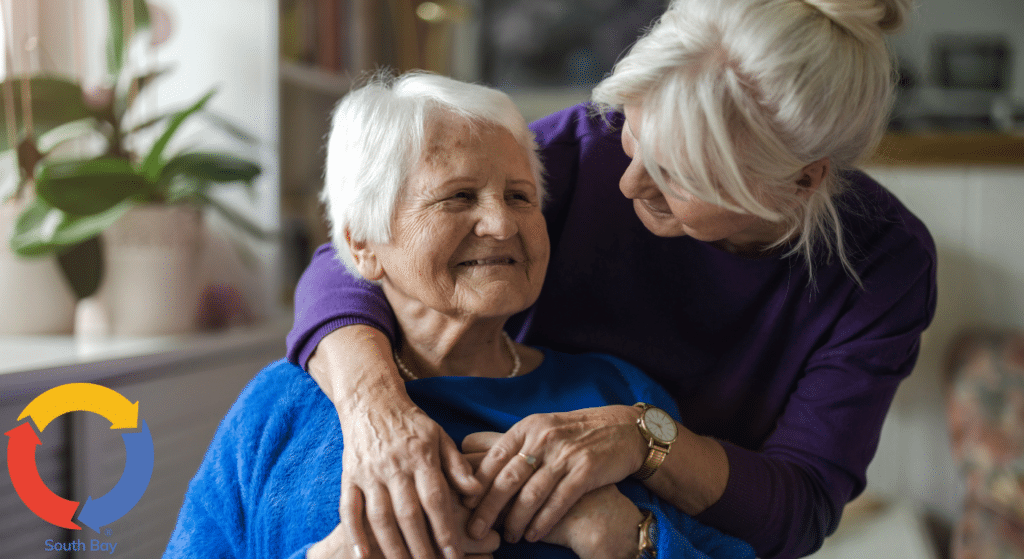
The peer-to-peer caregiving model is built on a simple but profound premise: the best care for a senior often comes from another senior — someone who has navigated the same life transitions, understands the importance of independence, and approaches care with the empathy that only lived experience can provide. [7]
This model doesn’t just describe E-E-A-T. It embodies it. Let’s break down each pillar.
Experience: Care That Comes From Having Lived It
Google’s addition of “Experience” to its quality framework was a recognition that first-hand, real-world knowledge is irreplaceable. [8] The question Google now asks is: does the content — or in this case, the care — come from someone who has actually lived through the subject matter?
For peer-to-peer caregivers, the answer is an unequivocal yes. These are individuals who have personally navigated the challenges of aging — managing health changes, maintaining routines, preserving independence, and facing the emotional weight of life transitions. Peer support in senior care is grounded in shared lived experiences, creating a foundation of trust and understanding that can significantly benefit seniors facing emotional and psychological challenges. [9]
This is not theoretical knowledge. It is the kind of experience that cannot be taught in a classroom — the kind that makes a caregiver say, “I understand what you’re going through, because I’ve been there too.”
Expertise: Knowledge Earned Through Personal Aging Journeys
Expertise, in the E-E-A-T framework, refers to demonstrable knowledge through credentials, education, or a proven track record in the subject matter. [10] For peer-to-peer caregivers, expertise is earned through decades of lived experience managing their own health, navigating the healthcare system, and supporting family members through aging.
Peer support specialists — individuals who have personal experience with similar issues — offer an empathetic and relatable presence that fosters hope and resilience. [11] Their expertise is not clinical in the traditional sense, but it is deeply practical. They know which questions to ask a doctor, how to adapt a home for safety, and how to encourage a reluctant senior to accept help — because they’ve faced these situations themselves.
This kind of expertise is especially valuable in a community like the South Bay, where active retirees and multigenerational households often prefer a caregiver who understands their lifestyle and values their independence.
Authoritativeness: Trust Built Within the Community
Authoritativeness, according to Google’s framework, comes from external recognition — other credible sources citing you, mentioning you, or recognizing you as a go-to resource. [12] In the senior care world, this translates to reputation within the community: referrals from healthcare professionals, positive reviews from families, and recognition from local organizations.
Peer-to-peer caregivers build authority organically. When a caregiver has lived in the same community for decades, attended the same churches, shopped at the same markets, and raised children in the same neighborhoods, their authority is not manufactured — it is earned. Research shows that peer support can significantly improve the health outcomes of older adults, [13] and this evidence base lends further credibility to the model.
Organizations like the National Council on Aging (NCOA) have recognized the value of peer networking in senior services, noting that connecting professionals and seniors who share similar experiences creates meaningful opportunities to learn, grow, and support one another. [14]
Trustworthiness: The Foundation of Everything
Trust is the cornerstone of E-E-A-T — and it is the cornerstone of great senior care. Research on home visit programs for older adults confirms that a trusting relationship is pivotal for seniors to accept care that is proactively offered to them, and that trust is built when caregivers meet the relational needs of older people. [15]
Trust in a care relationship is built on two conditions: a caregiver’s perceived competence and a caregiver’s perceived reliability — a willingness to always act in the care receiver’s best interest. [16] The peer-to-peer model addresses both. Caregivers who share the same life stage as their clients are naturally perceived as more relatable and reliable. They approach care with the respect and dignity they would want for themselves. [17]
For families in Redondo Beach, Manhattan Beach, Hermosa Beach, and Palos Verdes, this kind of trust is not a nice-to-have — it is the deciding factor when choosing who will care for a parent or loved one.
What the Research Says About Peer-to-Peer Care
The peer-to-peer model isn’t just philosophically compelling — it is backed by a growing body of research. Literature on peer-to-peer (P2P) programs suggests they improve health and well-being of older adults. [18] Studies have found that peer support programs have been associated with improvements in clinical and quality-of-life outcomes and reductions in hospitalizations. [19]
Research also highlights the emotional and psychological benefits. The emotional companionship derived from peer interactions notably enhances the psychological health of seniors, with peer-led activities shown to alleviate anxiety, sadness, and depression. [20] Peer relationships in late adulthood promote a sense of belonging and acceptance, which is essential for emotional well-being. [21]
For families navigating the complex decision of in-home care, these outcomes matter. They want to know that their loved one is not just receiving task-based assistance, but is genuinely thriving — emotionally, socially, and physically.
Seniors Helping Seniors® in-home care South Bay: The Peer-to-Peer Model in Action
As your team from Seniors Helping Seniors® in-home care South Bay, the peer-to-peer philosophy isn’t a marketing tagline — it is the foundation of every care relationship. Serving the coastal communities of Redondo Beach, Torrance, Manhattan Beach, Hermosa Beach, and Palos Verdes, the organization connects active, compassionate senior caregivers with seniors who need assistance — creating relationships built on genuine understanding, shared experience, and mutual respect.
The model is founded on the principle that life experience is invaluable, matching clients with caregivers who share similar backgrounds, interests, and life perspectives, fostering genuine companionship alongside professional care. [22] This isn’t just good caregiving — it is E-E-A-T in its most human form.
For families in the South Bay who are searching online for trusted, local in-home care, Seniors Helping Seniors® in-home care South Bay offers something that no national referral platform or impersonal agency can replicate: caregivers who are peers, not strangers. Caregivers who have navigated similar life challenges, understand the importance of maintaining routines and independence, and approach care with the respect and dignity they would want for themselves. [23]
This peer-to-peer model creates natural conversations, shared experiences, and often lifelong friendships that enrich both the caregiver’s and care receiver’s lives. [24] And in a world where Google’s algorithms are increasingly rewarding genuine human experience and trustworthiness, this model is not just the right thing to do — it is the smart thing to do.
Whether your loved one needs companionship, light housekeeping, meal preparation, medication reminders, or transportation to appointments, Seniors Helping Seniors® in-home care South Bay provides care that is deeply personal, locally rooted, and built on the kind of trust that only a true peer can offer.
Why This Matters for Families Searching for Care in the South Bay
When a family in Palos Verdes or Torrance types “trusted in-home senior care near me” into Google, they are not just looking for a list of services. They are looking for evidence of real experience, genuine expertise, community authority, and above all, trustworthiness. They want to know that the person who will be in their parent’s home is someone who truly understands what it means to age with dignity.
The peer-to-peer model answers every one of those questions — and Seniors Helping Seniors® in-home care South Bay is proud to be the local embodiment of that answer.
If you are exploring in-home care options for a loved one in the South Bay, we invite you to learn more about how our caregiver matching process works, what makes our approach different, and how we can support your family with the consistency, compassion, and community connection you deserve.
Contact Seniors Helping Seniors® in-home care South Bay today to schedule a complimentary consultation: https://locations.seniorshelpingseniors.com/ca/redondobeach
Citations
[1] https://developers.google.com/search/blog/2022/12/google-raters-guidelines-e-e-a-t
[2] https://mailchimp.com/resources/google-eeat/
[3] https://blog.clickpointsoftware.com/google-e-e-a-t
[4] https://www.searchenginejournal.com/google-e-e-a-t-how-to-demonstrate-first-hand-experience/474446/
[5] https://www.boostability.com/resources/google-e-e-a-t-guide/
[6] https://blog.clickpointsoftware.com/google-e-e-a-t
[7] https://spotlightseniorservices.com/provider/seniors-helping-seniors/
[8] https://developers.google.com/search/blog/2022/12/google-raters-guidelines-e-e-a-t
[9] https://www.thesupportivecare.com/blog/the-role-of-peer-support-in-behavioral-health-for-seniors
[10] https://blog.clickpointsoftware.com/google-e-e-a-t
[11] https://www.thesupportivecare.com/blog/the-role-of-peer-support-in-behavioral-health-for-seniors
[12] https://blog.clickpointsoftware.com/google-e-e-a-t
[13] https://www.themckendree.com/blog/the-role-of-peer-support-in-senior-living-adjustment
[14] https://www.ncoa.org/article/online-peer-networking-groups-for-senior-center-professionals/
[15] https://pmc.ncbi.nlm.nih.gov/articles/PMC5342295/
[16] https://pmc.ncbi.nlm.nih.gov/articles/PMC5342295/
[17] https://spotlightseniorservices.com/provider/seniors-helping-seniors/
[18] https://pmc.ncbi.nlm.nih.gov/articles/PMC8207241/
[19] https://pmc.ncbi.nlm.nih.gov/articles/PMC8207241/
[20] https://www.themckendree.com/blog/the-role-of-peer-support-in-senior-living-adjustment
[21] https://www.thesupportivecare.com/blog/the-role-of-peer-support-in-behavioral-health-for-seniors
[22] https://spotlightseniorservices.com/provider/seniors-helping-seniors/
[23] https://spotlightseniorservices.com/provider/seniors-helping-seniors/
[24] https://spotlightseniorservices.com/provider/seniors-helping-seniors/