




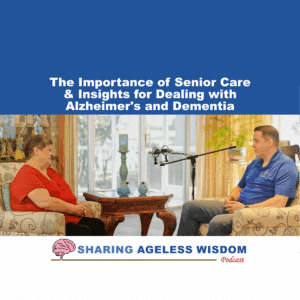
Welcome to the Sharing Ageless Wisdom Podcast! In this episode, host Diana Cabassi goes through various important topics with special guest Patrick Neeley, President and CEO of Seniors Helping Seniors® Hollywood Miami, to explore the continuum of senior care. Patrick shares his journey from a military career to leading the Seniors Helping Seniors® team in Hollywood and Miami, Florida, emphasizing their mission of service and compassion.
Where to Watch/Listen
Sharing Ageless Wisdom is available to watch on YouTube and Spotify, and available to listen as audio-only on Spotify, Apple Podcasts, Amazon Music, Pandora, iHeartRadio, Pocket Casts, and many more podcast apps! Just search for “Sharing Ageless Wisdom“.


Topics Discussed
- Exploring Senior Care Options
- Meet Patrick Neeley
- Services Offered by Seniors Helping Seniors®
- The Importance of Companionship
- Caregiver Qualifications and Training for Home Health Aide (HHA) and Certified Nursing Assistant (CNA)
- Supporting Families Dealing with Cognitive Impairment
- When to Start Senior Care
Podcast Summary
The discussion covers various senior living options, the importance of routine for seniors with cognitive impairment and behaviors to be aware of, the value of meaningful companionship, and the unique approach of Seniors Helping Seniors® in providing professional, peer-based care. Patrick also offers valuable insights for adult children caring for their aging parents, including tips on when and how to introduce professional caregivers into the family dynamic. Tune in for essential information and heartfelt advice on supporting and advocating for your senior loved ones.
Watch/Listen Now
Prefer to read the conversation instead of watching/listening? Click here for the full transcript.
You can reach Patrick Neeley at: shshollywoodmiami.com
Or call Patrick at 954-361-4916.
For more information about Diana Cabassi and Seniors Helping Seniors® Southwest Broward, visit: seniorcaresouthwestbroward.com
We hope you find this information useful. If you know someone who could benefit from this information, share it with them too!
What is Sharing Ageless Wisdom?
Sharing Ageless Wisdom aims to feature senior industry experts in South Florida who will share valuable insight to help our viewers prepare for aging. We will also cover topics related to in-home senior care, caregivers, family, and more. We hope you’ll benefit from this essential information.
Sharing Ageless Wisdom is a video podcast hosted by Diana Cabassi, a Certified Senior Advisor and life coach in Broward County, Florida. Diana has over a decade of experience in caregiving and running Seniors Helping Seniors® Southwest Broward, an in-home senior care service serving families in Pembroke Pines, Davie, Cooper City, Weston, Southwest Ranches, Miramar, Sunrise, and Plantation, FL.
Any specific guest or topics you would like to see in a future episode?
Send us your guest requests or topic suggestions!
Tap this link to send an email message to
marketing@shs-seniorcare.com
with the Subject: “Sharing Ageless Wisdom Guest Request or Topic Suggestion”
Are you a local senior care industry expert and want to be a featured guest in a future episode?
If you are a senior care industry expert in Broward County, Florida, and would like to join us in a future episode, please email us to let us know.
Send an email message to
marketing@shs-seniorcare.com
with the Subject: “Sharing Ageless Wisdom – Local Senior Industry Expert Request”
FULL TRANSCRIPT for Sharing Ageless Wisdom – Episode 3
The Senior Care Connection with Patrick Neeley – The Importance of Companionship, Supporting Families Dealing with Cognitive Impairment, Senior Care Options, and More
Diana Cabassi: Thank you for tuning into the Seniors Helping Seniors® Home Care Sharing Ageless Wisdom podcast. Our podcast aims to feature senior industry experts who will share valuable insights to help our viewers prepare for aging. We hope that you will benefit from the essential information.
Today we will be discussing the continuum of senior care with Patrick Neeley, President and CEO of Seniors Helping Seniors® Hollywood Miami, and the role that Seniors Helping Seniors® plays in that continuum. When we think of senior care, we need to consider many aspects of that care and exactly what the individual needs. In determining what type of care someone needs, you must first consider where they live.
The traditional senior living options include: Aging in place at home with family, which is actually where people prefer to be. There are independent living communities, which are age 55 and older retirement communities, assisted living communities where people receive support throughout the day for their meals and bathing and dressing and transferring.
And so you know when they need a little bit more help, but in situations where individuals have cognitive impairment that has advanced, an assisted living memory care facility may be the best place for them. There are continuous care retirement communities, which I think are really cool because you buy into them as an independent, living situation.
And then as your situation progresses, you may need to then go to an assisted living or a nursing home or. Back to, independent even sometimes. and then there’s skilled nursing facilities and nursing homes, which are basically at the end of people’s lives that they may need. But in terms of the actual care, there’s several traditional options, but most cases seniors are cared for by their families.
And as they age, it may be helpful to get help from professionals. there are adult daycare centers, homemaker companion, and home health agency services, nursing care, hospice care, and some people actually have people helping them privately.
At Seniors Helping Seniors®, we provide homemaker and companionship and Home Healthcare services, and Patrick will elaborate on the services we provide.
Welcome Patrick. Can you tell me a little bit about yourself and what brought you to Seniors Helping Seniors®?
Patrick Neeley: I’d be happy to, and thank you for having me. I’m really happy to be here. I grew up in a very small town.
I come out just west of Indianapolis called Plainfield. And so that, that shaped me in a number of ways. My way out was to join the military. So, I joined in 2001 and I went into the military as, an Air Crewman helicopter, Air Crewman and a rescue swimmer. And I spent a little over 10 years there in the military.
As a rescue swimmer, we always lived by the motto, so others may live, and it was something that was drilled into us. It became very much a part of who we are because the expectation is when you deploy in that capacity, you will, you’re putting someone else’s life first that’s very much before your own.
And Seniors Helping Seniors® seemed like such a natural fit for me because it sticks too. Those core values that mean so much to me. Things like, you know, service, and it’s so much more than just, pretty words on, on the wall. It’s kind of core to who I am. Dignity, things with purpose, connection with seniors, compassion for them, giving them more freedom and allowing people to maintain their freedom in their home, is really, really important. And, I always tell my kids and I, when I talk to people, I say doing good matters, because I believe that, and I have, I do, I have three girls and my at what we do every day, what I really want them to see is that we can help people and do good.
And still be successful. Those things aren’t, you know, mutually exclusive. So I really, really love Seniors Helping Seniors® for that.
Diana Cabassi: Oh, thank you so much, Patrick, for your service. it is something that is very honorable and I am very grateful that you have joined the Seniors Helping Seniors® family.
So can you share a little bit about, basically, what brought you to Seniors Helping Seniors®?
Patrick Neeley: Oh, I’d love to. I, so I, after I left the military, I had a sort of a traditional corporate path that I was following. I finished my master’s degree at FIU, here in South Florida. And ultimately, like anyone who’s on a path that isn’t sort of core to who they are and serving their themselves, I found that corporate path was not for me.
We were very successful and we helped a lot of people, but at the end of the day, I saw, I saw people being treated in ways that just don’t sit well with me, and I couldn’t continue down that path. It is just not, was not conducive to who I am.
Diana Cabassi: Sounds like you’re telling my story.
Patrick Neeley: And we, and for a lot of people, I think, kind of feel that way.
And I have to give credit to my wife because she was one of the most consistent voices in my ear saying, you should do something for you. Be, go be the leader. Go build something that’s core to who you are. And, that’s Seniors Helping Seniors® through and through. And that’s, I always tell we serve seniors.
I love that. We provide homemakers, and companion services and home health services. So I always tell people. The, term, the industry term is called activities of daily living. But I always tell people it’s, think about everything that needs to be done around the house, doing the dishes, preparing meals, doing laundry, to helping take care of your animals, uh, if you have them.
Yeah, transportation is a very big ask. We get asked quite a bit to do that. And maybe you’re going to an appointment or just Publix or even just to go to the beach. We do a lot of that. And the home health services a little bit added to that. That’s where you start to need to touch.
So there’s a level of care with things like going to the bathroom and bathing, and grooming, we can also provide those services as well. One of the things that I think makes us a little different than sort of your traditional, home health agency is, it’s sort of in the name, right? Seniors Helping Seniors®.
We aim to have, uh, to connect, able-bodied senior caregivers with senior clients, and certainly they can check all the boxes, they can do all the things that, that our clients are asking us for. But the core of what we do is meaningful companionship first. Because anybody can do your dishes and Uber can give you a ride, but that meaningful companionship really matters.
And that peer-to-peer model, I think does make us different in a lot of ways.
Diana Cabassi: Absolutely. You know, people really relate more when they’re older to the individuals that we’re servicing, and so that makes a huge difference.
Patrick Neeley: And I always talk about with my clients and my caregivers, I always talk about Semper Gumby. And part of that is because I used to train Marines, but Gumby is a character from TV many years ago.
It’s, um, it’s about meeting people where they are. And I do think that’s another differentiator for us in the industry is that, so much of this business is just trying to give people what they need. And often they don’t even know what they need. So, it’s how many hours do you need and what’s your schedule look like?
And we will always strive to find out exactly what you need and then give you that, whether in terms of if all you need is a ride, well we’re gonna try to make that happen. All the way up to if you need help 24/7, we’re gonna try to do that as well.
Diana Cabassi: But when we give a ride, it’s not just picking up and dropping off, right?
We are their companions. We can help them get ready. We will take them with whatever equipment they need, whether it’s their walker, cane or whatever, and we stay with them, right? Through the entirety of the visit, wherever it is that they’re going, and then bring them back home. So, it’s not just an Uber.
Patrick Neeley: Not just an Uber.
Diana Cabassi: Right? So, we’re a companion in that process.
Patrick Neeley: And my caregivers are themselves either Home Health Aides or CNAs. So I always like to tell when I’m talking to the families that it’s, they become an advocate for our clients as well. So they’re not only just gonna walk into the, the doctor’s office and just sort of drop their tool belt and wait to give ’em a ride home that can actually accompany them in and they then begin to become an advocate for them. So for family that are not local, they know that mom’s getting a ride to the doctor’s office, but they, I think it provides a little bit of comfort because they’re getting a lot more, as you said, than just an Uber ride.
Diana Cabassi: Mm-hmm. And so many times we also have the adult children on standby when they’re in the doctor’s office, so that they could be available to speak with the doctor when their parent is in the office. And that way they get the story straight from the horse’s mouth, so to speak.
Patrick Neeley: Absolutely. And it’s good. I think the, a lot of times, especially when the family members aren’t nearby, there’s a lot of anxiety when they’re, they know that they’re reaching out for help and they’re asking for help, and our caregivers can help quite a bit just by being nearby. So I tell, uh, I always tell family members who are farther away to feel free to call my caregivers and talk to them. And how did it go and what did the doctor say and understand that that conversation is going to be centered around the care that your loved one received. And so you can get good, reliable help.
Diana Cabassi: Absolutely.
Patrick Neeley: And know that that person is a lot more than just an Uber. That’s right.
Diana Cabassi: And so, you know, can you tell me what areas you serve here in South Florida?
Patrick Neeley: Sure. So we serve all of Broward County and Miami-Dade.
So our primary territories, we started Hollywood, which is Fort Lauderdale airport ish, all the way down to Miami. And I have clients as far south as, uh, like Homestead, Cutler Bay.
Diana Cabassi: Well, you’re sure servicing a large area.
Patrick Neeley: Absolutely.
Diana Cabassi: Okay. And so, can you perhaps share a little bit about, other than what you’ve already shared about your caregivers and, talk about their character and their qualifications?
Patrick Neeley: I get asked quite a bit, where do you find your caregivers and what are, you know, what makes them special? And I love it because my caregivers are the heart of what we do. They really are the business. but when you sign up with Seniors Helping Seniors®, our caregivers are going to be either a Home Health Aide or a Certified Nursing Assistant.
Home Health Aides go through a 75 hour specialized training program and Certified Nursing Assistants go through 120 hours of training every year. And that’s a, A CNA is a, is a license that’s issued by the state. It’s something that they have to maintain, and they get a lot of, uh, of, of very specialized training in how to provide care both in the home and out of the home.
So. For instance, when we are giving that ride, when somebody who’s not able to walk by themselves, how do you get them up and how do you help them into the wheelchair if they’re in a wheelchair? And varying degrees of difficulty? Because how much can they help? In some cases they can’t help at all. And a professional caregiver in those situations makes all the difference in the world.
’cause you can. You absolutely in unintentionally hurt someone,
Diana Cabassi: right? They’re trained basically to be able to care for the person the way that the person, needs it, right?
Patrick Neeley: There’s a lot of, uh, nuance to the care. Uh, as we know, half of people over 80 have some sort of cognitive decline, so Alzheimer’s and dementia is very common.
And, providing care to folks who are dealing with that requires its own level of training and they get a, they get quite a bit of, of extra training in that space as well. Speaking to their character. All of our caregivers are what we call a level two background check as well, so they’re gonna go, they’re gonna get their pictures taken, their fingerprints done.
We’re gonna check state and federal felonies to make sure that, that they have clean records. Uh, we’re also gonna do a search with the office of the Inspector General to make sure that there are no cases, from anywhere in the country of elder abuse or neglect. And, uh, ultimately just wanted to make sure that on top of being professional caregivers, that we’re getting the right kind of people.
Diana Cabassi: Absolutely. I mean, they’re building your reputation, aren’t they?
Patrick Neeley: They really are. And a good caregiver and a bad caregiver can make or break a situation.
Diana Cabassi: Absolutely.
Patrick Neeley: Ultimately, I meet every one of our caregivers as well. So I have, my personal barometer is if I wouldn’t put someone with my family or with my mother, then I would never ask one of my clients to do the same.
Diana Cabassi: That’s exactly how I feel. I started my Seniors Helping Seniors® office as a result of my mother being diagnosed with dementia. And knowing what her needs were, made me realize that there’s a very important role that we and Seniors Helping Seniors® play that is not necessarily something that people know about.
So, you know, part of the reason why we’re doing this today is to make people aware of what exists out there, and how we respond to the needs of individuals. And, you know, we provide support to seniors in all walks of life and all care needs.
Patrick, can you, talk, elaborate a little bit more on how we care for individuals with cognitive impairment?
Patrick Neeley: Yes, absolutely. I think, I, one of the things that I’ve found through the, my experience with Seniors Helping Seniors® is, in talking with families is, so often they’re just looking for information and they don’t necessarily even know the questions to ask. And, so I always, I spend a lot of time sharing information and trying to just sort of educate the families.
It’s a stressful situation when mom or dad has, Alzheimer’s, but not, you can sometimes kind of lose the forest through the trees because on top of it being a very stressful situation, it’s somebody that you love. It’s one of the most important people in your life going through this heartbreaking thing.
And so I feel a lot of times, like they’re lost and they’re just, they’re looking for some support and some help. And, education on top of the services that we provide, I think is one of the ways that I really enjoy trying to help people. And so we talk about kinda what are the early signs.
In the beginning with dementia and Alzheimer’s, first of all, dementia and Alzheimer’s are not the same thing. And I talked to a lot of people who don’t know the difference. But what you’re looking for in your loved one, often in the beginning, are forgetfulness, forgetting what did we just talk about, or something that they just read.
They, once it becomes a disruption in the daily life, then I think that’s when people need to start really asking questions. Talk to your doctor and seek help because it can be difficult, certainly. It’s a disruption in their daily life. It’s a disruption in going to the store. It’s in a disruption and having family over to eat and or anything that they’re doing.
So when people feel that, that’s why I always tell people, go out and ask for help and get it diagnosed so you have some sort of a better idea of kind of what you’re dealing with.
Diana Cabassi: Absolutely. And so, you know, it’s confusing sometimes too because sometimes our parents may seem perfectly well, and then all of a sudden they switch over.
It’s like a switch in the brain that tells, that, tells them, doesn’t tell them, but basically has them act differently, you know? And, uh, so it’s, uh, it’s difficult and it is emotionally draining. Can you maybe, give us a little bit information about how you help the adult children in being an advocate for them?
Patrick Neeley: It goes back to training and some of the training that our caregivers get is very helpful for, for the adult children that are trying to provide care as you can unintentionally. make it worse. And if you don’t understand what’s happening physically, ’cause I’ve run into some situations where, with adult children who are talking to me and saying things like, my mother’s never done that.
And she’s never yelled and she’s never said these things and she’s, some of the things that are coming outta her mouth. Goodness would make a sailor blush. And it was, so we talk, go back to the education part and different parts of the brain when they start to degrade with, they lose language to begin with.
But what’s really interesting in BA brain chemistry is bad words. Things that we associate as bad are stored in a different part of the brain. So where they will lose language, but bad words stick.
Diana Cabassi: I always say they lose their filter.
Patrick Neeley: Right.
Diana Cabassi: Filter’s gone.
Patrick Neeley: All of a sudden, mom starts cussing. I had a conversation very recently with some family members who said, my dad never spoke like that.
But we go back and say, you know, understand that your mother isn’t being difficult. Her and because that happens a lot, and I say, well, I keep telling my mom I, she needs help. And sometimes she agrees that I need help, and then an hour later she forgot. Right? So it it, that part is where we can really help adult children by reframing the expectation.
In those cases, you’re, what the family member wants is to say, you know, mom, you know, you need help. And to have mom say, you know what, you’re right. I know it, it’s very stressful on everyone and I do need help. So why don’t we get somebody in here? Well, that’s never gonna happen.
Diana Cabassi: Well, in moments of clarity, which don’t come very often, but they may say, okay, yeah, but then like you said, you know, they forget or later that they said that they would like to have someone help. So anyway, it’s a hard balance.
Patrick Neeley: It is. And I think understanding at a base that we could talk about Alzheimer’s and dementia for hours, but I, one of the most important things that I think for family members to understand is where.
Those who are suffering with Alzheimer’s or dementia, their comfort zone comes from their routine and the things that they know. So they may not necessarily be clocking that today’s Tuesday. And you know, what did we just talk about? But she, you know, mom definitely knows when she gets up in the morning, she has her coffee, and she has her breakfast, and she sits on the patio.
And sort of that routine is a sense of comfort. So anytime that we’re gonna do something like adding a caregiver that threatens the routine, we need to be very, very particular in how we do it. First, having a, a professional caregiver with the training, with the understanding and experience that our caregivers bring is invaluable.
Diana Cabassi: Absolutely.
Patrick Neeley: And understanding that we’re, what does success look like? Success, like I said, it’s never, mom May is not going to be mom understanding. And accepting of this caregiver all the time. Success is going to be managing her, the emotional response that comes from a threat to her routine. So, and, and just adding a caregiver and having somebody come in changes everything.
Diana Cabassi: It does. We never know what’s gonna throw them for a loop right?
Patrick Neeley: Right.
Diana Cabassi: Mm-hmm.
Patrick Neeley: And so we aim for consistency. For us, a consistency is very, very important.
Diana Cabassi: Critical.
Patrick Neeley: That way. Ultimately what we’re trying to do is to integrate somebody in a very natural, normal way into their routine. And so we start with, we, again, consistency.
So we’re gonna try to start it, try to do it at the same time, and then spend a little bit more and a little bit more time as, time goes by.
Diana Cabassi: Patrick, is there anything else that you think is important for our viewers to know about you and Seniors Helping Seniors®?
Patrick Neeley: Well, I always get asked when should we start?
And I, one of the things that I think is very important that I tell a lot of people I talk to is, early is better. When your loved one is going through something that’s emotionally or physically traumatic, like an injury, if, uh, you think about trying to get mom help after she fell and broke her hip, she’s in the hospital.
It’s really hard on her physically and mentally and just as spiritually. And that back and forth can be very, very difficult. And now imagine on top of that, trying to add a new person into her routine. So even if mom, mentally, and, is completely intact. That’s still really, really difficult. So it’s much better, I think, in the beginning to try to establish the relationship first, and then it’s so much easier to add a few hours with somebody who you already know and trust as opposed to just trying to, again, stick somebody new in there, I think is can be really, really stressful.
It’s stressful on the families too.
Diana Cabassi: it is. But the wonderful thing is, is that. People like you and I, have advocates for them.
Patrick Neeley: Yes.
Diana Cabassi: That could really make a big difference in their lives.
Patrick Neeley: Yeah. Well, and know that you’re never alone. That’s what, let’s say why we exist is we’re here to help.
And so it goes back to what we do.
We serve seniors.
Diana Cabassi: We serve seniors.
Patrick Neeley: No matter where you’re at in that continuum of care. Call and ask, and that’s, what we’re here to do, is to help in any way we can, and it makes me happy in my soul when we can help those folks out.
Diana Cabassi: Absolutely. There’s nothing better than giving to those who gave so much to us.
Right? So, Patrick, how can we find you?
Patrick Neeley: So there’s a couple of different ways you can find us. So our website is shshollywoodmiami.com. So it’s SHS for Seniors Helping Seniors®, all one big word. You can also give a, give our office a call, 954-361-4916. And please look us up. We’re on Facebook, Instagram, LinkedIn.
Just do a search for Seniors Helping Seniors® Hollywood Miami, and you’ll find us. Also a member of the Area Agency on Aging’s advisory board as well.
Diana Cabassi: Very good. Very good. Patrick, you’ve come a long way in this year. And you know, I thank you so much for this valuable information. and for all of you who tuned in.
Uh, we’ll put Patrick’s information in the, so show notes. So if you didn’t catch it, you’ll get it at the end. I hope you enjoyed this information and found this conversation valuable. if you want more content like this in the future. Please subscribe to our channel and follow us on social media. Let us know what you think about the show, what topics you would like to hear about.
And if you know of anyone who would like to be a guest on our show, we would love for that recommendation. You could just leave us a message about that. Thank you for listening, and we’ll see you next time. Patrick. Wonderful.
Patrick Neeley: Thank you.
Diana Cabassi: This was a great conversation. I, I love that you have joined our Seniors Helping Seniors® family.
I know that you are going to do very, very well because you really do exhibit the core values of our franchise and I am very grateful for that.
Patrick Neeley: Thank you. I’m very grateful for you.
Diana Cabassi: Mutual admirations aside. Right?
Patrick Neeley: Amen.
Learn More About
Seniors Helping Seniors®
Southwest Broward


Seniors Helping Seniors® in-home senior care services is an exceptional program of care and compassion that matches active seniors who want to help with those who need help. Our companions can assist with meal preparation, grocery shopping, transportation to doctor appointments or any other errand or outing, light housekeeping, medication reminders, overnight stays, 24/7 care, and much more.
We like to say it’s… Like getting a little help from your friends®
We serve throughout southwest Broward County, FL, including the cities of Miramar, Pembroke Pines, Davie, Cooper City, Southwest Ranches, Weston, Sunrise, Plantation and surrounding areas.