




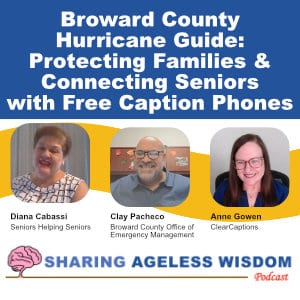
Welcome to the Sharing Ageless Wisdom Podcast! In this episode, host Diana Cabassi interviews two special guests. Clay Pacheco, Director of the Broward County Office of Emergency Management, and Anne Gowen, Vice President of ClearCaptions (a caption phone that is free for individuals with hearing impairment). Both are gathered to discuss hurricane preparedness and the importance of communication, as the hurricane season begins in Broward County, Florida.
Where to Watch/Listen to Sharing Ageless Wisdom Podcast
Sharing Ageless Wisdom is available to watch the video version on YouTube and Spotify, and available to listen as audio-only on Spotify, Apple Podcasts, Amazon Music, Pandora, iHeartRadio, Pocket Casts, and many more podcast apps! Just search for “Sharing Ageless Wisdom“.
Prefer to read the conversation instead of watching/listening? Click here for the full transcript.
Links to watch/listen to the Sharing Ageless Wisdom Podcast below:


More podcast platforms available at https://rss.com/podcasts/sharing-ageless-wisdom/
Topics Discussed
- Hurricane Preparedness with the Broward County Office of Emergency Management
- Free Caption Phone for Emergency Communication via ClearCaptions
- Meet Clay Pacheco, Director of Broward County Office of Emergency Management
- Why Hurricane Preparedness Matters
- Evacuation Zones Explained
- Shelters and Special Needs
- Seven-Day Supply Kit
- Safest Methods to Protect Documents and Photos during a Hurricane
- Local Hurricane Preparedness Events in Broward County
- Rapid Storm Intensification and What to Consider
- Shelter Types & Expectations
- Meet Anne Gowen, Vice President of Marketing at ClearCaptions
- Communication as Hurricane Preparedness
- Hearing Loss Risks
- Tools, Caption Phones, and Alerts
- How ClearCaptions Works
Watch/Listen Now
Prefer to read the conversation instead of watching/listening? Click here for the full transcript.
You can reach Broward County Office of Emergency Management at
broward.org/Emergency
Or dial 311 on your phone
You can reach ClearCaptions at
clearcaptions.com
or call 1-866-246-1931
For more information about Diana Cabassi and Seniors Helping Seniors® Southwest Broward, visit: seniorcaresouthwestbroward.com
or call 954-202-5200
We hope you find this information useful. If you know someone who could benefit from this information, share it with them too!
What is Sharing Ageless Wisdom?
Sharing Ageless Wisdom aims to feature senior industry experts in South Florida who will share valuable insight to help our viewers prepare for aging. We will also cover topics related to in-home senior care, caregivers, family, and more. We hope you’ll benefit from this essential information.
Sharing Ageless Wisdom is a video podcast hosted by Diana Cabassi, a Certified Senior Advisor and life coach in Broward County, Florida. Diana has over a decade of experience in caregiving and running Seniors Helping Seniors® Southwest Broward, an in-home senior care service serving families in Pembroke Pines, Davie, Cooper City, Weston, Southwest Ranches, Miramar, Sunrise, and Plantation, FL.
Learn more about Seniors Helping Seniors® Southwest Broward at seniorcaresouthwestbroward.com
Any specific guest or topics you would like to see in a future episode?
Send us your guest requests or topic suggestions!
Tap this link to send an email message to
marketing@shs-seniorcare.com
with the Subject: “Sharing Ageless Wisdom Guest Request or Topic Suggestion”
Are you a local senior care industry expert and want to be a featured guest in a future episode?
If you are a senior care industry expert in Broward County, Florida, and would like to join us in a future episode, please email us to let us know.
Send an email message to
marketing@shs-seniorcare.com
with the Subject: “Sharing Ageless Wisdom – Local Senior Industry Expert Request”
FULL TRANSCRIPT for Sharing Ageless Wisdom – Episode 6
Broward County Hurricane Guide: Protecting Families & Connecting Seniors with Free Caption Phones
Diana Cabassi: Thank you so much for tuning in to the Sharing Ageless Wisdom podcast. Our podcast aims to feature senior industry experts in the South Florida who will share valuable insight with us to help our community prepare for aging. We hope that you will benefit from this essential information.
Hello, everyone. Welcome back to our Sharing Ageless Wisdom podcast. Today we will have two guests that will help us understand the critical need to be prepared for storm season in South Florida. Our first guest today is Clay Pacheco. Clay is the director of Broward County Office of Emergency Management. And later in the show, we will speak with Anne Gowen, who is the vice president of marketing for ClearCaptions.
It’s my pleasure to introduce you to Clay Pacheco. Clay will speak with us about how everyone, and especially seniors, need to prepare for storm season and what to do when a storm is approaching.
Welcome to our podcast, Clay. Can you share with us a little bit about your role in the Broward County Office of Emergency Management?
Clay Pacheco: Absolutely, Diana. First and foremost, thank you for the opportunity to be on your podcast today and share some preparedness tips and readiness tips with the public. I’ve been here at Broward County Office of Emergency Management about two and a half years now, and as the director, I lead the day-to-day activities when it comes to preparedness, response, recovery, and mitigation. Also, when we do activate our EOC, I’m the unified commander for the EOC, ensuring that all the resources that are required to restore essential functions of our community are in place and are working to do that as quickly as possible. That includes coordinating with nonprofits, with FPL, and, you know, law enforcement of course, and emergency medical services, coordinating shelters, and making sure our public has everything they need.
Diana Cabassi: Well, that’s a little complicated, isn’t it? And it also sounds like an exciting role in our county, and one that is very valuable for our residents. So Clay, what brings you here today with us?
Clay Pacheco: So thanks again for the opportunity. The goal today is really to, how can I say bring awareness to readiness and community resilience to our community. Even storms that don’t make landfall can be dangerous. We’ve– The last few years, we’ve dealt a lot more with flooding. You know, downtown Fort Lauderdale, Hallandale Beach, West Park, many neighborhoods that were inundated with twenty-four inches of water in twenty-four hours. We saw what that does to a community and how much loss there is. We lost mobile home parks. Many people lost cars and a lot of the, the things that they own. But honestly, preparedness, I’m here to preach the message and carry the torch that preparedness is a shared responsibility between us in government, businesses, and the public.
And seniors are especially vulnerable to all hazards we face in Broward County. Many that have been paying attention lately seen we’ve been dealing with unbearable heat. There are heat warnings every day.
Diana Cabassi: People
Clay Pacheco: are dying because of heat across the world. Flooding, I previously denoted. Of course, we have to be prepared for hurricanes, tornadoes.
We saw in couple years back with Hurricane Milton, we had an outbreak of tornadoes in Florida that was unprecedented.
Diana Cabassi: That’s right.
Clay Pacheco: Sixty-three tornado warnings, like thirty touchdowns in Florida. That had never happened before. So, it’s a lot of things we’re dealing with. A lot of our listeners may be familiar with wildfires, especially the smoke we’ve been dealing with this summer. Uh, a lot of wildfires in the Everglades, and many times they’re started by those severe thunderstorms we have every afternoon. They spark them up, but with all our partners, you know, the Department of Forestry, the Florida Division of Emergency Management, and then local fire really doing an unbelievable job to really save homes and save neighborhoods and stopping the fires before they make it to a populated area east of the Everglades.
Diana Cabassi: Well, you know, we see it every day. I mean, the other day I popped in- hopped into my car at noon to run an errand, and when I looked at the dashboard, it said that the outside temperature was 107. Obviously, that’s because it was under the direct sun, but still, I- this is the first time I had seen, you know, temperatures over 100.
So anyway, you know, there’s so much more to the work that you do than just for hurricanes and I hear that, but, you know, one of the things that we would like for you to address for us is what preparedness really looks like for our seniors. So if you can elaborate on that for us a little bit, I would greatly appreciate that.
Clay Pacheco: Absolutely. Preparedness message for seniors is key. We do quite a, a bunch of outreach events, and I’ll mention a few here coming up. But first and foremost, what seniors need to do, they need to go to broward.org/hurricane.
At our website, you can look at what’s called our evacuation map. Many people make the mistake of thinking that we evacuate for wind speed, for the strength of the storm. We actually evacuate for water. Storm surge is what’s gonna prompt evacuations because of the surge coming in off the ocean, off the canals, off the rivers and basically flooding neighborhoods. So the first thing to do is to go to broward.org/hurricane and look up the evacuation zones. We’re very lucky in Broward County due to our topography, we have two evacuation zones.
Evacuation Zone A is if you have to cross a bridge over the Intracoastal onto a barrier island, you’re in Evacuation Zone A. If you’re in Evacuation Zone B, you’re right on US 1 and east of US 1. You’re in Evacuation Zone B. And like many of us learned years ago I was one back during Wilma, I evacuated my whole family to Jacksonville, and they were in traffic for 12 hours.
We ask you not to do that.
Diana Cabassi: Yeah.
Clay Pacheco: That is not the right move. Moving east of the evacuation zones is really what you need to do, whether it’s finding family, friends, neighbors you can stay with, getting a hotel that you can stay to ride out the storm that has a generator, as a last resort, going to one of our shelters. So I’m glad you brought this up. I wanna talk about our shelter program.
We have multiple shelter programs. The first one is a general population shelter of which we have about 35, 3 of which are pet-friendly, so you can bring your furry friends with you. But we also have, very important to our community, what we call special medical needs shelters. And also on broward.org/hurricane, you can look up the Special Medical Needs Shelter Program. And what that is basically, if you have medical needs, whether you have to inject insulin, you’re electrically dependent you need someone to help monitor you and monitor your medication, have five special needs shelters where in this program you pre-register, we call you, set up an appointment, and pick you up prior to the storm making landfall, take you to a special medical needs shelter, which is staffed with Florida Department of Health nurses care of you while you ride out the storm. the storm has exited, we double-check that there’s power in your home, and then we give you a ride back to your home so you can get settled back in your home. But it’s a very important program that I try to get the word out every day, and I can’t thank you enough for the opportunity to reach seniors directly and encourage them to pre-register for this program. That way, they have the peace of mind if they don’t have a place to go, if they’re in an evacuation zone, they don’t have friends, family, or neighbors to go to, they can go to one of these special medical needs shelters and be taken care of by these nurses from the Department of Health while riding out the storm. Um, another thing I wanted to mention is for those folks who aren’t savvy online or we just launched, so everybody also knows, an emergency management app that has all these programs, all these maps, evacuation routes. So there’s an emergency management app Broward Ready, basically you can go on Apple or Google to download. But for those folks who are not savvy, don’t wanna go on the internet, don’t wanna fill out forms electronically, you can call our main number, which is 954-831-3900, and say you wanna sign up for the special needs registry. They’ll connect you with our folks here to able to fill out the application for you over the phone and get you registered, which is a great service that many people do not take advantage of.
Diana Cabassi: That’s wonderful Clay. You know, I often worry about our seniors because many of them don’t actually a- use a computer, um, and much less an app. I mean, we think that the apps are easy to use, but you know, using a telephone which is small for the seniors, it becomes a great challenge. So having someone that will take their application is such a blessing for them, and so I’m so happy to hear that.
And for our listeners, we will definitely post all of these websites and phone numbers in our show notes and well, I’ll remind everybody later of that.
Clay Pacheco: Oh, for sure.
Diana Cabassi: So, one of the things that, that I hear often is that we should have a seven-day plan or a seven-day kit. So what do we need to build a seven-day disaster supply kit?
Clay Pacheco: Diana, I’m so glad you brought that up because I think that’s where most people really drop the ball and wait till the last minute to go get the supplies that they need. And as we learned from previous hurricanes, as we learned from COVID, uh, we remember that the shelves were empty. Um, people who waited till the last minute couldn’t get their hands on essential needs like toilet paper and water, um, that’s something we ask everybody to do now, is to sort of, uh, keep a kit for seven days.
When you do your groceries, buy a couple of things that you can add to your kit, you know, for that rainy day, including water. When it comes to water, you should think about a gallon per person per day, so that’s seven gallons per person in your home that you should have on standby if needed. Non-perishable food, canned vegetables, canned meats, bread, milk that’s in canisters. Everything from evaporated milk, condensed milk, that type of stuff that could hold you off. Medications is key. Once there’s a hurricane out there, many of the big pharmacies, you know, Walmart, CVS, Walgreens, they let you even request through your doctor additional medications to hold you off, especially if you’re running out soon and there’s a hurricane out there that still may be a week away. I highly recommend get additional medications in case there’s prolonged power outages where these pharmacies can’t open again. We’ve seen that over the years. You wanna have flashlights and batteries. Test them. Phone chargers, backup charging ports that you could have. But most… One of the biggest things that people also forget to do is actually to take pictures, you know, in their condo, in their apartment, in their home, of everything that they own. Take out some cash from the bank in case the ATMs are down. But that, documenting everything that’s in your home, is very important later on for insurance adjusters.
Diana Cabassi: What a great idea.
Clay Pacheco: If they come after the fact and everything is gone, and I went through this with the no-name storm. It wiped out everything we had, but I had the sense to have pictures of everything, and we were able to show insurance adjusters what we owned and everything that got destroyed. So it’s very important to do that. A lot of folks always ask me, “But where do I put those pictures? Where do I put the important documents that we have?” And really important, you know, birth certificates, marriage certificates, stuff like that, you don’t wanna lose, passports. I always tell people the most waterproof thing in your home that nothing’s gonna get in is your dishwasher. So I actually put them in Ziploc bags and put them in my dishwasher, even more than using a safe. A safe can float away. Dishwasher’s not going anywhere.
Diana Cabassi: No, it’s, it’s built in, right?
Clay Pacheco: It’s built in and it’s waterproof. So it’s one of those that I highly recommend to people to take pictures, have your important documents put away safely where you know they’ll be in the dishwasher. You can always go back and get them
Diana Cabassi: Well, we learn something new every day, don’t we? I had no idea that the dishwasher would be a great place. As you’re talking, I’m thinking, oh, I have everything in my safe deposit box in the bank.
Clay Pacheco: Right.
Diana Cabassi: Because, you know, ordinarily I don’t like having, you know, critical documents in my home because anything can happen, you know, over the years, unfortunately.
Clay Pacheco: That’s a viable option. Many people don’t do that. I mean I have a safe deposit box too that I keep certain documents, but that’s, that’s the way to go. But if you don’t have one, the dishwasher’s a viable option for you at home.
Diana Cabassi: So nowadays as well, you know, I like to make sure that anything that’s important I’ve actually scanned and have saved on my computer, right?
Clay Pacheco: Yes. Yeah it’s very important.
Diana Cabassi: Which is, you know, can be backed up as well.
Clay Pacheco: Mm-hmm.
Diana Cabassi: So having multiple copies of things is important. And having pictures, what a wonderful idea of documenting what your home looked like before.
Because, you know, especially after a storm, after a large storm,
Clay Pacheco: Mm-hmm.
Diana Cabassi: the insurance adjusters are just overwhelmed with what they need to do. So, you know, having all of that is a great suggestion, and I appreciate you for that. That’s, that’s wonderful.
Clay Pacheco: Absolutely. If I could mention one more thing,
Diana Cabassi: Absolutely.
Clay Pacheco: We are having a big event this weekend at the African American Research Library and Cultural Center in Fort Lauderdale. It’s at 2650 Sistrunk Boulevard, and we’re having our hurricane preparedness open there, where we’ll have plenty of information that I mentioned, the shelter list, preparedness kits, all types of stuff that you could take home with you, the special needs registry applications. We’re also gonna have BSO there with their mobile command vehicles and some ambulances, and a lot of different vendors from Broward County will also be there. Libraries of course, um, but several of the departments that we work with closely during disasters will be there giving out information that’ll really be beneficial to seniors, and we’ll have a spin wheel where they can win some really cool prizes. I’m trying to get Lowe’s to give us a generator, which would be nice. So,
Diana Cabassi: Oh, cool.
Clay Pacheco: So definitely, I did want to mention that. This Saturday, July 11th. It’s from 10:00 AM to 2:00 PM. come by the African American Research Library and Cultural Center. I’ll be there, my whole team will be there, and we’ll be handing out a bunch of stuff and some cool things going down.
Diana Cabassi: So will you have other events like that or is this the only one?
Clay Pacheco: This is the– We have honestly about 20 a year, so
Diana Cabassi: Oh wonderful.
Clay Pacheco: I will share that also with you, Diana. We do multiple places, multiple cities, multiple events. Um, usually, um, I’m trying to think. Recently, we did the, uh, Chamber of Commerce. Um, we did, uh, Pembroke Pines. We’re gonna be doing Margate later in the year. So every city that has an open house, we come with a table and provide a lot of this information.
So I’ll make sure and get that list to you.
Diana Cabassi: Oh, that’s great.
Clay Pacheco: That way you can put it as part of the information.
Diana Cabassi: Wonderful. So we’ll put that in our show notes as well.
Clay Pacheco: Absolutely.
Diana Cabassi: What a fascinating conversation. You know, we, we go through our lives and we just move at the way that we need to. But, you know, having the opportunity to just rest for a minute and to think about what it is that we need to do to be prepared for a storm because as, as we know, it could happen anytime.
Clay Pacheco: Absolutely.
Diana Cabassi: It’s not something that we even have a lot of warning time. So basically,
Clay Pacheco: I’m so glad you brought that up.
Diana Cabassi: having,
Clay Pacheco: I’m so glad you brought that up.
Diana Cabassi: Yeah, having the kit, so to speak, in advance is critical. And then if once hurricane season is over, we need to give it a month or so though, because sometimes they come late.
Clay Pacheco: For sure. And something we’re
Diana Cabassi: and-
Clay Pacheco: with a lot, Diana, is, um … I’m sorry to interrupt you. We’re dealing a lot with what we call the hurricane emergency, which is my biggest fear.
Diana Cabassi: Right.
Clay Pacheco: That everyone listening to this podcast is gonna watch the news, and we’re gonna be on TV talking about a tropical storm. But like happened in 2024, within 48 hours it was a Category 5 hurricane, and it’s not a lot of time
Diana Cabassi: no.
Clay Pacheco: to get out of
Diana Cabassi: N-
Clay Pacheco: you know, evacuation zone and all that. So it’s one of those where I, I plead and implore everyone to please pay attention to the National Weather Service, to your local news, to our local press conferences providing updates.
I’ll be on TV letting people know what shelters are open, who should be evacuating and when. But it’s one of those where in those cases I ask everyone to pay attention ’cause it can really go from a tropical storm to a major category hurricane in less than 48 hours. We’ve seen it happen in the last few years.
Diana Cabassi: And then it’s mayhem. It’s mayhem at the stores, right? Wherever you go.
Clay Pacheco: At the gas station, something we didn’t talk about.
Diana Cabassi: And the gas station. Yeah, I never let my tank go less than half a tank because it w- I mean, in ordinary times, because you could be stuck on I-95 for a half a tank, right? So anyway, I am an advocate for being prepared in advance.
I have my little boxes that I put my batteries in- and then every year I make sure that everything’s still fresh too before there’s any seasonal storm that pops up, so.
Clay Pacheco: Absolutely.
Diana Cabassi: So Clay, what a pleasure. Is there anything else that you would like to share with our community today?
Clay Pacheco: Just to remind them that, um, we always say it: “Hide from the wind, run from the water.” It’s the water that takes most lives, and I really want people to know as far as shelters, think of it this way. It’s not a cruise ship, it’s a lifeboat. You’re gonna have food. At a special medical needs shelter, you’re gonna have a cot.
At a general population shelter, you need to bring everything you need for riding out the storm. At the pet-friendly shelter, we ask you to bring your crate and your dog’s diet, whatever they eat, their food. We’ll have some of that there, but we all know some of our furry friends are, are finicky, so you wanna try and bring food for your pet, and, uh, bring your rabies shot records too.
We’ll ask you for that if you bring in a pet,
Diana Cabassi: Oh, very good reminder.
Clay Pacheco: Especially that they’ll be aroud other dogs and cats and other animals.
Diana Cabassi: Yeah.
Clay Pacheco: But I can’t thank you enough for the opportunity to spend some time with you today and get the message out. It means the world to us.
Diana Cabassi: Thank you. Thank you so much, Clay, and it’s been my pleasure as well. And, you know, I know that the work that you do is critical. And, the time that you took to share with us today, because I know your time is also very valuable, and this information just will go a long way, and I am absolutely certain that many lives are saved as a result of the work that you do for our county.
I applaud you for that. And you know, it’s important for people to see who’s behind the scenes getting everything done and, you know, it’s not always something simple like people think, you know?
Clay Pacheco: Yeah.
Diana Cabassi: Based on what you’ve told us at the beginning of the podcast, it is quite complicated, and coordination for the work that you do to protect us is invaluable, and I appreciate you, and I thank you very much.
Clay Pacheco: Thank you. It’s truly a team effort. We have a big team here behind me working every day, making a difference and the support of county administration, the support of the commissioners, the Broward County commissioners. I ask and they give. So they, they really support us wholeheartedly and help us make a difference.
Diana Cabassi: Absolutely. That’s wonderful. Well, thank you so much, Clay.
Clay Pacheco: Thank you.
Diana Cabassi: We’ll, we could come up with another idea to have you on our show an- again another time to go maybe in depth with something in particular.
Clay Pacheco: Absolutely. Look forward to it.
Diana Cabassi: Thank you so much.
Clay Pacheco: Thank you for your time.
Diana Cabassi: Thank you. I appreciate you. So now we’ll turn our attention to Anne Gowen. Anne is the Vice President of Marketing for ClearCaptions. Anne, can you share a little bit about yourself with us and the role that you play as VP of Marketing with ClearCaptions?
Anne Gowen: Yes, happy to. Thanks so much, Diana, for having me today. I’m excited to be here to talk about our senior audience, and certainly one that I’m very passionate about. I’ve been in the senior space now for upwards of 20 years across a variety of verticals. I’ve been in the hearing aid space, the Medicare space, and then the last four years with ClearCaptions in the captioning phone space.
So I’m very committed to our senior audience and continuing to build additional products and services for the future.
Diana Cabassi: As I say, it does take a village, and each one of us-
Anne Gowen: It absolutely does, yes
Diana Cabassi: … each one of us has a different role, and so, you know, the goal is hopefully to make a huge difference in our senior population.
Anne Gowen: Yeah. As a company, we are very focused on helping seniors continue to maintain their independence and certainly staying connected to friends, family, and community.
Diana Cabassi: Well, that’s wonderful. And it’s not only something that we need to concentrate on for hurricane season, but as you know, hurricane season is beginning, and families are hearing a lot about food, water, medications, batteries, evacuation plans, as we just heard from Clay.
But, um, what is one preparedness issue that may be easy to overlook for older adults? It’s communication access. And yes, there’s all of the, I’ll say, more functional preparedness, but certainly with older adults who may have hearing loss, their ability to stay connected and communicate with others is really a lifeline for them.
Anne Gowen: So it’s not just enough to have a, a phone nearby, but the real question is whether they can hear, understand, and respond to calls during a crisis, since that’s often how they’re gonna get updates. So communication and the ability to hear and understand is critically important. And so why can hearing loss become a bigger issue during a storm or any other emergency?
You know, it, what’s interesting about emergencies, and of course you know living in Florida as I do, that they demand fast. They’re high-stress communications, and so for someone with hearing loss, background noise, poor phone service connectivity, rushed conversations already make a call hard, particularly if they live alone.
And their phone certainly is their main lifeline to be able to stay connected and to understand what’s happening in the environment.
Diana Cabassi: And so much more now with cellular technology that, you know, even if you don’t have hearing loss, sometimes it’s difficult to hear. It all becomes a huge challenge once we start to lose our hearing.
Anne Gowen: It does.
Diana Cabassi: And so how common is hearing loss among older adults, and why might families underestimate it?
Anne Gowen: It’s extremely common, and it’s about, I would say, one to three adults 65 to 74 have some level of hearing loss, but that number grows at exponentially once they turn 75 and older. And talking on the phone can become particularly problematic.
They’re asking people to repeat words. They’re not understanding the conversation. So addressing hearing loss is particularly important because we don’t want them to avoid using the phone as a contact point, even if they have hearing loss.
Diana Cabassi: And so, how can unsupported hearing loss affect someone’s day-to-day life?
Anne Gowen: It ultimately makes calls exhausting for people because they’re struggling to hear. They’re asking people to repeat themselves, and so they start to disconnect. They start to avoid phone calls, which subsequently can lead to isolation, missed communication with those important people in their lives, doctors, caregivers, and they’re starting to just lose their confidence.
In an emergency, that isolation can really become dangerous.
Diana Cabassi: Mm-hmm. And so, you know, what should families and caregivers discuss with an older loved one before severe weather is in the forecast?
Anne Gowen: Double-check with your parents, family, loved ones on can they hear calls clearly? Identify who should check in with the senior and when, and then what’s the backup plan if the phone, power, or internet fails?
Make sure that it’s important that you write down emergency contacts and confirm that local alerts are set up, whether they receive that through the radio, through their cell phone. It’s really important to make sure that those are available.
Diana Cabassi: So I know nowadays technology is evolving and there’s so many more tools that we can use.
What are some tools or support that can help older adults with hearing loss stay connected?
Anne Gowen: So certainly to start with hearing aids. And I know that there’s a, a bit of a bias towards hearing aids because then people start to feel like, “Ooh, I’m really getting old if I’m losing my hearing.” But we’re in the midst of a silver tsunami right now with the boomers aging in.
The first ones turn 80 this year, and they’re definitely more determined to live their life on their terms. And we’re optimistic that they’ll be more receptive to addressing their hearing loss sooner rather than later. So it’s important to either get hearing aids, get a caption phone. Really the key is for them to stay connected.
Connection is so important for this audience.
Diana Cabassi: And you know, it, it starts so much younger than we think.
Anne Gowen: It absolutely does
Diana Cabassi: … and we don’t really want to get old, and I get it ’cause I’m on my route. And so I, you know, that route’s been long and you don’t realize how years go by so quickly, but you know, I still consider myself young even though I’m not.
Anne Gowen: Yes.
Diana Cabassi: And so, you know, I don’t see that there’s gonna be a difference in 15 or 20 years on how I see myself. So I, you know, I could definitely relate to people that don’t want to accept-
Anne Gowen: Mm-hmm
Diana Cabassi: … um, the fact that they’re aging and need a hearing aid. Um, and, and there’s a social stigma.
Anne Gowen: There is a social stigma, yes.
Diana Cabassi: Yeah.
Anne Gowen: And it, I think it’s our own self-perception that if I’m losing my hearing, I’m starting to get old.
Diana Cabassi: Yeah.
Anne Gowen: And as we know, there’s all sorts of reasons why people lose their hearing. I think what’s so important and perhaps something that people don’t realize is that your hearing loss is so gradual. It can take seven to 10 years before it becomes really noticeable.
But in that timeframe, if you’re unable to hear, it starts to slow down your brain, and so it’s really important to address hearing loss sooner rather than later.
Diana Cabassi: And yeah, something that I always am an advocate for because many of the seniors that we care for have dementia. Yes. And I know that there’s a direct correlation-
Anne Gowen: There is
Diana Cabassi: …between hearing loss and dementia.
Anne Gowen: Mm-hmm.
Diana Cabassi: And so- If we accept it earlier, and correct it, then our probability of getting dementia will obviously be less. But, you know, it’s so prevalent now.
Anne Gowen: It absolutely is. And if you think about the, the Boomers and the Gen Xers that are soon gonna be re- of retirement age, you know, they grew up with earbuds and earphones and headphones.
And so they’re very damaging to hearing. So we expect people are going to have a greater level of loss as they age.
Diana Cabassi: Absolutely, and I’ve been saying that for years.
Anne Gowen: Absolutely.
Diana Cabassi: We need to invest in hearing aid technology. Uh, and people that ha- you know, the kids, when we were kids, you know, people would have their boom boxes up to their ears, right?
Anne Gowen: Right! Yeah.
Diana Cabassi: And the volume and the bass is turned up all the way in the cars, right? And so we’ve, we’ve been doing damage to our ears for a long time. Mm-hmm. And so now we’re, we’re paying the price for that.
Anne Gowen: Yes. That’s absolutely right. I think of my husband, who still drives the car with his, the radio on full blast, and it’s- I keep telling him to turn it down, but, uh, he likes it loud. That’s how he grew up.
Diana Cabassi: He likes it loud. Well, maybe he can’t hear it very well.
Anne Gowen: Well, there is that.
Diana Cabassi: And so for our listeners who may not be familiar with caption phones, what are they and how do they work?
Anne Gowen: So what I love about what we do is a caption phone allows an individual to not only hear the conversation, but more importantly, see the words of the conversation. So that way they’re activating two senses with both the visual, being able to see the words, and then also hear the words.
So it’s kind of a, an opportunity for them to read the captions from the callers. And what is so important about it is because it allows people to reengage, you know, certainly not only with doctors and pharmacies and friends and family, but we also have a high percentage of our people who call in remotely to services.
So it’s really a beautiful service that enables people with hearing loss to reengage with the phone again. I’ll also mention, since we’re talking about hurricanes, one of the unique attributes of our phone is that we have visual notifications to our phone that are linked directly to FEMA. So we’re ensuring that customers receive local warnings instantly.
And I can tell you that the alerts are loud with a flashing screen ultimately designed for those with hearing loss. So you’re seeing what the alert is, but you’re also hearing the sound of the alert through the phone.
Diana Cabassi: What a valuable feature,
um, then.
Anne Gowen: It absolutely is. Yes.
Diana Cabassi: Yeah.
Anne Gowen: It’s something that we rolled out last year that has been very well received by our customers.
Diana Cabassi: So I, I know whenever I hear my cell phone giving an alert-
Anne Gowen: Yeah
Diana Cabassi: … you know, it’s like you, you immediately stop and- Yes … and pick up your phone to see what’s going on. So in having the multiple, um, uh, displays, I guess, and audio, uh, au- auditory?
Anne Gowen: Mm-hmm. Yeah
Diana Cabassi: … alert and a visual. Yes.
Anne Gowen: Yeah. So we’re really speaking to people on two different levels, right?
They can see what the alert is, understand where the alert is, and what’s coming, but they also can hear through the volume of the notification that comes through on the phone.
Diana Cabassi: Well, that’s a great option there- Mm-hmm … to have regardless as to whether or not your hearing loss is tremendous or not.
Anne Gowen: That’s true.
Diana Cabassi: So what should listeners know if they think a caption phone could help them or a loved one of theirs?
Anne Gowen: What’s so interesting about our service is that very few people know it exists. And while we’re trying to create awareness for the service, because it is a program that is funded by the federal government.
So the service on our phone, and also all of our support, whether it’s an in-home setup or calling into customer service, are all completely at no cost to a customer. So it’s a wonderful service that is at no cost, and again, enabling seniors to re-engage and reconnect with people.
Diana Cabassi: So refreshing to hear about something that our taxpayer dollars are going towards, right?
Anne Gowen: It is. I will say that we all contribute to this fund. It’s a tiny, little number on all of our cell phone bills.
Diana Cabassi: Well, that’s a good thing to know.
Anne Gowen: It is.
Diana Cabassi: So what is the broader emergency planning reminder for people?
Anne Gowen: So I would imagine that Clay addressed some of this, but certainly very critical to have backups for power, internet, cell service, and more than one contact and communication method, in addition to certainly having food, water, and medication planning.
Diana Cabassi: So since hurricane season is just starting, what are a few things that our listeners should do right now, in particular if they’re considering getting a ClearCaption phone?
Anne Gowen: Well, first and foremost, I would say call us because I think you’ll find the service and certainly the FEMA alerts very helpful. But beyond that, it’s critically important that individuals keep their cellphone on their person and always, always make sure that it is charged because that’s the way most people are receiving alerts these days.
If you’re a caregiver, ensure that your loved one can hear calls clearly, and determine who checks in on mom, dad. Write down emergency contacts, and then certainly confirm local alerts. All of the pre-planning will certainly help as we get into hurricane season here in Florida.
Diana Cabassi: Absolutely. And so at this point, Anne, is there anything else that you would like to share with our community that you think is of value?
Anne Gowen: If you have hearing loss, please address it. It is not a sign of aging. People of all ages have hearing loss, and it’s critically important that you address it sooner rather than later. And so whether you engage with hearing aids or our caption phone, it’s really important to acknowledge that you have hearing loss and address it and do something about it, because social isolation, disconnection can be very isolating for people, and we know how important that human connection is.
Diana Cabassi: And it is. It is very isolating, and I see it more and more in people, um-
Anne Gowen: Yes
Diana Cabassi: … that they rather not have a conversation if they’re not gonna be able to engage. So, you know, accepting the fact that you have hearing loss and having it corrected early is critical.
Anne Gowen: I’ll just share with you one story in closing out, that we had a, um, a woman in her 80s who hadn’t talked to her sister in over 10 years, and she got the caption phone and was able to call her sister who lived in California.
She was in the Midwest, and now they talk every week. I mean, so it’s, it’s those little moments and I guess the gratification that we know that we’re changing people’s lives every single day and enabling them to once again communicate with their loved ones.
Diana Cabassi: And that’s what makes us feel good about the work that we do, right?
Anne Gowen: Yes. That’s why I love what we do. I love our seniors. So it is, it’s, uh, extremely gratifying work.
Diana Cabassi: It really is. Yeah. And I appreciate you, and I thank you so much for the work that you do-
Anne Gowen: Thank you
Diana Cabassi: … and for sharing this valuable information with us. Obviously, we will be posting all of the information in our show notes.
But Clay and Anne, thank you so much for sharing this valuable information with us today.
Anne Gowen: Thank you so much.
Diana Cabassi: And for all of you who tuned in, we’ll put our guests’ information in the show notes. I hope you found this conversation valuable. If you want more content like this in the future, please subscribe to our channel and follow us on social media.
Let us know what you think about today’s show and what topics you would like to hear about in the future. Thank you so much everyone for tuning in. Have a wonderful day or evening if it happens to be for you.
Anne Gowen: Thank you so much, Diana.
Diana Cabassi: Oh, my pleasure. Thank you.
Learn More About
Seniors Helping Seniors®
Southwest Broward


Seniors Helping Seniors® in-home senior care services is an exceptional program of care and compassion that matches active seniors who want to help with those who need help. Our companions can assist with meal preparation, grocery shopping, transportation to doctor appointments or any other errand or outing, light housekeeping, medication reminders, overnight stays, 24/7 care, and much more.
We like to say it’s… Like getting a little help from your friends®
We serve throughout southwest Broward County, FL, including the cities of Miramar, Pembroke Pines, Davie, Cooper City, Southwest Ranches, Weston, Sunrise, Plantation and surrounding areas.