




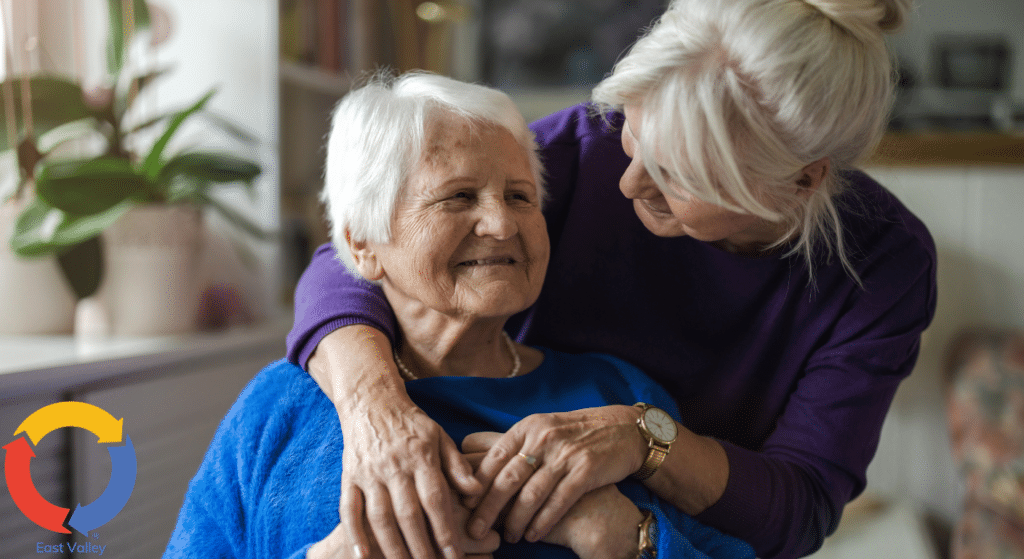
When families in Chandler, Gilbert, Mesa, Tempe, and Queen Creek begin searching for in-home care for an aging parent, they’re not just looking for a list of services. They’re looking for someone they can trust—someone who truly understands what their loved one is going through. In the world of digital content and search engine optimization, Google has a name for this kind of credibility: E-E-A-T. And in the world of senior care, no model demonstrates it more naturally than the peer-to-peer approach.
What Is E-E-A-T—and Why Does It Matter for Senior Care?
E-E-A-T stands for Experience, Expertise, Authoritativeness, and Trustworthiness. It’s a framework that Google uses to evaluate the quality and credibility of content and the organizations behind it [1]. Originally introduced as E-A-T, Google added the second “E” for Experience in December 2022, signaling that first-hand, lived experience with a topic is a distinct quality signal—separate from formal expertise alone [2].
Breaking it down simply [3]:
- Experience: You’ve actually done it.
- Expertise: You know it deeply.
- Authoritativeness: Others recognize and validate you.
- Trustworthiness: You’re accurate, honest, and transparent.
For senior care—a topic that directly impacts the health, safety, and well-being of vulnerable individuals—E-E-A-T takes on even greater importance. Google’s Search Quality Rater Guidelines explicitly state that “Trust is the most important member of the E-E-A-T family because untrustworthy pages have low E-E-A-T no matter how Experienced, Expert, or Authoritative they may seem” [4]. In other words, trust isn’t just one of four equal pillars—it’s the foundation everything else rests on.
This is especially true for what Google calls “Your Money or Your Life” (YMYL) topics—areas where inaccurate or misleading information can cause real harm, including health, safety, and well-being [5]. Choosing a caregiver for an aging parent is about as YMYL as it gets.
The Peer-to-Peer Model: A Living, Breathing E-E-A-T Framework
Here’s where it gets interesting: the peer-to-peer caregiving model—where older adults care for other older adults—is not just a compassionate approach to senior care. It is, in essence, a real-world embodiment of every single pillar of E-E-A-T.
Experience: They’ve Lived It
Google’s addition of “Experience” to its quality framework was a recognition that first-hand, life experience with a subject is a distinct and valuable quality signal [6]. In senior care, this principle is profound. A caregiver who has personally navigated the challenges of aging—managing chronic pain, adapting to physical changes, maintaining independence—brings something no textbook can teach.
Research published through the National Institutes of Health supports this: shared lived experiences, including age-related physical health issues and functional decline, create a foundation for relatable and open communication between peer supporters and older adults [7]. When a caregiver has walked the same road, the connection is immediate and authentic.
As one profile of the Seniors Helping Seniors® in-home care model describes it, senior caregivers “relate to our receivers of care as peers, not clients. They’ve navigated similar life challenges, understand the importance of maintaining routines and independence, and approach care with the respect and dignity they would want for themselves” [8].
Expertise: Wisdom Earned Over a Lifetime
Expertise in the E-E-A-T framework is about demonstrable knowledge—a proven track record in the subject matter [9]. For peer caregivers, this expertise isn’t academic. It’s earned through decades of life experience: raising families, managing households, navigating healthcare systems, and understanding what it means to age with dignity.
Many peer caregivers are retired teachers, nurses, and other professionals who have spent their lives in service to others [10]. They bring professional knowledge alongside personal wisdom—a combination that creates a uniquely qualified caregiver. This is expertise that resonates deeply with seniors who may be skeptical of younger caregivers who, however well-intentioned, simply haven’t lived through the same experiences.
Authoritativeness: Recognized by the Community
Authoritativeness in E-E-A-T comes from external recognition—other credible sources citing you, linking to you, or mentioning you as a go-to source [11]. In the context of senior care, this translates to the reputation a care provider builds within its community: family testimonials, referrals from healthcare professionals, and recognition from local organizations.
The peer-to-peer model builds this authority organically. When a senior caregiver and their client develop a genuine friendship—going to the diner together, sharing stories, supporting each other through life’s transitions—that relationship becomes a story worth telling [12]. Word spreads. Families talk. Trust compounds.
Peer support plays a vital role in community care by fostering trust-based relationships and enhancing accessibility to services [13]. This community-level trust is the very definition of authoritativeness in action.
Trustworthiness: The Heart of It All
Trust is the cornerstone of the E-E-A-T framework, and it’s also the cornerstone of effective senior care. Research on home visit programs for older adults confirms that a trusting relationship is pivotal for older people to accept care that is proactively offered to them [14]. Without trust, even the most skilled caregiver will struggle to make a meaningful difference.
The peer-to-peer model accelerates trust-building in a way that traditional care models simply cannot. Visits feel less like a service appointment and more like time spent with a trusted peer [15]. Research on peer support for older adults found that shared age-related experiences—including roles as parents or grandparents—deepen the bond by fostering understanding and empathy, making it easier for older adults to open up, share struggles, and develop supportive alliances [16].
Peer-to-peer in-home care is also flexible by design. Seniors can start with occasional companionship and add assistance as needs evolve—without changing caregivers or environments [17]. This adaptability ensures care grows naturally with changing needs, further reinforcing the trust that has been built over time.
Why This Matters for Families in the East Valley
For adult children and family decision-makers in Chandler, Gilbert, Mesa, Tempe, and Queen Creek, the E-E-A-T framework offers a useful lens for evaluating senior care providers. When you’re searching for care for a loved one, ask yourself:
- Does this provider have real, lived experience with the challenges of aging—not just clinical training?
- Do their caregivers demonstrate genuine expertise—wisdom earned through life, not just a certification?
- Is this provider recognized and trusted by the local community, by families who’ve been through this before?
- Is there transparency and honesty in how they communicate, how they match caregivers, and how they handle the unexpected?
These aren’t just SEO questions. They’re the right questions to ask when choosing someone to care for the people you love most.
Loneliness is one of the most common challenges facing older adults, especially those who live alone or have lost spouses and friends [15]. Peer support programs not only reduce feelings of isolation but also empower older adults by sharing coping strategies and life experiences [13]. Choosing a care model that addresses both the practical and emotional dimensions of aging isn’t just good care—it’s the right care.
Seniors Helping Seniors® in-home care East Valley AZ: E-E-A-T in Action
As your team from Seniors Helping Seniors® in-home care East Valley AZ, the peer-to-peer model isn’t a marketing concept—it’s the foundation of everything we do. Serving families across Chandler, Gilbert, Mesa, Tempe, and Queen Creek, our team carefully matches older adults who need assistance with caregivers who are seniors themselves. These aren’t strangers showing up at the door. They’re neighbors, peers, and companions who understand the journey of aging because they’re living it too. Unlike traditional home care models, Seniors Helping Seniors® in-home care emphasizes companionship just as much as practical support [18] because we know that dignity, connection, and independence matter as much as any task on a care checklist.
Our caregivers bring the kind of Experience, Expertise, Authoritativeness, and Trustworthiness that no credential alone can confer—the kind that comes from a life well-lived. Whether it’s help with daily routines, transportation to appointments, meal preparation, or simply meaningful conversation, every interaction is rooted in genuine human connection. By focusing on relationships, respect, and reliability, Seniors Helping Seniors® in-home care East Valley AZ is meeting a growing need in the community while helping families find peace of mind and empowering seniors to support one another [19]. If you’re ready to explore what peer-to-peer care looks like for your family, we invite you to reach out to our locally based team. Let’s start a conversation about how we can support your loved one—and your whole family—through this important chapter of life.
Citations
[1] https://backlinko.com/google-e-e-a-t
[2] https://www.seo-kreativ.de/en/blog/e-e-a-t-guide-for-more-trust-and-top-rankings/
[3] https://blog.clickpointsoftware.com/google-e-e-a-t
[4] https://blog.clickpointsoftware.com/google-e-e-a-t
[5] https://www.seo-kreativ.de/en/blog/e-e-a-t-guide-for-more-trust-and-top-rankings/
[6] https://developers.google.com/search/blog/2022/12/google-raters-guidelines-e-e-a-t
[7] https://pmc.ncbi.nlm.nih.gov/articles/PMC9121547/
[8] https://spotlightseniorservices.com/provider/seniors-helping-seniors/
[9] https://blog.clickpointsoftware.com/google-e-e-a-t
[10] https://www.candgnews.com/news/seniors-helping-seniors-brings-compassionate-peerbased-care-to-oakland-county-10480
[11] https://blog.clickpointsoftware.com/google-e-e-a-t
[12] https://franchisingmagazineusa.com/special-feature/seniors-helping-seniors-providing-compassionate-care-and-companionship/
[13] https://www.thehighpointresidence.com/blog/the-role-of-peer-support-in-assisted-living-communities
[14] https://pmc.ncbi.nlm.nih.gov/articles/PMC5288942/
[15] https://seniorsbluebook.com/articles/why-seniors-caring-for-seniors-creates-trust-comfort-and-companionship
[16] https://www.thesupportivecare.com/blog/the-role-of-peer-support-in-behavioral-health-for-seniors
[17] https://seniorsbluebook.com/articles/why-seniors-caring-for-seniors-creates-trust-comfort-and-companionship
[18] https://www.candgnews.com/news/seniors-helping-seniors-brings-compassionate-peerbased-care-to-oakland-county-10480
[19] https://www.candgnews.com/news/seniors-helping-seniors-brings-compassionate-peerbased-care-to-oakland-county-10480