




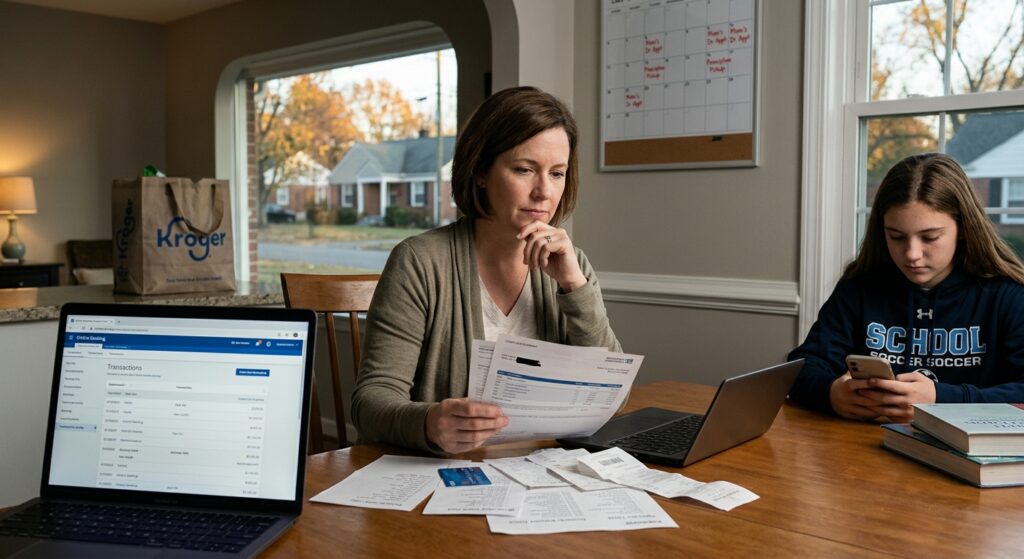
It was $42 at Kroger.
Nothing she couldn’t afford. Mom needed groceries, so she picked them up. She didn’t ask for the money back.
Then there was the prescription. And the gas driving from Bellevue to Mom’s house twice that week.
Then she used half a day of PTO for a doctor’s appointment.
A few weeks later, her husband was looking over their credit card statement when he asked a question neither of them had really thought about.
“Do you know how much we’re spending taking care of your mom?”
She didn’t.
Because she’d never thought of any of it as caregiving. She was just helping her mom.
Caregiving Doesn’t Send You a Bill
When we think about the cost of caring for an aging parent, we usually think about the big expenses.
Home care.
Assisted living.
Medical bills.
Home modifications.
Those expenses matter.
But there’s another kind of caregiving cost that arrives differently.
Seven dollars here.
Thirty-five dollars there.
Gas.
Groceries.
Lunch after the doctor’s appointment.
Something Mom needs from Amazon.
You don’t enter it into a spreadsheet.
Never send your parent an invoice.
You just pay for it.
Because it’s Mom.
And over time, those little things aren’t always so little.
Sometimes the Biggest Cost Isn’t Money
There’s another expense that won’t appear on your credit card statement.
Time.
You leave work two hours early for Dad’s appointment. Even need to take a long lunch because Mom needs something. You even use a vacation day after a hospital discharge. Then another.
Maybe you have a flexible employer. Maybe you don’t.
Either way, many working caregivers gradually begin using the flexibility they once had for themselves and their families to manage someone else’s care.
The PTO balance gets smaller. The calendar gets tighter. And you’re still telling yourself:
“It’s fine. I can handle it.”
Then Work Starts Bending Around Caregiving
This is where the cost can become much harder to measure.
Maybe you stop volunteering for projects that require travel.
You turn down an evening event because you can’t leave Dad.
You’re distracted during a meeting because you’re waiting for a call from Mom’s doctor.
You stop pursuing the promotion that would require more hours.
Nobody deducted $300 from your paycheck, but caregiving still affected your financial life.
That’s why I think the phrase “unpaid caregiver” sometimes misses part of the story.
You’re not simply providing care without being paid. Sometimes you’re paying for the privilege of providing it.
The Sandwich Generation Feels This Twice
For adults raising children while helping aging parents, the financial tension can become especially complicated.
You’re trying to save for college.
And retirement.
Your teenager needs braces.
Your house needs a new HVAC unit.
You’re paying for summer camps, soccer registration, groceries and everything else family life brings.
Then Mom needs help too.
Of course you’re going to help.
The difficult part is that nobody tells you exactly where the money, time or energy is supposed to come from.
So you borrow it from somewhere else.
Your savings. On your PTO. Your own plans. Your evenings. Even on your marriage.
That’s how caregiving becomes expensive without anyone ever handing you a bill.
Families Need to Talk About Money Earlier
Money can be uncomfortable for families.
Especially between parents and adult children.
But avoiding the conversation doesn’t make the cost disappear.
If you’re regularly spending money or missing work to help a parent, it’s reasonable to understand the bigger picture.
What resources does Mom have?
Does she have long-term care insurance? Are there benefits or programs she may qualify for? Which expenses should she reasonably be paying herself? What are the siblings contributing? Which responsibilities could someone else handle?
These aren’t selfish questions.
They’re planning questions.
And asking them earlier can prevent resentment later.
Don’t Automatically Do the Math in Hours
There’s another trap families can fall into.
They look at professional support and think:
“I could just do that myself.”
And technically, maybe you can.
But the real question isn’t whether you can drive Mom to the grocery store.
It’s what that trip actually costs you.
If you leave work early, drive across Bellevue, shop together, unload everything, and drive home, what did those three hours replace?
Work?
Dinner with your children?
An evening with your spouse?
Rest?
Sometimes doing something yourself is absolutely the right choice.
But it shouldn’t automatically be the choice simply because your own time feels free.
Your time isn’t free.
Which Parts Actually Require You?
This may be the most useful question a family caregiver can ask.
Which parts of Mom’s care actually require me?
Maybe you want to attend the cardiology appointment because you need to hear what the doctor says.
That’s important.
But do you need to make every grocery run?
Does every ride to physical therapy require you?
Do you need to be the person sitting with Dad every Tuesday afternoon?
Could someone else handle errands, transportation, companionship or a few hours of support?
The goal isn’t to outsource your relationship with your parent.
It’s to protect it.
Because when every interaction with Mom becomes a task, it’s easy to forget how to simply be her son or daughter.
Support Has a Cost. So Does Doing Everything Yourself.
Professional caregiving costs money.
We shouldn’t pretend otherwise.
But family caregiving has costs too.
Some are financial.
Some are professional.
It can be emotional.
Some show up in relationships.
The right question isn’t always:
“Which option is free?”
Sometimes there isn’t a free option.
The better question is:
“Which arrangement is sustainable for our family?”
That answer will look different for everyone.
Helping Mom Shouldn’t Put Your Own Future at Risk
One of the most loving things adult children do is show up.
They rearrange schedules.
They drive across town.
When they sit in waiting rooms.
They pick up groceries.
They solve problems nobody else even knows happened.
That’s family.
But loving your parent doesn’t require pretending those things have no cost.
You are allowed to protect your job.
Your savings.
Your marriage.
Having time with your children.
Your own retirement.
And your relationship with your parent.
Sometimes getting a little help isn’t an additional expense.
Sometimes it’s what keeps caregiving from costing your family more than anyone ever intended.
Sharing The Burden May Be Easier Than You Think
If caring for Mom or Dad has gradually started taking more time away from work, family or everyday life, it may be worth looking at what you actually need to keep doing yourself.
At Seniors Helping Seniors® Nashville, we help families identify the places where companionship, transportation, respite and practical support can make caregiving more sustainable.
You don’t have to hand over everything.
Sometimes you just need to decide what you don’t have to carry anymore.