




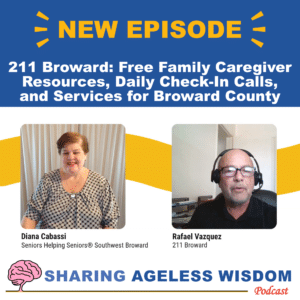
Welcome to the Sharing Ageless Wisdom Podcast! In this episode, host Diana Cabassi interviews Rafael Vazquez of 211 Broward, a free, anonymous 24/7 helpline offering listening support, referrals, and crisis services backed by a database of nearly 3,800 Broward County programs and bilingual assistance.
Where to Watch/Listen to Sharing Ageless Wisdom Podcast
Sharing Ageless Wisdom is available to watch the video version on YouTube and Spotify, and available to listen as audio-only on Spotify, Apple Podcasts, Amazon Music, Pandora, iHeartRadio, Pocket Casts, and many more podcast apps! Just search for “Sharing Ageless Wisdom“.
Prefer to read the conversation instead of watching/listening? Click here for the full transcript.
Links to watch/listen to the Sharing Ageless Wisdom Podcast below:


More podcast platforms available at https://rss.com/podcasts/sharing-ageless-wisdom/
Topics Discussed
- What Is 211 Broward?
- Senior Touchline Program Overview
- How The Touchline Program Works
- Safety And Emergencies
- No Answer Protocol
- Family Caregiver Navigation Help
- Real Life Impact Stories
- Luncheons And Education
- Aging Wisdom Mindset
- More 211 Services
- Jobs And Contact Info
- Programs Beyond Broward County, Florida
Podcast Summary
In this episode, Rafael Vazquez highlights the Senior Touchline Program, funded by the Jim Moran Foundation, which provides free morning reassurance calls to Broward seniors 55+ at a chosen time window, with protocols for missed calls that include contacting an emergency contact and requesting a law enforcement welfare check if needed. He explains how the Touchline Program can help reduce isolation, supplement safety measures, and connect clients through periodic social luncheons. The episode also covers 211’s family caregiver navigation resources, assistance finding professional services for any of your needs, its role as Broward’s main suicide hotline, and how to enroll via 211, the website, or the Touchline Program line at 954-640-5800.
Watch/Listen Now
Prefer to read the conversation instead of watching/listening? Click here for the full transcript.
You can reach 211 Broward at
211-broward.org
Or dial 211 on your phone
Touchline Program phone number: 954-640-5800
For more information about Diana Cabassi and Seniors Helping Seniors® Southwest Broward, visit: seniorcaresouthwestbroward.com
We hope you find this information useful. If you know someone who could benefit from this information, share it with them too!
What is Sharing Ageless Wisdom?
Sharing Ageless Wisdom aims to feature senior industry experts in South Florida who will share valuable insight to help our viewers prepare for aging. We will also cover topics related to in-home senior care, caregivers, family, and more. We hope you’ll benefit from this essential information.
Sharing Ageless Wisdom is a video podcast hosted by Diana Cabassi, a Certified Senior Advisor and life coach in Broward County, Florida. Diana has over a decade of experience in caregiving and running Seniors Helping Seniors® Southwest Broward, an in-home senior care service serving families in Pembroke Pines, Davie, Cooper City, Weston, Southwest Ranches, Miramar, Sunrise, and Plantation, FL.
Any specific guest or topics you would like to see in a future episode?
Send us your guest requests or topic suggestions!
Tap this link to send an email message to
marketing@shs-seniorcare.com
with the Subject: “Sharing Ageless Wisdom Guest Request or Topic Suggestion”
Are you a local senior care industry expert and want to be a featured guest in a future episode?
If you are a senior care industry expert in Broward County, Florida, and would like to join us in a future episode, please email us to let us know.
Send an email message to
marketing@shs-seniorcare.com
with the Subject: “Sharing Ageless Wisdom – Local Senior Industry Expert Request”
FULL TRANSCRIPT for Sharing Ageless Wisdom – Episode 5
211 Broward: Free Family Caregiver Resources, Daily Check-In Calls, and Services for Broward County
Diana Cabassi: Thank you for tuning into the Sharing Ageless Wisdom Podcast. Our podcast aims to feature industry experts. In South Florida who will share valuable insight to help our community prepare for aging. We hope that you’ll benefit from this essential information.
Hello everyone. Welcome back to the Sharing Ageless Wisdom podcast. Today, it’s my pleasure to introduce you to Rafael Vazquez. Raphael is with 211 Broward and his role in the continuum of senior care is assisting families and individuals by connecting them to resources for health and human services, crisis and many other useful services you may not know about and that are available to you. Please welcome Rafael.
Rafael, it’s great to have you here.
Rafael Vazquez: Thank you so very much, Diana, for having me here representing 211 Broward. As you mentioned in your introductory remarks, 211 Broward is a place where people in the community can call when they need answers to some of life’s challenges, big or small. 211 Broward is a 24 hour free anonymous helpline offering listening support, information, referral, and crisis services.
In addition, we have our counselors are degreed staff. Our database is connected to nearly 3,800 programs and services in the Broward County area. And our bilingual staff and telephone interpreter services make sure that callers can talk with us in the language of their choice.
Diana Cabassi: That’s wonderful. What resources do you have available for helping seniors?
Rafael Vazquez: You know, one of the great programs that we have Diana, is called the Senior Touchline Program. This is a program funded by the Jim Moran Foundation. It is a free telephone reassurance program, uh, or rather a reassurance telephone call to seniors 55 and older who live in Broward County. It’s a free service where our counselors call the seniors in the morning to check up on their safety and wellbeing and start their day off with a friendly telephone call.
Diana Cabassi: It’s interesting Rafael. This is when we first met was the first time I had heard about the Touchline program and I think it’s fabulous. Is that something that the individual who is asking for this support can choose in terms of how often we touch base with them?
Do they get a phone call? Do they get an email?
Can you explain a little bit more about how that program works?
Rafael Vazquez: Many times when we have seniors call 211 Broward about, let’s say needing help getting food or needing help paying their electricity bills, our counselors will ask them, in addition to those needs, what other the needs do you have? And sometimes they will talk about things that are personally affecting them.
For example, sense of isolation, maybe no connection with family or friends, little social interaction or a lack of a community center nearby. And that’s an opportunity for our counselors to let the caller know about the Senior Touchline program and the process in which we go about signing individuals up for the program.
The application for the Touchline program is available on our website. Or if seniors don’t have access to a computer or have difficulty managing filling out an application online, we will mail a paper application to them with a self-addressed stamped envelope for their convenience.
The Touchline program is a program that we consider. The person’s program, it’s their program. For example, they select the time at which they would like to be called between 7:00 AM and 12:00 PM in half hour increments. So for example, if someone tells me that they would like to receive their call at 7:00 AM they will actually receive it between 7:00 and 7:30.
If someone says they would like to receive their call at 7:30, they will receive it between 7:30 and 8:00, and so on and so forth, up to, and including 11:30 AM to 12:00 PM So we have a wide range of time for a person to select select the time for which they would, when they would like to receive their call.
Diana Cabassi: That seems to me like a tremendously valuable benefit that is offered because so many people, as you were saying are isolated and don’t have anyone locally. You know, we grow up and we go to school and we don’t come back, so we are not necessarily where our parents are. And so having a benefit like this is a tremendous thing for our seniors. Thank you that.
Rafael Vazquez: Of course, you’re most welcome. And even for those individuals who may have social connections in the community or family members of the community, the Touchline program still serves a purpose in ensuring the person’s safety and wellbeing in the morning. And what do I mean by that?
So let’s say we call an individual and they say that they’re not feeling well, they’re having heart palpitations. We will actually call the paramedics for them with their permission to get them the help that they need. Even though the Touchline program, its main purpose is not as a medical emergency service, it just supplements whatever other safety elements they may have in the home or where, for example, a medical alert device or any other device in the home that serves a primary purpose of being a medical alert, a service. We just supplement that program.
Diana Cabassi: That’s great.
Rafael Vazquez: Mm-hmm.
Diana Cabassi: It’s nice to know that you’re gonna have someone checking in on you every morning, right?
Rafael Vazquez: Absolutely. There’s nothing like a friendly call in the morning. That personal human interaction that I think we need more and more nowadays with all of the technology, even though the technology plays an invaluable part, just as you and I are doing this podcast, but also we also need that human interaction. Mm-hmm.
Diana Cabassi: There’s nothing better than another person to be your friend. Right.
Rafael Vazquez: Absolutely. Exactly.
Diana Cabassi: You know, it’s not uncommon for the elderly to fall in the night because they get up and may trip and fall and, you know, even if they have a medical alert, may not be alert enough to push the button to get the help. So if someone is on your call list for a particular time and they don’t answer, how is that handled?
Rafael Vazquez: That’s a very good question Diana, that gets into the emergency protocol that we have built into the program. So for example, we make the initial call. Let’s say the person doesn’t answer, we will leave them a voice message asking them if they are able to, to call us back to let us know that they are okay.
We will try calling over the course of about two hours, two and a half hours, because sometimes we don’t want people to rush to get to the phone or we don’t want people to fall when they’re getting the call. When we call, sometimes people are occupied with other things. They’re making a cup of coffee, getting the newspaper, throwing out garbage.
So we make allowances for that. But in the event that we cannot contact the person, or the person has not returned our voice message, we will call the emergency contact they have listed on the application and ask them if they have seen or spoken with the person during the course of the morning.
Uh, Let’s say the emergency contact says, oh yeah so and so was just here for a cup of coffee. They’re fine. We will leave it at that. In the event that we cannot get in touch with the emergency contact. Then as a last resort, we will call the local police department that serves that particular city or the Broward Sheriff’s Office and ask them to do a welfare check on the person.
And we work very closely with the law enforcement community to make sure that these welfare checks are done, and the law enforcement community does a fabulous job in returning our request about the person’s safety and wellbeing.
Diana Cabassi: Oh, that’s wonderful. It’s so necessary. Actually, yesterday, I was talking to a woman who has no family. She was never married. She never had children. Her parents are gone. Her older brother is in a facility, and so she’s all alone. But she doesn’t live in Broward County. So do you know if this resource is available in other counties in Florida?
Rafael Vazquez: Of course Palm Beach County, our sister agency in Palm Beach County has a similar program called the Sunshine Program. And, these, this program, these programs are very rare. I’ve had calls from organizations in other states asking about the Touchline program, how to set up the Touchline program.
This is, it’s a very rare program because not only is it free, but it’s conducted by human beings, by counselors. It’s not a machine dialing the phone and just expecting the person to pick up the phone, and then the machine says, “okay, that person is okay”. The Touchline program is very unique in that way.
And so I think we’re very lucky to have it. But it’s, it’s rare, uh, you know, in other communities.
Diana Cabassi: So it’s such an invaluable service that our Broward County provides. That’s wonderful for us. And um, so I, I will suggest perhaps in other counties for people to call what their, what part of the…
Rafael Vazquez: Probably, uh, um, United Way.
Diana Cabassi: Oh okay.
Rafael Vazquez: Normally if there is a program similar to ours, it would most likely be under the auspices of United Way that serves that area.
Diana Cabassi: That’s great. Well, that’s so important to know.
Rafael Vazquez: Mm-hmm.
Diana Cabassi: Raphael, do you have any resources for adult children who are family caregivers? You know, it’s not uncommon for us to care for our loved ones and, you know, that’s a kind of work that could be a little stressful. So I was just, uh, curious if you have any resources for adult children, to avail themselves to.
Rafael Vazquez: Absolutely. Uh, well, certainly first of all, the Touchline program. If they enroll their parents in the Touchline program, that may ease their concern a little bit about them having to call their parents every day or their loved one every day. We can certainly supplement that for them. But in addition to that 211 does have what’s called a Caregiver Navigation program.
And it’s resources for people who are caregivers. Within the Caregiver Navigation program, there are resources, for example peer groups. It’s a way to contact the caregiver with other individuals who are caregivers and give them the opportunity to get together and share information and share their experiences with one another.
Because oftentimes talking with someone else and sharing those similar experiences provides for making that caregiving process a lot easier.
Diana Cabassi: Yes, caregiver support groups are wonderful. I used to actually co-host a caregiver support group and it was a very, um, great time in my life because basically when people are caring for other people, they tend to neglect their own needs and basically end up having difficulties in their own lives.
So, you know, that’s a wonderful thing as well.
Rafael Vazquez: Sure, for people who who are caregivers listening, uh, watching your program, if they’re interested in getting additional information, they simply would dial 211 and ask to speak with someone regarding the caregiver program.
Diana Cabassi: So I imagine you’ve been doing this for a while. And in that time, you know, we always have special stories. Is there something in particular that you would like to share with us that has made a huge difference in someone who two on one has helped?
Rafael Vazquez: Well, it certainly has been quite a journey personally for myself in learning about the aging process, what to expect, what people go through. Uh, remember the program is for people from 55 to over and we have people in the age range, 55 to 100, 101. Uh, the oldest person in the program was 105 years old.
Diana Cabassi: Wow.
Rafael Vazquez: So we have a wide spectrum of ages and life experiences that they share with us, which is absolutely extraordinary. But certainly in terms of the Touchline program and experiences, with respect to the emergency protocol, there have been times when I’ve called and the other counselors have called where the person was on the floor.
Uh, for example, uh, couldn’t get up. They’d been on the floor for a couple of hours. And in those instances we’ve called the paramedics right away to get them the help that they need. And it’s interesting some people have self-disclosed that when I ask them, after they have returned home, why didn’t they call 911 if they were able to?
And they said that they were embarrassed to do so. They were embarrassed about having the paramedics come over and having the neighbors, you know, be aware of what was happening. So that’s always a challenge and something that I train our counselors to be aware of. You know, what is the psychological, uh, emotional impact that is having on the person within when they have experienced a fall or they’re incapacitated for that time. I, uh, remember talking with someone, making the Touchline call and the person had fallen at that moment and they actually had broken their hip.
Uh, so, um, I called the paramedics immediately. They got to the house. They brought her to the house and she had surgery and then once returned home. So we are always ready to react to a situation like that. And we never become complacent about the telephone calls that we make. Each day that we make the call, it’s like calling the person for the first time because we don’t want to become comfortable about not having expectations, uh, you know, make thinking that, oh, that we spoke with that person yesterday, they’ll be fine this morning. So we treat each call as a brand new telephone call to the person.
Diana Cabassi: Absolutely. Just a split second can change everything. You know?
Whenever the elderly fall, the reality is, is that, you know, our bones are getting, you know, more brittle and they break easily. And after a fall sometimes things can never be the same. So, you know, catching the person early, I guess is a, is a wonderful way to do it. Right?
Rafael Vazquez: Absolutely, that, catching the person early, and also providing education to the person about obstacles in the home or what could lead to a fall. That’s why in the Touchline program, about four times a year we have a lunch for everyone in the Touchline program. It’s an opportunity for them to meet the counselors that they’ve been speaking with and also to meet others in the Touchline program, make other additional connections.
However, I also try to make the luncheons important in terms of providing information to the clients. Just not the food and the music that we have and the conversation, but also I’d like to have information that they can use. So that’s why the lunches, I’ll have, for example, the Area Agency on Aging, uh, the Florida Department of Agriculture to talk about fraud.
I’ve got programs on hospice. I’ve had, I have different agencies there so that the lunch also is educational, providing with information that they may not know about. Mm-hmm.
Diana Cabassi: Yes, it’s so important to educate people and you know, that’s the whole reason behind this podcast because I want to share as much information as I can with people so that they know that things are available. So
Rafael Vazquez: Absolutely. Mm-hmm. I’m sorry.
Diana Cabassi: What advice do you have for anyone listening to this podcast? What wisdom would you like to share with them aside from the services?
Rafael Vazquez: Oh. Well, one of the things I discovered with the aging process and working with the clients that I have been working with for the last about 10 years, is having a positive outlook on life makes a big difference in the quality of one’s life. Now it’s easy to say, have a positive outlook of someone is going through some very difficult challenges in their life.
But what I have discovered is that positive outlook makes it easier for people to recover from a fall, for example or the loss of a loved one. And it takes a lot to have that positive outlook after going through you know, tragedy or challenge, but it plays an important role in the recovery process and it’s like a form of medicine basically.
And that’s what I’ve seen in terms of the aging process. Those who have a positive attitude, the quality of life is much better overall. Even though everyone you know, is, uh, as we go through the aging process, there are those ailments that we get right as part of the aging process. But I notice that those who have a positive outlook on life get through that more comfortably.
You know, whether it’s surgery or they’ve sub disclosed that they’ve have to take another medication. But they just get through it in a much more comfortable way.
Diana Cabassi: It all makes a huge difference when you have a positive outlook. I mean, if you’re not happy in your circumstances, but tolerate it because you’re naturally positive, then your life can be a lot easier than not. Right? So if you are
Rafael Vazquez: Absolutely.
Diana Cabassi: not happy and are down on your circumstances and don’t have you know, anything positive to see about your life? It just is, is very sad. So, as I absolutely agree, that the energy that you bring in your positivity in life makes a big difference in your recreation whenever you have anything going on.
Rafael Vazquez: Yes, indeed. And, uh, all the more reason for people to be willing to share themselves with others and make that human connection. The power of human connection to share. Because just by sharing what one is going through, it’s a form of medicine, you know, and to connect with another person, especially if the other person, has experienced the same, same thing.
Diana Cabassi: It sure is.
Rafael Vazquez: Mm-hmm. And that’s, mm-hmm.
Diana Cabassi: And there’s nothing better than sharing life with a friend. Right?
Rafael Vazquez: Absolutely. And that’s why we encourage people to attend hour lunches. Uh, and it’s amazing when someone who just enrolls in the touchline program and you can see the noticeable change within about two week period. They are like a completely different person.
First of all, we’re calling them. They’re happy that someone is calling and checking up on them. But then they’re making friends, in addition to getting that call. And it’s just a life changing experience for people who think that there’s nothing else in their life that will, you know, make them change or, you know, brighten their life a little bit.
But I’ve discovered that the Touchline program has certainly done that for hundreds and hundreds of individuals.
Diana Cabassi: And, and it must make you feel good, right? When you know that you’re making a difference in someone’s life.
Rafael Vazquez: Absolutely. Of course, absolutely.
Diana Cabassi: So is there anything else that you would like to share about Broward 211 with our viewers?
Rafael Vazquez: Certainly, I just would like to let the community or the viewers know that the services that are available are for the entire community. So for example, if they know someone who’s, let’s say, is a mother. She’s got some young children, and she’s concerned about the child’s emotional or academic development.
She can call 211 and the counselors will make arrangements for the children, for the children to be tested and then get them the help that they need as well. Uh, again, you know, people needing food or someone going through crisis. And we are also the main suicide hotline for Broward County.
Uh, and this is a very sensitive topic, I know for people especially maybe for some of your viewers who may have experienced this in their own life, uh, that we support those who are not only, you know, survivors of people in their lives who have taken their life, and we support them.
We support everyone. And if anyone knows of other people who have expressed thoughts of suicide, they can call 211 on behalf of the person and then we will certainly get them the help that they need. So we cover a broad spectrum of human and social services for the community, and we played a vital role during the COVID epidemic when people were isolated, of course in their homes. And that’s where the Touchline program became even more valuable when we were able to certainly check on the person’s safety and wellbeing and then make arrangements for have food delivered to them. So that was just one of the elements that came into play with the Touchline program with respect to the COVID epidemic.
Diana Cabassi: It occured to me that there are probably some people listening that may be interested in perhaps being a counselor in the Touchline program. How would they go about doing that?
Rafael Vazquez: Well, certainly we have the job descriptions posted on our website. www. 211- broward.org or they can simply go on Indeed and see what positions are available. Normally it’s bachelor’s degree as a minimum requirement. We go through level two FBI background checks to ensure that our counselors have the necessary background to provide the service that they’re trained to do. Because we do work with the vulnerable population and we wanna make sure that the community has trust in the counselors that they’re providing personal information to. Mm-hmm. So people can just go onto the website and see what positions available, then submit their resume for the position.
Diana Cabassi: What is the best way for someone to get in contact with you for the other services? Is it through the website? Is it a phone call?
Rafael Vazquez: Yeah, certainly for, yeah, for all the other services, they would simply call 211. Uh, I manage the Touchline program, so if anyone is interested in enrolling in the Touchline program, they could do it either once again through our website or they can call. (954) 640-5800. That is the Touchline telephone number.
They can request a Touchline application or they can also call dial 211 and ask for a Touchline application. And we wanted to make the Touchline program especially important. That’s why we have a dedicated telephone number for the program.
Diana Cabassi: That’s wonderful Rafael. And knowing about all of these services being available to the community for free is a wonderful thing. And I certainly hope that this conversation will be kept in the back of people’s minds as they are going through life and need help. And so, it’s wonderful the work that you do.
Rafael Vazquez: Thank you so much.
Diana Cabassi: Thank you so much for this valuable information.
Rafael Vazquez: You are welcome. Thank you for having me.
Diana Cabassi: And for all of you who tuned in, we will put Rafael’s information in the show notes. But before we go, Rafael, is there anything else that you would like to share with the community?
Rafael Vazquez: Yes. I just want to encourage your viewers to not hesitate to call 211 about any type of need they may have or sometimes people are hesitant to call or may have to do with pride, sense of pride, but you know, please, I just encourage all your viewers, you know, in any event where they need some type of help simply to call 211 Broward.
We’re there 24 hours a day.
Diana Cabassi: It’s a wonderful service, and I am so, so happy that we encountered each other so that we could share this information with our viewers.
Rafael Vazquez: Well, the feeling is mutual. Diana, thank you so much.
Diana Cabassi: Thank you Rafael. So for our viewers, I hope that you enjoyed this information and found this conversation valuable. If you want more content like this in the future, subscribe to our channel.
It is a new channel. It’s not that popular yet, but we will become popular. And follow us on social media for more. Let us know what you think about the show and what topics you would like to hear about in the future. Thank you so much for tuning in. Have a wonderful day, or evening if it’s nighttime. Bye-bye. Until next time.
Learn More About
Seniors Helping Seniors®
Southwest Broward


Seniors Helping Seniors® in-home senior care services is an exceptional program of care and compassion that matches active seniors who want to help with those who need help. Our companions can assist with meal preparation, grocery shopping, transportation to doctor appointments or any other errand or outing, light housekeeping, medication reminders, overnight stays, 24/7 care, and much more.
We like to say it’s… Like getting a little help from your friends®
We serve throughout southwest Broward County, FL, including the cities of Miramar, Pembroke Pines, Davie, Cooper City, Southwest Ranches, Weston, Sunrise, Plantation and surrounding areas.